01Facts
The petitioner was selected as an Anganwadi Sevika in 2013.
p. 2Although she was initially ranked lower in the merit list, she was selected under the 2011 Guidelines because no candidate from the "Bahulya Varg" (majority category) was available.
¶ 4Respondent No. 6 challenged this selection, alleging the petitioner’s matriculation certificate was fabricated. The District Programme Officer (DPO) dismissed the complaint after the Bihar School Examination Board (BSEB) verified the certificate as genuine.
¶ 5, 10On appeal (Misc. Case No. 03 of 2019), the District Magistrate (DM) found the petitioner did not belong to the "Bahulya Varg" and raised suspicions regarding her school leaving certificates.
¶ 6Consequently, the DM ordered her removal and the recovery of all honorarium paid during her service.
¶ 3, 602Issues
i.1. Whether the selection of an Anganwadi Sevika can be cancelled if they do not belong to the "Bahulya Varg" when the guidelines allow for second-category appointments in their absence?
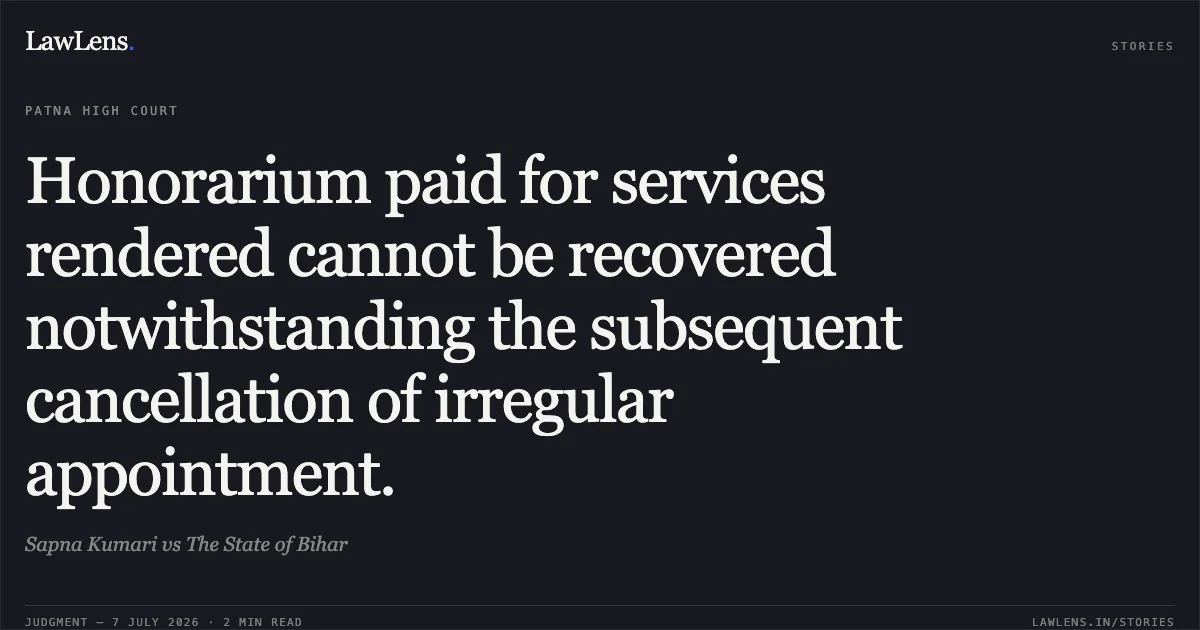
¶ 4, 6ii.2. Whether the state can recover honorarium paid for services actually rendered if the appointment is later found to be irregular but not fraudulent?
¶ 7, 1103Law Applied
The court applied the Anganwadi Sevika/Sahaika Selection Guidelines, 2011, regarding category-based recruitment.
¶ 4The principle that suspicion cannot replace proof in the absence of a formal proceeding.
¶ 8High Court precedents in Pinki Devi v. State of Bihar (CWJC No. 7527 of 2014) and Smt. Anita Kumari v. State of Bihar (CWJC No. 8239 of 2017), which establish that honorarium cannot be recovered for work performed despite appointment irregularities.
¶ 9Supreme Court ruling in Man Singh v. State of Uttar Pradesh (2022), holding that employees must be paid for duties discharged even if the appointment is irregular.
¶ 11Provisions in the judgment · 1
Anganwadi Sevika/Sahaika Selection Guideline, 2011 not specified
04Reasoning
The court observed that the petitioner’s matriculation certificate had been officially verified as genuine by the BSEB. Therefore, the DM’s order for recovery could not be justified on the grounds of fraud.
¶ 10, 11While the court noted the petitioner did not contest the cancellation of her appointment based on the "Bahulya Varg" finding, it held that the DM's order for recovery of honorarium was "casual" and "unsustainable".
¶ 7, 11The court reasoned that since the petitioner actually performed her duties until the appellate order, and the appointment was not "void ab initio" or obtained through proven fraud, the principle of quantum meruit applies. Suspicion regarding school leaving certificates without an independent inquiry does not constitute legal proof of fraud.
¶ 1105Holding
The court held that while an appointment may be illegal/irregular, recovery of wages for services rendered is impermissible unless the appointment was obtained through fraud.
¶ 11The court allowed the writ petition in part. It set aside the order dated 17.06.2020 specifically to the extent that it directed the recovery of the honorarium amount from the petitioner for the period she worked. The petitioner is permitted to participate in the fresh selection process if found eligible.
¶ 12, 7Original Court PDF
Sapna KumarivsThe State of Bihar
Click to open original judgment
Original judgment, available to read, download and summarize on LawLens.in