Facts
The applicant sought the quashing of FIR Crime No. 268/2024 (P.S. Jabera) and the subsequent trial (Case No. SC/33/2025) involving charges of kidnapping and sexual assault
Source reference: paras. 1–2The prosecution alleged that the applicant took a minor girl (under 15 years) to Ajmer, where he had sexual relations with her, resulting in pregnancy
Source reference: para. 2The applicant contended that the prosecutrix is now a major, they have married and have a child, and that the prosecutrix (PW/1) and her parents (PW/2, PW/3) turned hostile during the trial
Source reference: para. 3While the defense claimed innocence based on consent, the State opposed the petition, highlighting that the prosecutrix was a minor at the time of the incident, her Section 164 Cr.P.C. statement supported the charges, and the DNA report was positive
Source reference: para. 4Issues
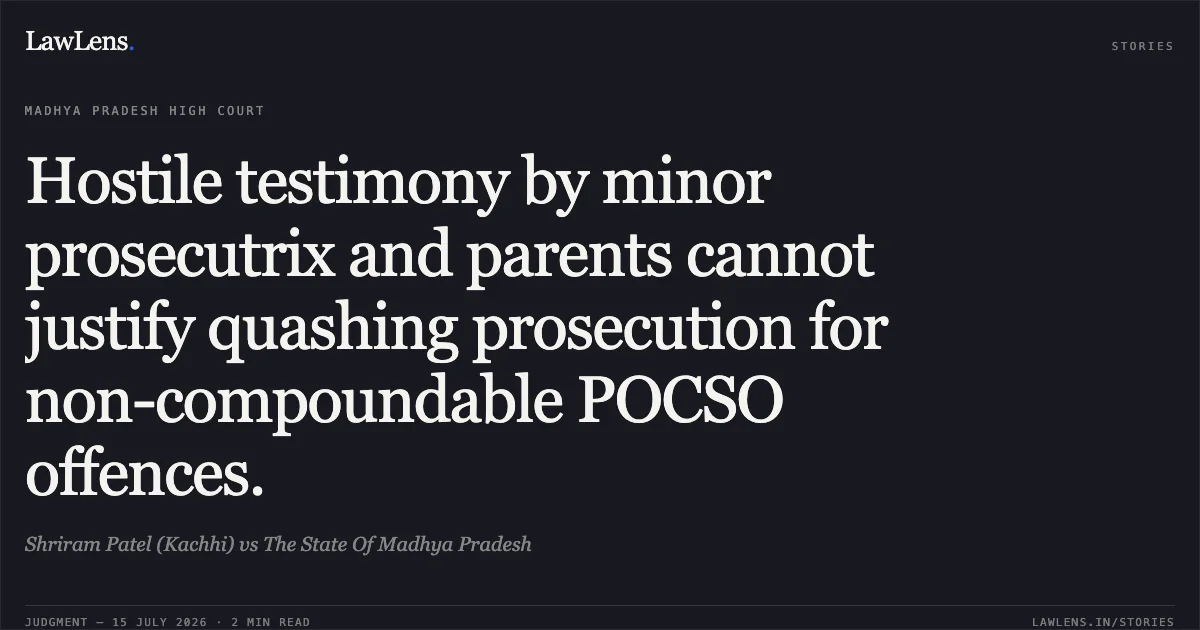
1. Whether the High Court should exercise its inherent powers to quash criminal proceedings for non-compoundable offenses on the grounds of subsequent marriage and hostile testimony of witnesses when the victim was a minor
Source reference: para. 62. Whether the consent of a minor is a valid defense in a prosecution under the B.N.S. and POCSO Act
Source reference: para. 6Law Applied
The court applied Section 528 of the Bharatiya Nagarik Suraksha Sanhita (B.N.S.S.), which provides for the High Court's inherent jurisdiction to prevent abuse of the process of law
Source reference: para. 6The substantive charges were framed under Sections 87 (kidnapping), 137(2) (kidnapping from lawful guardianship), and 64(2)(m) (rape in certain circumstances) of the Bharatiya Nyaya Sanhita (B.N.S.), alongside Sections 3/4 of the Protection of Children from Sexual Offences (POCSO) Act
Source reference: para. 2The legal principle established is that the consent of a minor is legally immaterial in such offenses
Source reference: para. 6Reasoning
The court reasoned that inherent jurisdiction under Section 528 B.N.S.S. must be used sparingly and only to prevent injustice
Source reference: para. 6In this instance, the court found that the evidence collected during investigation—particularly the DNA report identifying the applicant as the biological father—prima facie disclosed a cognizable offense
Source reference: para. 6The court rejected the applicant's reliance on the prosecutrix’s hostile testimony, noting that serious and non-compoundable offenses under POCSO and B.N.S. cannot be quashed simply because witnesses turn hostile or the parties settle
Source reference: para. 6It further observed that evaluating the weight of evidence or the "consent" of a minor girl below 15 years would amount to premature adjudication, as these are matters belonging exclusively to the domain of the Trial Court
Source reference: para. 6Holding
The court dismissed the petition, refusing to quash the FIR and the criminal proceedings
It held that since the trial is ongoing and material witnesses are yet to be examined, interference by the High Court would be improper
Source reference: para. 6The court clarified that the Trial Court must decide the case on its merits independently of the observations made in this order
Source reference: para. 9Acts & Sections Cited
7 provisions across 4 statutes referred to in this judgment. Each provision opens on LawLens.
Bharatiya Nagarik Suraksha Sanhita, 20231
Bharatiya Nyaya Sanhita, 20233
Code of Criminal Procedure, 19731
Original Court PDF
Shriram Patel (Kachhi)vsThe State Of Madhya Pradesh
Click to open original judgment
Original judgment, available to read, download and summarize on LawLens.in