Facts
On 5 September 2020, a transformer at Indraini Nagar, Bhosari, Pune, exploded and spilled oil, causing burn injuries to a five-month-old child and two women; one woman later died.
Source reference: p. 2A public-interest association complained to the Maharashtra State Human Rights Commission (“Commission”), alleging negligence by MSEDCL officials.
Source reference: pp. 2–5After receiving explanations from the officials, the Commission recommended that MSEDCL and the police jointly pay ₹10 lakh each to the victims’ legal heirs.
Source reference: pp. 2–5MSEDCL challenged the Commission’s communication and order by writ petition, contending, among other things, that the finding of negligence was unsupported and the Commission had exceeded its jurisdiction.
Source reference: pp. 2–5, 10Issues
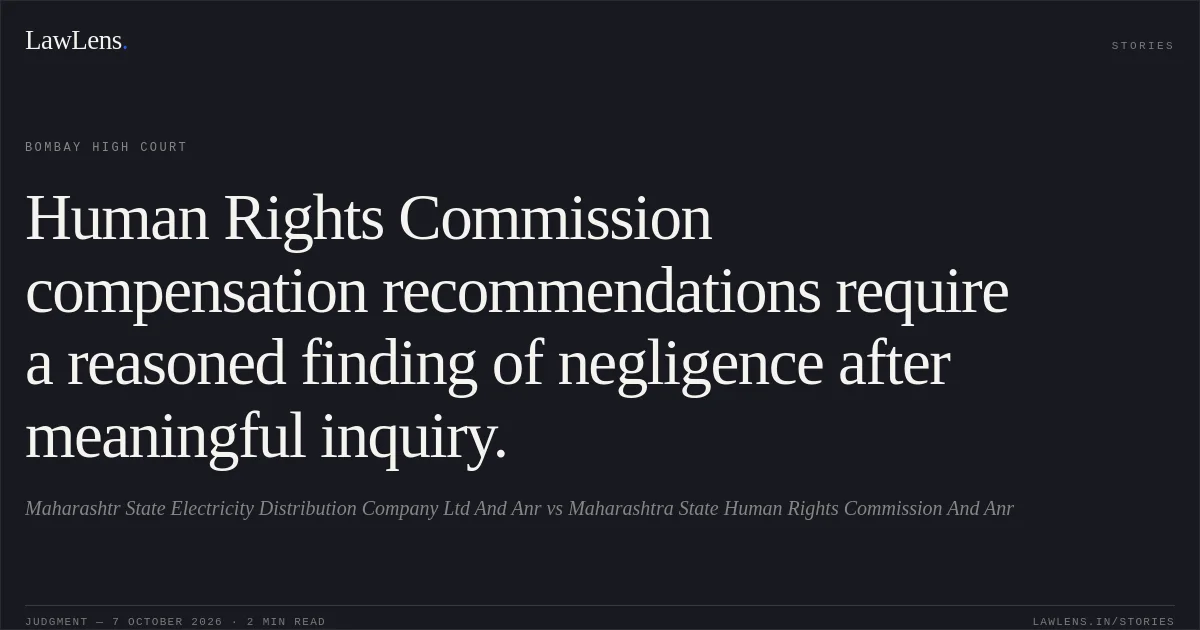
1. Whether the Commission’s recommendation for compensation was supported by a reasoned finding, based on an adequate inquiry, that MSEDCL officials were negligent in preventing a human-rights violation.
Source reference: pp. 9–112. Whether the Commission’s order recommending compensation should be set aside on judicial review.
Source reference: pp. 5–6, 11Law Applied
Under Sections 17 and 18 of the Protection of Human Rights Act, 1993, the Commission may inquire into complaints and, where an inquiry discloses a human-rights violation or negligence in preventing or abetting one by a public servant, recommend compensation or damages to the appropriate Government or authority.
Source reference: pp. 7–9Sections 13 and 14 provide the Commission with powers to summon witnesses, require documents and public records, and use investigating officers or agencies; Section 16 provides for an opportunity to the concerned person to present a defence.
Source reference: pp. 3, 10–11The Court referred to a coordinate-bench decision holding that Commission recommendations are not to be ignored with impunity, but remain amenable to judicial review.
Source reference: pp. 6–9It also noted the principles in SPS Rathod v. State of Haryana, (2005) 10 SCC 1, and M.C. Mehta v. Union of India, (1987) 1 SCC 395: compensation for rights violations requires a prima facie or established violation, and writ compensation is generally suited to clear and patent infringements rather than cases involving foundational disputed facts.
Source reference: pp. 8–9Reasoning
The Commission had received the officials’ explanations denying negligence, but rejected them as an “eyewash” principally on the basis that experienced officials ought to have anticipated the incident and that criminal proceedings had been initiated against them.
Source reference: pp. 10–11The order did not explain why the officials’ specific explanations were rejected or identify the material supporting its finding of negligence.
Source reference: pp. 10–11Although the Act empowered the Commission to conduct a fuller inquiry using its statutory powers, it had not undertaken such an inquiry.
Source reference: pp. 10–11Because a recommendation for compensation under Section 18 depends on an inquiry disclosing negligence, the unsupported finding did not satisfy the statutory threshold and could not sustain the recommendation.
Source reference: pp. 10–11Holding
The Court allowed the writ petition and set aside the Commission’s communication dated 31 March 2023 and order dated 1 March 2023; the Rule was made absolute.
It recorded that MSEDCL had paid ₹12 lakh to the deceased’s legal heirs, a fact not disputed by the Commission’s counsel, and clarified that the victims or complainant remained at liberty to seek compensation or damages before the competent civil court; the Court’s observations would not impede such proceedings.
Source reference: pp. 10–12Acts & Sections Cited
5 provisions across 1 statute referred to in this judgment. Each provision opens on LawLens.
Protection of Human Rights Act, 19935
Original Court PDF
Maharashtr State Electricity Distribution Company Ltd And AnrvsMaharashtra State Human Rights Commission And Anr
Click to open original judgment
Original judgment, available to read, download and summarize on LawLens.in