01Facts
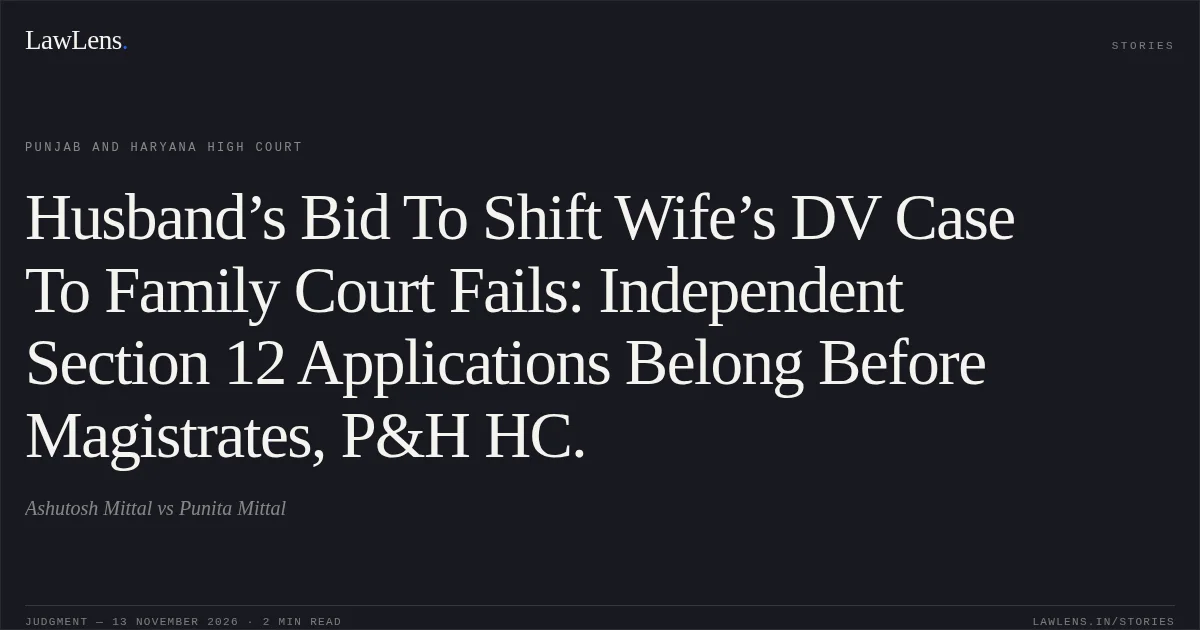
Ashutosh Mittal sought transfer of Punita Mittal’s independent application under Section 12 of the Protection of Women from Domestic Violence Act, 2005 (DV Act), pending before a Judicial Magistrate First Class at Gurugram, to the Family Court at Gurugram, where a maintenance petition between the parties was pending.
¶ 1He argued that the proceedings involved overlapping facts and evidence, and that transfer would avoid multiplicity and conflicting findings. The respondent opposed transfer, contending that the Family Court lacked jurisdiction to entertain an independent Section 12 application.
¶ 1–402Issues
i.Whether an independent proceeding under Section 12 of the DV Act pending before a Magistrate may be transferred to a Family Court because another proceeding between the parties is pending there
¶ 6ii.Whether Section 26 of the DV Act or Section 7 of the Family Courts Act, 1984 gives the Family Court jurisdiction to entertain and adjudicate an independent application under Section 12 of the DV Act
¶ 8, 1403Law Applied
Sections 12 and 27 of the DV Act provide for an application by an aggrieved person before the Magistrate and designate the Magistrate having the prescribed territorial jurisdiction as the forum for an independent application.
¶ 7Section 28 generally governs the procedure for proceedings under Section 12 and related provisions.
¶ 7Section 26 permits an aggrieved person to seek reliefs under Sections 18–22 in qualifying proceedings already before a Civil Court, Family Court or Criminal Court; it does not confer jurisdiction to entertain an independent Section 12 application.
¶ 8Section 7(2)(a) of the Family Courts Act confers the specified maintenance jurisdiction but does not enlarge the Family Court’s jurisdiction to encompass an independent DV Act proceeding.
¶ 14The Court followed the jurisdictional interpretation in Vineet Ganesh v. Priyanka Vasan and Aseem Khanna v. Akanksha Dua, and treated the Supreme Court’s interpretation of Sections 26 and 27 in Shaurabh Kumar Tripathi v. Vidhi Rawal as relevant; it distinguished the contrary approach in Rohan Shah v. Nishigandha Shah.
¶ 9–13Provisions in the judgment · 16 · Linked ones open on LawLens
Code of Civil Procedure, 1908 Section 24Section 151
Family Courts Act, 1984 Section 7
Code of Criminal Procedure, 1973 Section 125
Bharatiya Nagarik Suraksha Sanhita, 2023 Section 144
Protection of Women from Domestic Violence Act, 2005 11 provisions
Section 12Section 18Section 19Section 20Section 21Section 22Section 23Section 26Section 27Section 28Section 3104Reasoning
The Court held that Section 26’s permission to seek specified DV Act reliefs in proceedings already pending before a Family Court is distinct from jurisdiction to adjudicate an independent application under Section 12.
¶ 8–16The pending maintenance case, shared parties, overlapping allegations, possible common evidence, and convenience concerns could not confer jurisdiction absent statutory authority.
¶ 8–16Nor did the civil nature of DV Act reliefs alter the forum designated by Sections 12 and 27.
¶ 8–16The Court therefore declined to follow the Bombay High Court’s contrary approach in Rohan Shah and applied the reasoning in Aseem Khanna, Vineet Ganesh and the Supreme Court’s interpretation of the statutory scheme.
¶ 8–1605Holding
The Court held that the Family Court lacked jurisdiction to entertain the independent Section 12 DV Act proceeding and that the pending maintenance petition did not justify transfer.
¶ 17–21The transfer application was dismissed; the parties were directed to appear before the Judicial Magistrate First Class on the date already fixed.
¶ 17–21The Court clarified that it expressed no opinion on the merits of either pending proceeding.
¶ 17–21Original Court PDF
Ashutosh MittalvsPunita Mittal
Click to open original judgment
Original judgment, available to read, download and summarize on LawLens.in