Facts
The petitioner, an Assistant Manager at IDBI Bank, filed a writ petition under Article 226 of the Constitution of India challenging a disciplinary order dated April 3, 2024. The order imposed a major penalty of "reduction to a lower grade" from Manager (Grade 'B') to Assistant Manager (Grade 'A') following proceedings regarding irregularities in loan accounts at the Kishanganj Branch
Source reference: para. 2The petitioner sought the setting aside of the penalty and the initiation of proceedings, restoration of his previous post/location, or alternatively, a direction to the Appellate Authority to dispose of his pending appeal
Source reference: para. 2The respondent Bank raised a preliminary objection regarding the maintainability of the writ, asserting it is not a "State"
Source reference: para. 3Issues
1. Whether IDBI Bank Ltd. qualifies as "State" or an instrumentality of the State under Article 12 of the Constitution of India, and consequently, whether a writ petition against it is maintainable under Article 226
Source reference: para. 3Law Applied
Article 12 and Article 226 of the Constitution of India concerning the definition of "State" and the High Court's writ jurisdiction
Source reference: para. 3Bombay High Court in All India IDBI Officers Association v. Union of India, which held that after 2018, IDBI is categorized as a "private sector bank"
Source reference: para. 4"deep and pervasive control" test from Pradeep Kumar Biswas v. Indian Institute of Chemical Biology
Source reference: para. 4.1principle from Federal Bank v. Sagar Thomas, which established that private banking business does not constitute a "public duty" for the purpose of writ maintainability
Source reference: para. 4.1Reasoning
The Court examined the institutional status of IDBI Bank following the Industrial Development Bank (Transfer of Undertaking and Repeal) Act, 2003, noting that the Reserve Bank of India officially categorized it as a "Private Sector Bank" effective January 21, 2019
Source reference: para. 4.1The Court observed that the Central Government does not exercise deep or pervasive administrative, functional, or financial control over the Bank; rather, its decisions are made by its Board of Directors similar to any private company
Source reference: para. 4.1Using the tests outlined in K.K. Saksena v. International Commission on Irrigation Drainage, the Court reasoned that the Bank’s internal disciplinary actions and employment contracts do not partake in the nature of a public duty or statutory obligation
Source reference: para. 4.1Following the consensus among the Bombay, Kerala, and Jharkhand High Courts, the Court determined that the Bank is not an instrumentality of the State
Source reference: paras. 4-5Holding
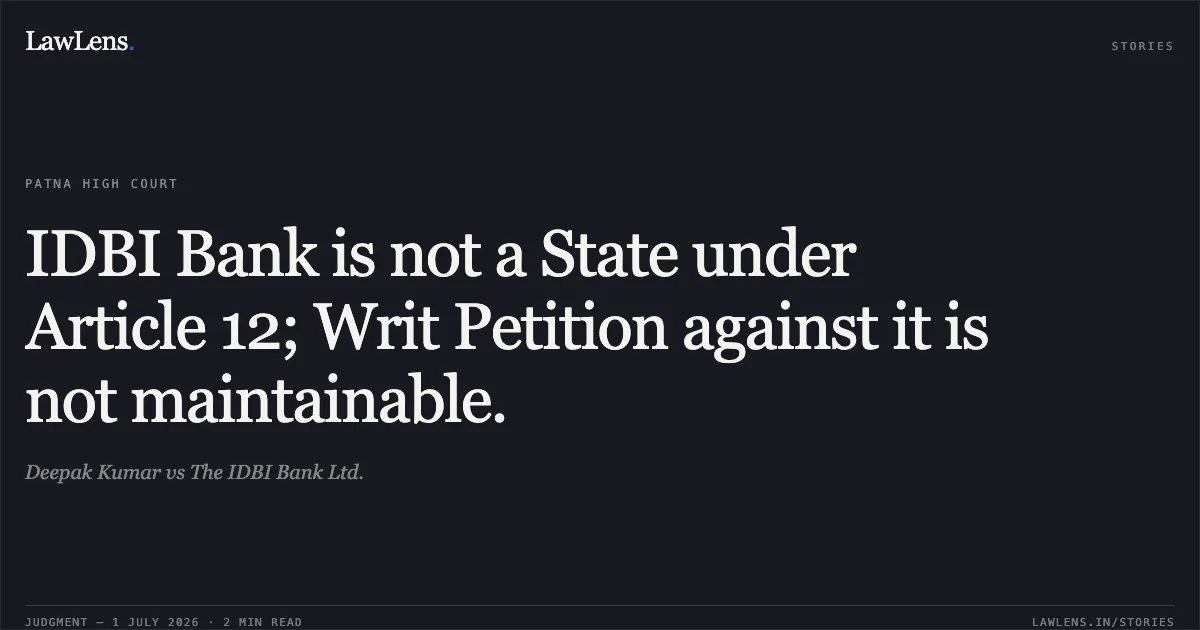
The Court held that the writ petition is not maintainable as IDBI Bank Ltd. is not a "State" within the meaning of Article 12 of the Constitution
The petition was dismissed. However, the Court granted the petitioner liberty to approach the appropriate forum (such as a civil court or the internal Appellate Authority) to seek redressal for his grievances
Source reference: para. 6Acts & Sections Cited
1 provisions across 1 statute referred to in this judgment. Each provision opens on LawLens.
Industrial Development Bank (Transfer of Undertaking and Repeal) Act, 20031
Original Court PDF
Deepak KumarvsThe IDBI Bank Ltd.
Click to open original judgment
Original judgment, available to read, download and summarize on LawLens.in