Facts
The appellant was accused of murdering his wife, Rejina Munda, with a dao and subsequently setting their dwelling house on fire at approximately 3:00 AM on January 22, 2019.
Source reference: para 3The trial court convicted the appellant under Sections 302 and 436 of the IPC based on circumstantial evidence, including an alleged extrajudicial confession made before villagers, the recovery of the weapon of offense, and the appellant's failure to explain the death of his wife under Section 106 of the Evidence Act.
Source reference: para 2, 13The appellant challenged this conviction, asserting that the extrajudicial confession was made in the presence of police and that the chain of circumstantial evidence was incomplete.
Source reference: para 6Issues
1. Whether the extrajudicial confession made by the appellant is admissible in evidence under Section 26 of the Indian Evidence Act.
Source reference: para 312. Whether the prosecution established a complete chain of circumstantial evidence to sustain a conviction under the principles of Sharad Birdichand Sarda v. State of Maharashtra.
Source reference: para 123. Whether the burden of proof shifted to the accused under Section 106 of the Evidence Act regarding facts "especially within his knowledge".
Source reference: para 60Law Applied
The court applied the "five golden principles" for circumstantial evidence established in Sharad Birdichand Sarda v. State of Maharashtra, requiring a complete chain of evidence excluding every hypothesis of innocence.
Source reference: para 12It applied Section 26 of the Indian Evidence Act, which mandates that confessions made in the presence of police officers are inadmissible unless made before a Magistrate.
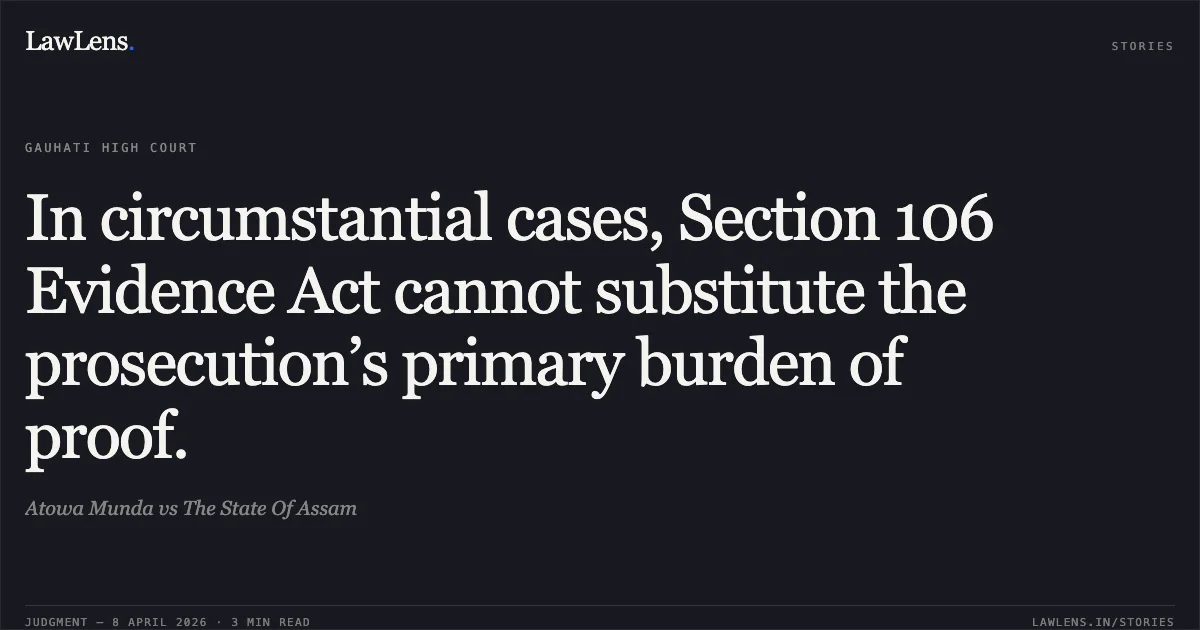
Source reference: para 32, 39The court further relied on Anees v. State (NCT of Delhi) and Shambhu Nath Mehra v. State of Ajmer regarding Section 106 of the Evidence Act, emphasizing that this section does not relieve the prosecution of its primary burden to prove the case beyond reasonable doubt.
Source reference: para 62, 67Reasoning
The High Court found the extrajudicial confessions inadmissible as PW-2, PW-4, PW-5, PW-6, and PW-9 admitted during cross-examination that police personnel were present when the appellant allegedly confessed.
Source reference: para 33-37, 42Regarding the weapon of offense, the court noted significant discrepancies in the testimony of witnesses concerning the location of recovery (varying from the roadside to the side of the dead body) and observed that the dao was never sent for forensic examination to link it to the victim’s blood.
Source reference: para 54-55A contradiction in the timing of the incident emerged; while some witnesses claimed the fire occurred at 3:00 AM, the informant (PW-2) and others (PW-6, PW-9) testified to seeing the house burning in the evening (7:00 PM to 9:00 PM), which lent plausibility to the appellant's defense that he was away at work during the day.
Source reference: para 66, 72The court held that since the prosecution failed to establish a prima facie complete chain of circumstances, Section 106 could not be invoked to fill the gaps in the prosecution's case.
Source reference: para 69, 73Holding
The court held that the extrajudicial confession was hit by the exclusionary rule of Section 26 of the Evidence Act and that the circumstantial evidence failed the "conclusive nature" test.
The court concluded that an alternative hypothesis of the appellant's innocence remained possible due to conflicting timelines and investigative lapses.
Source reference: para 72-73The High Court set aside the judgment dated June 7, 2022, acquitted the appellant of all charges by granting the benefit of doubt, and ordered his immediate release.
Source reference: para 77-78Acts & Sections Cited
3 provisions across 2 statutes referred to in this judgment. Each provision opens on LawLens.
Indian Penal Code, 18602
Code of Criminal Procedure, 19731
Original Court PDF
Atowa MundavsThe State Of Assam
Click to open original judgment
Original judgment, available to read, download and summarize on LawLens.in