Facts
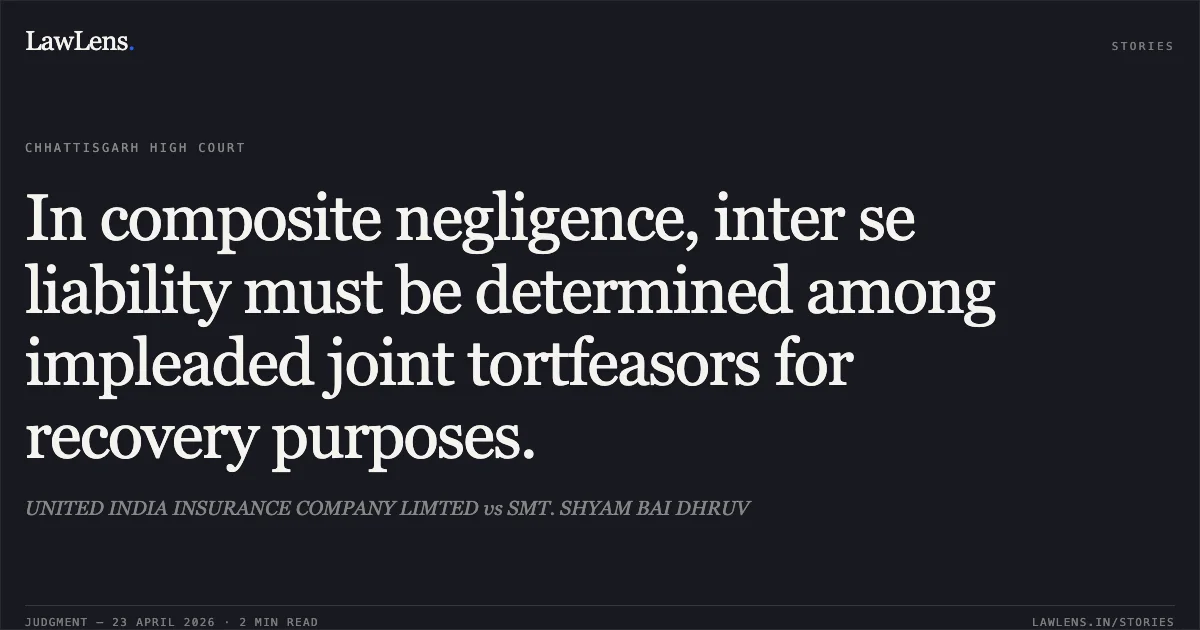
United India Insurance Company appealed against two awards dated 6-4-2019 passed by the Additional Motor Accident Claims Tribunal, Mahasamund.
Source reference: p.1-2The Tribunal had fastened joint and several liability upon the Insurance Company (Appellant), the driver (Jitendra Yadav), and the owner (Virendra Kumar Sinha) for accidents involving a Tractor.
Source reference: p.3The Insurance Company contended that since it was a case of composite negligence involving multiple tortfeasors, the Tribunal failed to apportion specific liability.
Source reference: p.3In MAC No. 1487/2019, the claimants filed a cross-appeal seeking enhancement of compensation based on the deceased's actual minimum wages.
Source reference: p.6Issues
1. Whether the Claims Tribunal was required to determine the inter se apportionment of liability between joint tortfeasors in a case of composite negligence
Source reference: p.3 / para. 32. Whether the "pay and recover" doctrine should apply when a vehicle involved in a composite negligence accident is uninsured
Source reference: p.5 / para. 83. Whether the compensation awarded in MAC No. 1487/2019 was inadequate due to incorrect income assessment
Source reference: p.6 / para. 9Law Applied
The Court relied on the precedent set by the Supreme Court in Khenyei v. New India Assurance Co. Ltd. and others (2015), which established that in cases of composite negligence, liability is joint and several, and while a claimant can recover the full amount from any one tortfeasor, the Court may determine inter se liability for the purpose of recovery between tortfeasors.
Source reference: p.4 / para. 6The Court also applied the principle of Minimum Wages for income assessment and the "pay and recover" doctrine to protect third-party claimants when a vehicle is uninsured.
Source reference: p.5-6Reasoning
The Court observed that all tortfeasors were parties to the proceedings, yet the Tribunal failed to fix inter se liability despite a finding of composite negligence.
Source reference: p.5 / para. 7Applying the Khenyei principles, the Court determined the Insurance Company’s negligence at 60% and the uninsured Tractor’s (owner/driver) negligence at 40%.
Source reference: p.5 / para. 8Regarding the quantum in MAC No. 1487/2019, the Court found the Tribunal's assessment of income at ₹4,500/- per month to be lower than the prevailing minimum wages of ₹6,000/-.
Source reference: p.6 / para. 9By recalculating the income, applying a 40% future prospect hike, and using a multiplier of 17, the Court found the claimants entitled to an enhanced sum.
Source reference: p.6 / para. 10Holding
The High Court modified the awards, holding the Insurance Company liable for 60% and the owner/driver liable for 40% of the compensation.
It directed the Insurance Company to pay the entire amount to the claimants first and subsequently recover 40% from the owner and driver.
Source reference: p.5 / para. 8In MAC No. 1487/2019, the Court allowed the cross-appeal, enhancing the compensation from ₹10,33,900/- to ₹13,55,200/-, carrying 9% interest per annum from the date of the claim application.
Source reference: p.6-7 / para. 11Both appeals were disposed of with these modifications.
Source reference: p.7 / para. 12Acts & Sections Cited
3 provisions across 1 statute referred to in this judgment. Each provision opens on LawLens.
Motor Vehicles Act, 19883
Original Court PDF
UNITED INDIA INSURANCE COMPANY LIMTEDvsSMT. SHYAM BAI DHRUV
Click to open original judgment
Original judgment, available to read, download and summarize on LawLens.in