Facts
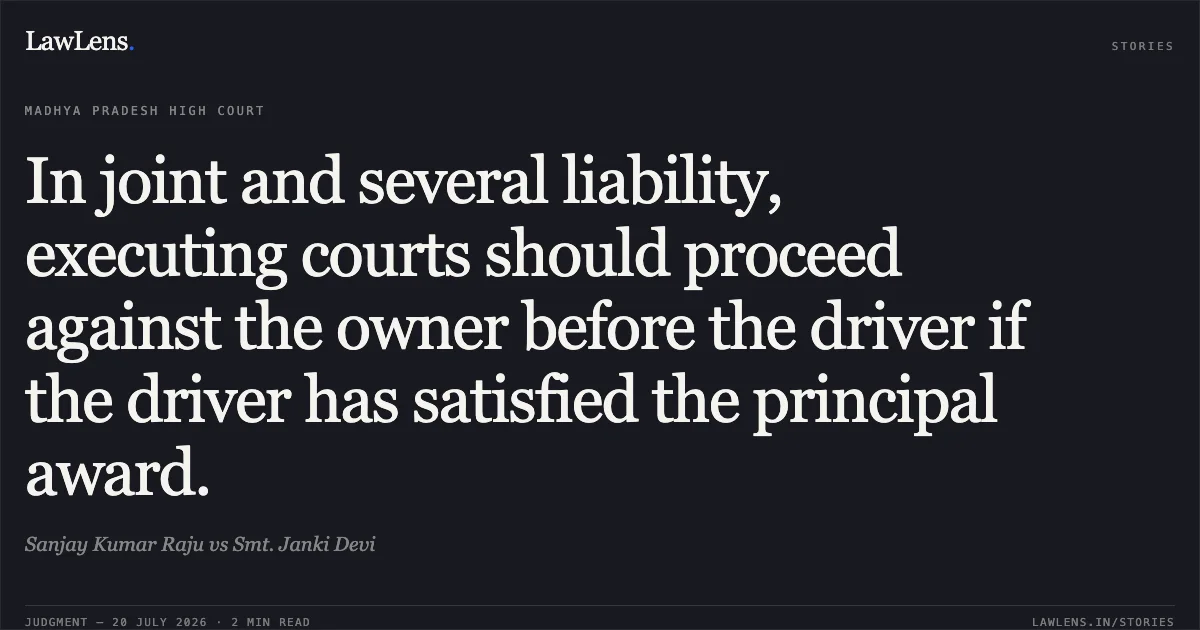
The Petitioner, a driver of an offending vehicle, was held jointly and severally liable along with the vehicle owner for a motor accident claim award of ₹14,70,344/- plus interest
Source reference: para. 2The Petitioner deposited ₹15.00 lakhs, covering the principal amount but leaving a portion of the interest unsatisfied
Source reference: para. 3While the Executing Court initially ordered recovery of the remainder from the owner via attachment warrant on 23.12.2023 [para. 6], it later reversed course.
Source reference: no citationBy an order dated 19.11.2024, the Tribunal rejected the Petitioner’s application to proceed against the owner, holding that the decree-holder has the absolute choice to execute against any joint tortfeasor
Source reference: para. 8Issues
1. Whether the Executing Court was justified in proceeding exclusively against the driver for the remaining interest amount when the driver had already satisfied the principal award and the owner had failed to appear
Source reference: para. 9-112. Whether the principle of "joint and several liability" allows the court to ignore its prior order to proceed against a specific co-debtor in the interest of equity
Source reference: para. 11Law Applied
The Court applied the doctrine of "Joint and Several Liability" regarding joint tortfeasors (driver and owner), where the owner is vicariously liable for the driver's negligence
Source reference: para. 9Order 21 Rule 30 of the Code of Civil Procedure (CPC), which prescribes the mode of executing a decree for the payment of money against the property or person of the judgment debtor
Source reference: para. 1, 11Reasoning
The Court acknowledged that while claimants generally have the right to choose which judgment debtor to proceed against in cases of joint and several liability [para. 8], the specific circumstances of this case demanded an equitable approach.
Source reference: no citationThe Court noted that the Petitioner/driver had already shown bona fides by depositing ₹15.00 lakhs—more than the principal amount—while the owner had completely evaded the proceedings
Source reference: para. 10The Court found the Tribunal’s sudden shift to target only the driver, despite its own previous order dated 23.12.2023 to attach the owner’s property, to be unreasonable
Source reference: para. 7, 11It reasoned that since only a small interest portion remained, the primary burden of the remaining recovery should now shift to the owner to ensure justice between the co-judgment debtors
Source reference: para. 11Holding
The Court held that only if the amount cannot be recovered from the owner, even after potential detention in civil prison, should the Executing Court then recover the remainder from the Petitioner/driver
The High Court set aside the impugned order and disposed of the Revision with a direction to the Executing Court to first proceed against the owner of the vehicle under Order 21 Rule 30 of the CPC for the recovery of the remaining amount
Source reference: para. 11Acts & Sections Cited
1 provisions across 1 statute referred to in this judgment. Each provision opens on LawLens.
Code of Civil Procedure, 19081
Original Court PDF
Sanjay Kumar RajuvsSmt. Janki Devi
Click to open original judgment
Original judgment, available to read, download and summarize on LawLens.in