Facts
The appellants challenged the acquittal of the respondent for offences under Section 138 of the Negotiable Instruments Act, 1881.
Source reference: p. 1The dispute involved ten cheques totaling ₹2,60,00,000, specifically focusing on a liability of ₹85,00,000.
Source reference: p. 2The respondent claimed the cheques were issued merely as security for a trade advance of ₹2,00,00,000, most of which had been repaid.
Source reference: p. 2, 5On 19th September 2024, the High Court set aside the acquittal, ruling that the issuance of cheques was admitted and the Memorandum of Understanding (MoU) dated 05th December 2007 established a subsisting liability.
Source reference: para. 2-3The matter reached the Supreme Court, which directed the High Court to determine the sentence but keep it in abeyance pending the Special Leave Petition.
Source reference: para. 5Issues
1. Whether the respondent's claim that the cheques represented only a disputed profit/interest component serves as a mitigating factor in sentencing.
Source reference: p. 5-62. What is the appropriate quantum of sentence and compensation for the dishonour of cheques totaling ₹85,00,000 under Section 138 of the NI Act?
Source reference: p. 6-7Law Applied
The Court applied Section 138 and Section 139 of the Negotiable Instruments Act regarding the rebuttable presumption of legally enforceable debt.
Source reference: p. 1, 2The Court further utilized Section 357(1)(b) of the Cr.P.C. to award compensation.
Source reference: p. 7The Court relied on R. Vijayan v. Baby (2012), which establishes that compensation in cheque cases should be realistic and include interest components (typically 9% p.a.) to restitute the complainant.
Source reference: p. 4, 7Meters and Instruments (P) Ltd. v. Kanchan Mehta (2018), which characterizes Section 138 proceedings as primarily compensatory rather than punitive.
Source reference: p. 7Reasoning
The Court reasoned that the respondent’s conduct lacked bona fides, as he persisted in denying liability despite admitting to the issuance of cheques and failing to lead defense evidence.
Source reference: para. 7, 10The Court rejected the respondent's plea for a nominal sentence based on the "profit component" argument, noting that the statutory presumption under Section 139 remained unrebutted and the appellants had been deprived of their funds since 2007.
Source reference: para. 10-11Applying the principle that Section 138 aims to ensure the credibility of commercial transactions, the Court determined that the punitive element must support the compensatory remedy.
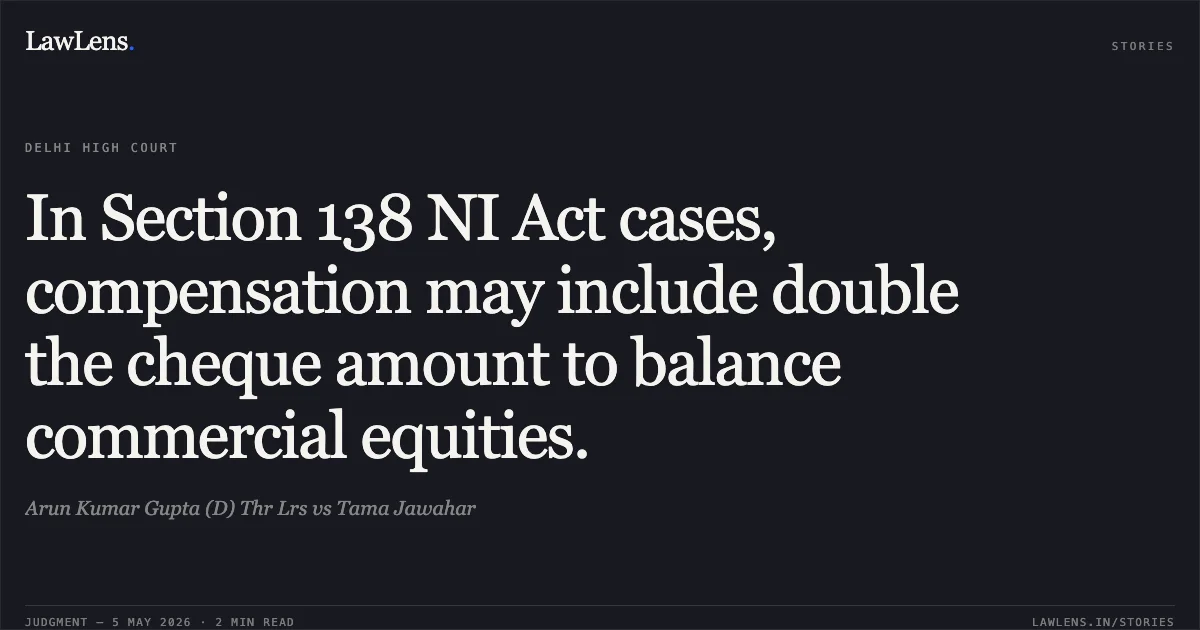
Source reference: para. 12It concluded that doubling the cheque amount as a fine was more appropriate than calculating separate interest, as it balanced the equities after nearly two decades of litigation.
Source reference: para. 13Holding
The Court convicted the respondent and sentenced him to pay a fine of ₹1,70,00,000 (twice the cheque amount), to be paid as compensation to the appellants under Section 357(1)(b) Cr.P.C.
The respondent was directed to deposit this amount within six months, failing which he must undergo three months of simple imprisonment; however, pursuant to the Supreme Court’s order, the execution of this sentence was kept in abeyance pending the final outcome of the Supreme Court proceedings.
Source reference: para. 15, 17-18Acts & Sections Cited
5 provisions across 2 statutes referred to in this judgment. Each provision opens on LawLens.
Negotiable Instruments Act, 18813
Code of Criminal Procedure, 19732
Original Court PDF
Arun Kumar Gupta (D) Thr LrsvsTama Jawahar
Click to open original judgment
Original judgment, available to read, download and summarize on LawLens.in