Facts
The petitioner, a Secondary Grade Teacher appointed in 1999, was granted incentive increments on July 11, 2013, for acquiring M.A. (Economics) and B.Ed. degrees.
Source reference: p.1, 3, 6Following an audit objection, the 5th respondent revised the petitioner’s pay, and the 6th respondent issued an order on November 18, 2024, to recover excess payments, asserting that the M.A. (Economics) degree did not qualify for incentive increments.
Source reference: p.3The petitioner challenged these orders, arguing that G.O.Ms.No. 324 (1995) permits increments for any qualification in a Higher Secondary syllabus subject, including Economics.
Source reference: p.3-4Issues
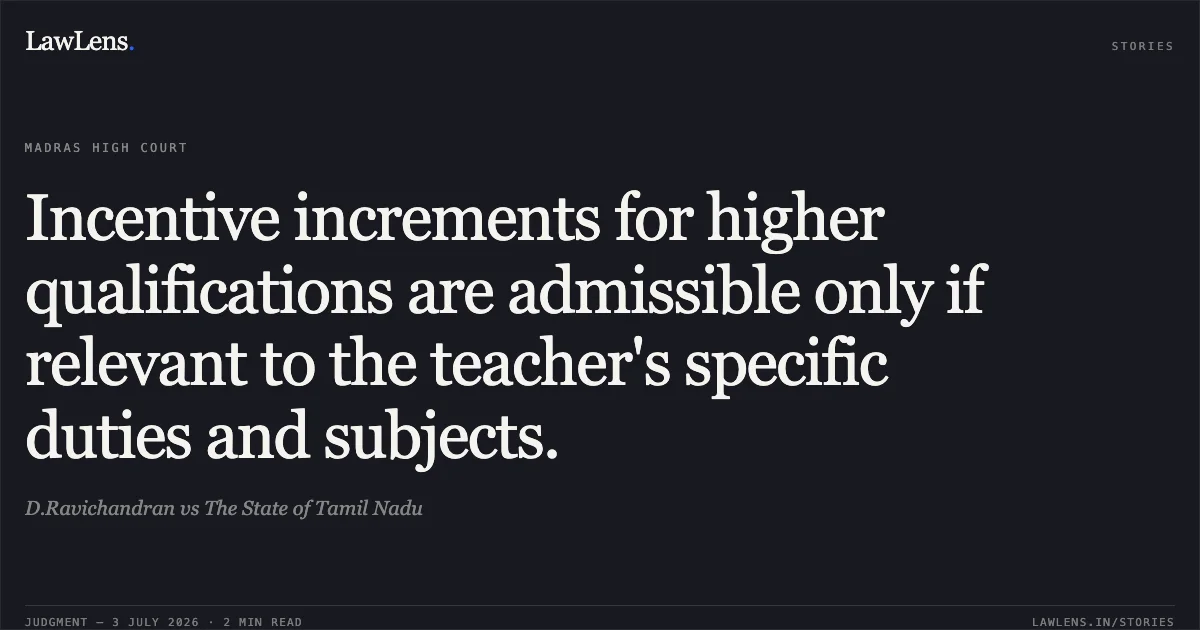
1. Whether a Secondary Grade Teacher is entitled to incentive increments for a postgraduate degree in a subject (Economics) that is not directly relevant to the specific teaching duties discharged at the elementary or middle school level.
Source reference: p.72. Whether the expression "relevant Higher Secondary syllabus subjects" in G.O.Ms.No. 324 must be interpreted in isolation or in conjunction with the object of the incentive scheme.
Source reference: p.7-8Law Applied
G.O.Ms.No. 324, Education Department (1995), which allows increments for "relevant Higher Secondary syllabus subjects".
Source reference: p.7G.O.Ms.No. 907, PAR Department (1986), which mandates that higher qualifications must relate to the area of specialization normally taught by the employee.
Source reference: p.8Clarification issued by the Director of Elementary Education dated August 24, 2016, limiting eligible subjects to Science, Mathematics, Tamil, English, and Social Science.
Source reference: p.8Principles from S. Thangathai v. Director of School Education and R. Sakthivel v. Secretary to Government, establishing that incentives are rewards intended to enhance the quality of classroom instruction and must enure to the benefit of students.
Source reference: p.11-13Reasoning
The Court reasoned that an "incentive" is a reward to encourage efficiency and specialized knowledge that benefits public service.
Source reference: p.9-10The Court held that the phrase "relevant Higher Secondary syllabus subjects" in G.O.Ms.No. 324 cannot be read in a vacuum; there must be a nexus between the qualification and the teacher's duties.
Source reference: p.7-8In this case, the petitioner teaches at the elementary/middle school level where Economics is not a primary subject of instruction; therefore, the M.A. (Economics) degree does not advance the scheme's object of improving classroom instruction for the petitioner's specific students.
Source reference: p.11, 13The Court also noted a policy shift via G.O.Ms.No. 37 (2020) to abolish the scheme, emphasizing that taxpayer money spent on increments is only justified if it continues to serve its original purpose.
Source reference: p.14-15Holding
The Court dismissed the Writ Petition, holding that the petitioner is not entitled to incentive increments for M.A. (Economics) as it lacks relevance to his duties as a Secondary Grade Teacher.
The court upheld the pay revision and recovery of excess payments.
Source reference: p.15The Court directed the Government to devise a mechanism by December 9, 2026, to periodically assess whether teachers currently receiving increments are effectively utilizing their higher skills to benefit students.
Source reference: p.15Acts & Sections Cited
5 provisions across 5 statutes referred to in this judgment. Linked provisions open on LawLens.
G.O.Ms.No.42, Education Department, dated 10.01.19691
G.O.Ms.No.907, Personnel and Administrative Reforms (FR.II) Department, dated 17.09.19861
G.O.Ms.No.624, Education Department, dated 13.07.19921
Technology Development Board Act, 19951
G.O.Ms.No.37, Personnel and Administrative Reforms (FR-IV) Department, dated 10.03.20201
Original Court PDF
D.RavichandranvsThe State of Tamil Nadu
Click to open original judgment
Original judgment, available to read, download and summarize on LawLens.in