01Facts
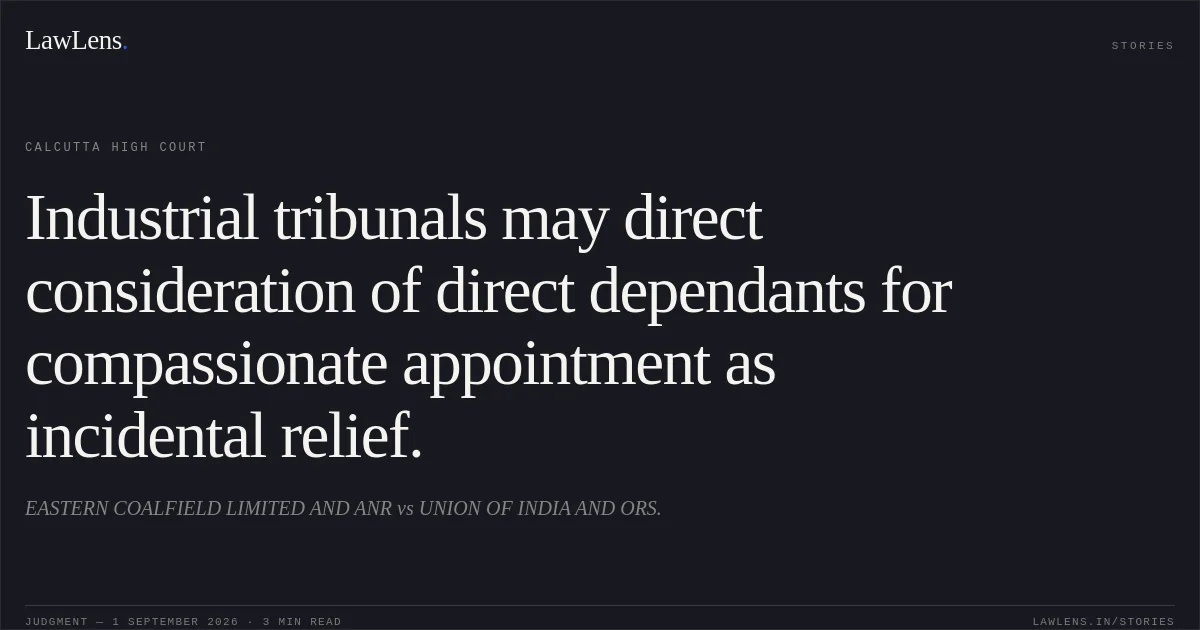
Binod Muchi, an employee of Eastern Coalfields Limited, died leaving behind his widow, children and other family members.
His son-in-law, Jitendra Muchi, claimed compassionate appointment, while his widow, Sakunma Muchi, claimed monthly monetary cash compensation under Clause 9.5.0(iii) of the National Coal Wage Agreement (NCWA).
p. 6The dispute referred to the Central Government Industrial Tribunal-cum-Labour Court, Asansol, concerned: (i) Jitendra Muchi’s entitlement to compassionate appointment; and (ii) Sakunma Muchi’s entitlement to monetary compensation.
pp. 2–3By award dated 3 October 2025, the Tribunal held that the son-in-law was not entitled to compassionate appointment in the presence of direct dependants, granted monetary compensation to the widow, and directed Eastern Coalfields Limited to consider the name of any nominated direct dependant for employment upon attaining majority.
pp. 1–2Eastern Coalfields Limited challenged the latter direction, contending that it exceeded the order of reference and that Clause 9.5.0(iii) applied only to a male dependant aged between 12 and 18 years at the time of the employee’s death.
pp. 3–402Issues
i.Whether the Tribunal correctly determined the eligibility of Jitendra Muchi, the deceased employee’s son-in-law, for compassionate appointment.
pp. 2–3ii.Whether Sakunma Muchi, the deceased employee’s widow, was entitled to monthly monetary cash compensation under Clause 9.5.0(iii) of the NCWA.
pp. 2–3iii.Whether the Tribunal exceeded the scope of the industrial dispute referred to it by directing Eastern Coalfields Limited to consider a direct dependant of the deceased for compassionate employment upon attaining majority.
pp. 3–4, 6–703Law Applied
The Court applied the principle under Section 10(4) of the Industrial Disputes Act, 1947, that an Industrial Tribunal’s jurisdiction is confined to the points of dispute specified in the order of reference, while permitting determination of matters incidental to those points.
pp. 5–6Relying on Hochtief Gammon v. Industrial Tribunal, Bhubaneshwar, Orissa, AIR 1964 SC 1746, the Court reiterated that a Tribunal is one of limited jurisdiction and cannot materially travel beyond the terms of reference; however, it may address connected or incidental matters, including matters concerning persons who ought to be brought before it.
pp. 5–6The Court also applied Clauses 9.3.0 and 9.5.0 of the NCWA, including Clause 9.5.0(iii), governing monetary compensation and compassionate employment for eligible dependants of deceased employees.
pp. 3–4Provisions in the judgment · 6
National Charter For Children, 2003 Section 9.5.0
National Charter For Children, 2003 Section 9.5.0
National Charter For Children, 2003 Section 9.3.0Section 9.5.0
Industrial Disputes Act, 1947 Section 10Section 18
04Reasoning
The Court upheld the Tribunal’s determination that Jitendra Muchi, being the deceased employee’s son-in-law and not a direct dependant entitled to appointment in the circumstances, could not claim compassionate employment.
p. 6It also upheld the widow’s entitlement to monthly monetary cash compensation under the applicable NCWA provision.
p. 6Although the petitioner argued that no claim by the deceased’s daughters, sons or other direct dependants had been referred for adjudication, the Court noted that the Tribunal’s record contained the names of the deceased’s wife, daughter and sons.
pp. 6–7On that factual basis, the direction to consider a direct dependant for compassionate employment upon attaining majority was treated as incidental and connected to the issues of compassionate appointment and monetary compensation, rather than as an impermissible enlargement of the reference.
p. 7Accordingly, the Court found no jurisdictional or legal error warranting interference.
05Holding
The writ petition was dismissed.
The Court affirmed the Tribunal’s findings that Jitendra Muchi was not entitled to compassionate appointment and that Sakunma Muchi was entitled to monthly monetary cash compensation from the date of Binod Muchi’s death until employment was provided to an eligible dependant or until she attained 60 years, whichever was earlier.
pp. 1–2, 6The direction to consider the name of a nominated direct dependant for employment upon attaining majority was also upheld as incidental and connected to the referred dispute.
p. 7Any connected applications were disposed of, and any interim order was vacated.
p. 7Original Court PDF
EASTERN COALFIELD LIMITED AND ANRvsUNION OF INDIA AND ORS.
Click to open original judgment
Original judgment, available to read, download and summarize on LawLens.in