Facts
The petitioners, partners of M/s Shri Balaji Infrastructure, developed the residential colony “Swastik Vilas” at Mouza Sagda, Jabalpur, between approximately 2015 and 2019.
Source reference: paras. 2–3The prosecution alleged that the petitioners covered a government nala situated on Khasra No. 168 and constructed a house, park, garden, road, gym and swimming pool over the nala and adjoining green-belt area.
Source reference: paras. 2–3House No. G-06, allegedly constructed over the disputed area, was sold to respondent No. 2 for approximately ₹63 lakhs.
Source reference: para. 3On the basis of respondent No. 2’s complaint and an EOW enquiry, FIR No. 0009/2026 dated 15 January 2026 was registered under Sections 406, 420 and 120-B IPC.
Source reference: paras. 1, 3During the proceedings, the petitioners and respondent No. 2 amicably settled their dispute concerning House No. G-06.
Source reference: para. 4Respondent No. 2 stated that he had no surviving grievance and sought compounding under Section 359 of the BNSS; the compromise was verified by the Registrar (J-II) as voluntary and free from coercion.
Source reference: para. 18Issues
1. Whether the High Court should exercise its inherent jurisdiction under Section 528 of the BNSS to quash the FIR and consequential proceedings on the basis of the settlement between the petitioners and the private complainant?
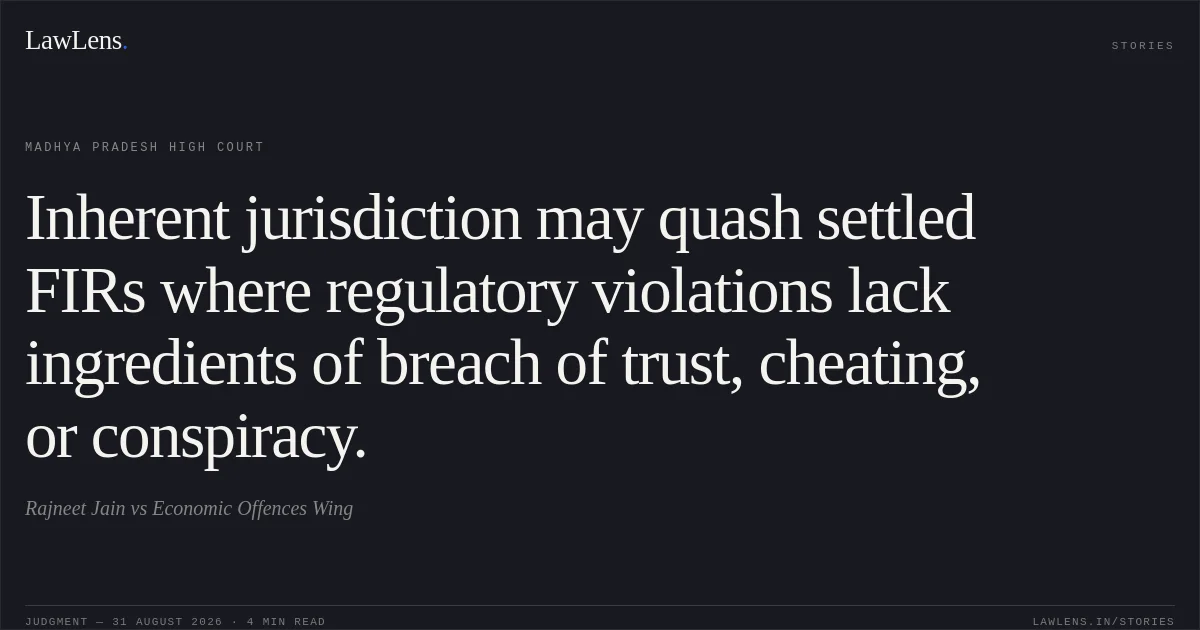
Source reference: paras. 18–21, 28–312. Whether the allegations, taken at face value, disclose the essential ingredients of criminal breach of trust under Section 406 IPC, cheating under Section 420 IPC, and criminal conspiracy under Section 120-B IPC?
Source reference: paras. 22–253. Whether the alleged covering of the government nala and construction over the green-belt area made the dispute sufficiently public or regulatory in character to preclude quashing on settlement or merits?
Source reference: paras. 10–16, 21, 24, 30Law Applied
The Court applied Section 528 of the BNSS, corresponding to Section 482 CrPC, which preserves the High Court’s inherent power to prevent abuse of process and secure the ends of justice.
Source reference: paras. 19, 26It distinguished this power from statutory compounding under Section 359 of the BNSS and relied on Gian Singh v. State of Punjab, (2012) 10 SCC 303, and Narinder Singh v. State of Punjab, (2014) 6 SCC 466, for the principle that proceedings arising predominantly from commercial, financial or civil disputes may be quashed after a genuine settlement, subject to the gravity and societal impact of the offence.
Source reference: paras. 19–20Under Section 406 IPC, criminal breach of trust requires entrustment or dominion over property followed by dishonest misappropriation, conversion, use or disposal in violation of the entrustment.
Source reference: para. 22Section 420 IPC requires deception and dishonest or fraudulent inducement existing from the inception of the transaction; a mere breach or subsequent failure does not constitute cheating.
Source reference: para. 23Section 120-B IPC requires a specific agreement or meeting of minds to commit an illegal act.
Source reference: para. 25The Court also relied on Indian Oil Corporation v. NEPC India Ltd., (2006) 6 SCC 736, against giving a criminal colour to essentially civil disputes, and State of Haryana v. Bhajan Lal, 1992 Supp. (1) SCC 335, concerning quashing where continuation of proceedings would amount to abuse of process.
Source reference: paras. 23, 29Reasoning
The Court found that the compromise was voluntary, duly verified and had completely resolved respondent No. 2’s dispute concerning House No. G-06.
Source reference: para. 18Independently of the settlement, Section 406 IPC was not prima facie attracted because there was no allegation that the government nala or green-belt land had been entrusted to the petitioners in a fiduciary capacity.
Source reference: para. 22Section 420 IPC was also not established because the FIR identified no specific false representation, fraudulent inducement or dishonest intention at the inception of the sale transaction.
Source reference: para. 23The allegation of conspiracy rested merely on the petitioners’ partnership in the developing firm and lacked particulars of an agreement or meeting of minds.
Source reference: para. 25The existence of development permissions, culvert permission, town-planning permission, municipal permission and a completion certificate further indicated that the central dispute concerned alleged deviations from sanctioned conditions rather than inherently criminal conduct.
Source reference: para. 24Such alleged unauthorized development could be addressed through the statutory remedies under the M.P. Municipal Corporation Act, 1956 and the M.P. Nagar Tatha Gram Nivesh Adhiniyam, 1973.
Source reference: para. 24Although the Court acknowledged the State’s interest in government land and public drains, it held that the material did not disclose large-scale financial fraud, systematic economic deception or misappropriation warranting EOW proceedings.
Source reference: para. 30Consequently, continuation of the prosecution, particularly after settlement and in the absence of the foundational ingredients of the offences, would constitute an abuse of process.
Source reference: paras. 28–29Holding
The Court held that the compromise could be taken on record and that the allegations did not prima facie satisfy Sections 406, 420 or 120-B IPC.
It allowed the petition under Section 528 of the BNSS and quashed FIR No. 0009/2026 dated 15 January 2026, registered at Police Station EOW, Bhopal, together with all consequential proceedings.
Source reference: para. 31Acts & Sections Cited
5 provisions across 3 statutes referred to in this judgment. Each provision opens on LawLens.
Bharatiya Nagarik Suraksha Sanhita, 20232
Indian Penal Code, 18602
Code of Criminal Procedure, 19731
Original Court PDF
Rajneet JainvsEconomic Offences Wing
Click to open original judgment
Original judgment, available to read, download and summarize on LawLens.in