Facts
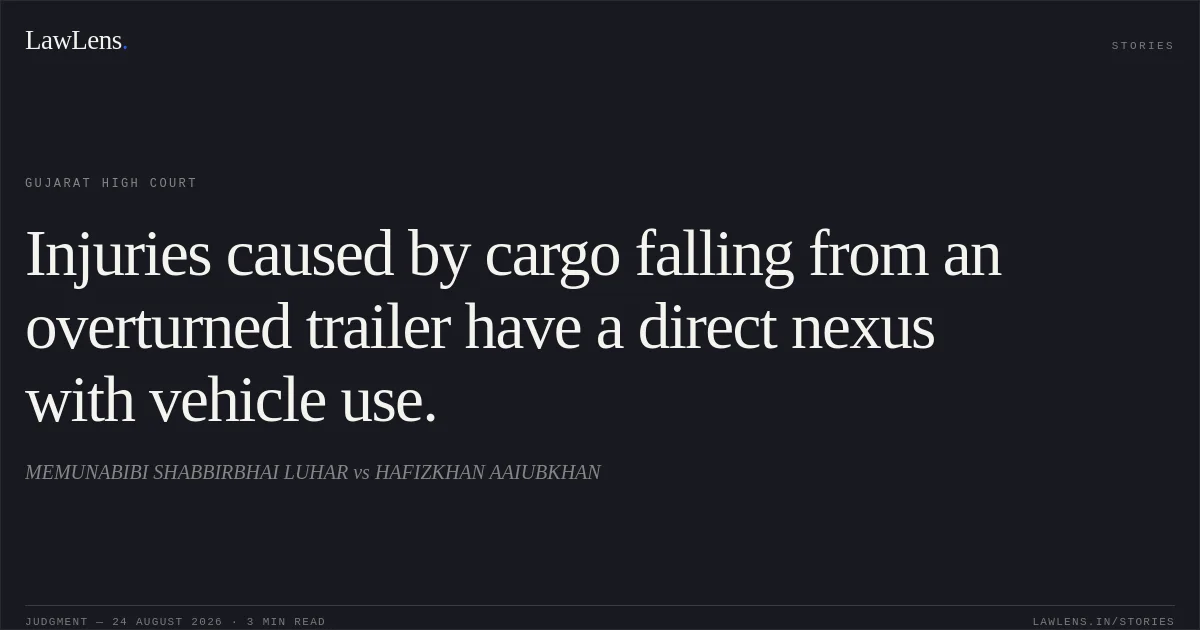
On 25 November 2013, Shabir Hanif Luhar was standing/sitting on a bench near Bhuravav Circle, Godhra, when trailer No. HR-63-6290, allegedly driven rashly and negligently at excessive speed, overturned while taking a turn.
Source reference: p.2, paras. 2, 7, 10The rolls loaded in the trailer fell upon him, causing crush injuries and resulting in his death at the spot.
Source reference: p.2, paras. 2, 7, 10The deceased’s claimants instituted MACP No. 2311/2017 before the Motor Accident Claims Tribunal, Lunawada.
Source reference: p.1, paras. 1, 4The Tribunal rejected the claim petition, holding that the claimants had failed to prove that the deceased’s death resulted from an accident involving the offending vehicle.
Source reference: p.1, paras. 1, 4Issues
Whether the claimants had established a direct nexus between the deceased’s fatal injuries and the use of trailer No. HR-63-6290?
Source reference: p.4, para. 10Whether the Tribunal erred in holding that negligence and the vehicle’s involvement in causing the deceased’s death were not proved?
Source reference: pp.4–5, paras. 10–11Whether the Tribunal’s rejection of the claim petition was sustainable, or whether the matter required remand for fresh determination?
Source reference: p.5, para. 11Law Applied
The Court applied the motor accident compensation framework under the Motor Vehicles Act, particularly the principle that a claim is maintainable where the death or injury has a direct causal nexus with the use of the offending motor vehicle.
Source reference: p.4, para. 10It relied on Kalim Khan v. Fimidabee, 2018 (0) AIJEL-SC 62399, wherein the Supreme Court held that a vehicle may be considered “in use” for purposes of the Act even when it is being used in an activity connected with its operation—in that case, a tractor battery was used to activate explosives for digging a well.
Source reference: p.4, para. 10The Court further proceeded on the principle that the driver’s admission regarding the manner of the accident and the injuries caused by the vehicle’s load was relevant to determining negligence and causation.
Source reference: p.4, para. 10Reasoning
The High Court found that the driver’s FIR itself recorded that he was driving the trailer at excessive speed and in a rash and negligent manner, lost control while taking a turn, and caused the loaded roll to fall upon the deceased.
Source reference: p.4, para. 10This established, prima facie, both negligent use of the trailer and a direct nexus between the vehicle’s use and the deceased’s fatal injuries.
Source reference: p.4, para. 10Applying the reasoning in Kalim Khan, the Court held that the fact that the deceased was struck by goods carried by the trailer did not sever the connection between the death and the use of the vehicle.
Source reference: pp.4–5, paras. 10–11Accordingly, the Tribunal had committed a manifest error in rejecting the claim on the ground that involvement of the offending vehicle and negligence were not proved.
Source reference: pp.4–5, paras. 10–11However, since the issue of negligence required fuller consideration, the Court directed a fresh adjudication rather than determining the compensation claim itself.
Source reference: p.5, para. 11Holding
The High Court held that the Tribunal’s finding that negligence and the offending vehicle’s involvement were not proved was unsustainable.
It set aside the Tribunal’s judgment and award dated 5 January 2023 and remanded the claim petition for fresh decision, permitting both parties to lead evidence on negligence.
Source reference: p.5, para. 11The Tribunal was directed to decide the matter expeditiously, preferably within six months, and the parties were directed to cooperate and avoid unnecessary adjournments.
Source reference: p.5, para. 11Any amount deposited with the High Court Registry was ordered to be transmitted to the Tribunal, and the record was directed to be returned.
Source reference: p.6, paras. 12–13No order as to costs was made.
Source reference: p.6, paras. 12–13Acts & Sections Cited
1 provisions across 1 statute referred to in this judgment. Linked provisions open on LawLens.
the Act (alias, unresolved)1
Original Court PDF
MEMUNABIBI SHABBIRBHAI LUHARvsHAFIZKHAN AAIUBKHAN
Click to open original judgment
Original judgment, available to read, download and summarize on LawLens.in