Facts
The Revenue appealed under Section 260A of the Income Tax Act, 1961, against the ITAT’s order dated 30 September 2014 concerning Assessment Year 2008–09.
Source reference: para. 1It sought condonation of a stated delay of 2,376 days in filing the appeal before the Karnataka High Court.
Source reference: paras. 2, 9–11The Revenue explained that it had first filed an appeal before the High Court of Bombay at Goa on 16 February 2015; that appeal was returned on 27 October 2020 for presentation before the jurisdictional High Court.
Source reference: paras. 2, 6The present appeal was filed on 31 July 2021, following administrative forwarding of the case papers.
Source reference: paras. 2, 6The respondent opposed condonation, arguing that the delay was inordinate and insufficiently explained.
Source reference: paras. 3–4The Revenue also relied on the COVID-19 pandemic in oral submissions, although it had not stated that ground in its supporting affidavit.
Source reference: paras. 6–7, 10Issues
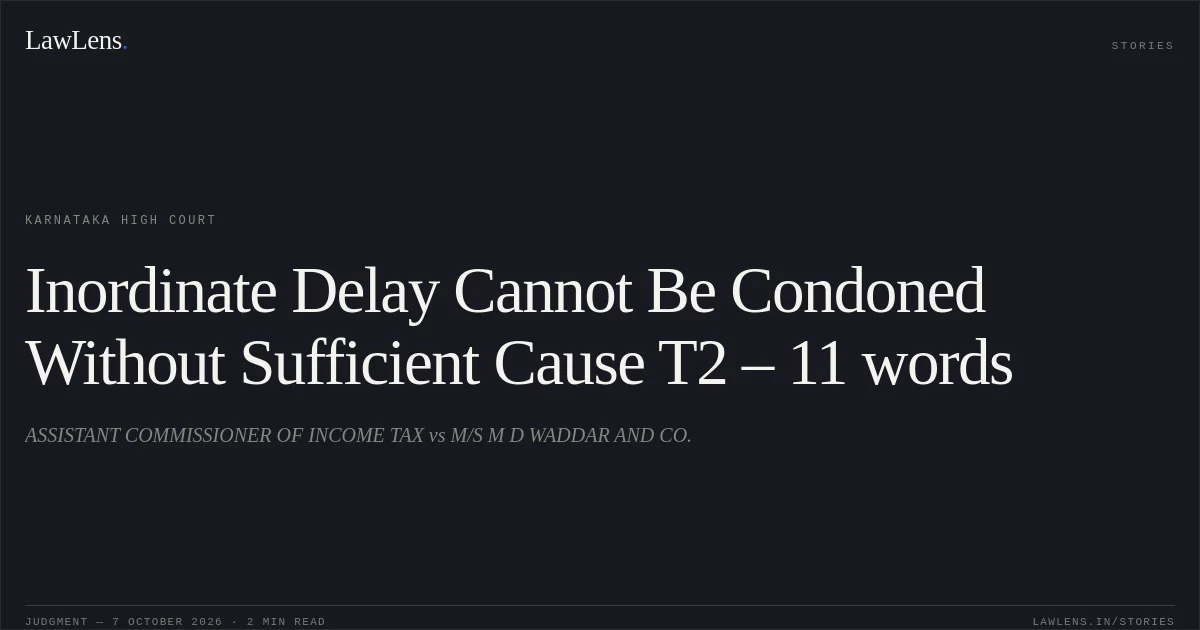
Whether the Revenue established “sufficient cause” under Section 5 of the Limitation Act for condoning the stated delay of 2,376 days in filing the appeal.
Source reference: paras. 2, 9–11Whether the COVID-19 pandemic could support condonation when it was not pleaded in the affidavit accompanying the application.
Source reference: paras. 7, 10Law Applied
Section 5 of the Limitation Act permits condonation of delay only where sufficient cause is shown.
Source reference: no citationThe Court relied on Chennai Metropolitan Water Supply and Sewerage Board v. T.T. Murali Babu, (2014) 4 SCC 108, for the principles that delay and laches require scrutiny, inordinate delay may defeat a claim, and courts should consider whether the explanation is acceptable.
Source reference: paras. 12–13It also relied on Majji Sannemma @ Sanyasirao v. Reddy Sridevi, Civil Appeal No. 7696/2021, and Basawaraj v. Special Land Acquisition Officer, (2013) 14 SCC 81, for the rule that “sufficient cause” cannot be liberally construed where negligence, inaction, or lack of bona fides is attributable to the party.
Source reference: para. 14The Court further referred to Lingeswaran Etc. v. Thirunagalingam, SLP (C) Nos. 2054–2055/2022; Shivamma (Dead) by LRs v. Karnataka Housing Board, Civil Appeal No. 11794 of 2025; and State of Odisha v. Managing Committee of Namatara Girls High School, 2026 SCC OnLine SC 191, in support of rejecting unexplained delay and holding that condonation is not a matter of right.
Source reference: paras. 15–16Reasoning
The Court found that the affidavit explained the initial filing before the Bombay High Court at Goa and the subsequent administrative movement of the papers, but did not establish sufficient cause for the full delay in bringing the appeal before the Karnataka High Court.
Source reference: paras. 9–11It rejected the COVID-19 explanation because that ground was absent from the affidavit and was raised only in counsel’s submissions.
Source reference: para. 10Applying the cited principles on inordinate delay and the need for an adequate explanation, the Court held that the Revenue had not justified condonation of the stated 2,376-day delay.
Source reference: paras. 11–17Holding
The Court answered the condonation issue against the Revenue, holding that sufficient cause had not been shown for the delay.
It rejected Interlocutory Application No. 1 of 2022 and consequently dismissed the appeal without examining its merits.
Source reference: para. 18Acts & Sections Cited
1 provisions across 1 statute referred to in this judgment. Each provision opens on LawLens.
Limitation Act, 19631
Original Court PDF
ASSISTANT COMMISSIONER OF INCOME TAXvsM/S M D WADDAR AND CO.
Click to open original judgment
Original judgment, available to read, download and summarize on LawLens.in