01Facts
M/s Assam Rifles Group Insurance Scheme (ARGIS), Shillong, challenged the show-cause notice dated 05.10.2016 and the Order-in-Original dated 12.03.2025, whereby the respondent authorities confirmed a Service Tax demand and imposed interest and penalties under the Finance Act, 1994.
¶ 1 · pp. 2–3The dispute concerned three schemes operated for Assam Rifles personnel—Death Benefit Insurance Scheme, Disability Benefit Scheme and Post-Retirement Insurance Scheme—and the administrative charges and mandatory salary deductions collected under them.
¶ 8 · p. 8The principal ground accepted by the Court was that the adjudication order was passed approximately 8.5 years, or 3081 days, after issuance of the show-cause notice; the first personal hearing was granted only on 05.04.2024.
¶ 20–21 · pp. 17–19The respondents attributed the delay to the petitioner’s requests for exemption, alleged non-furnishing of documents, inter-departmental coordination and examination of the schemes.
¶ 21, 26 · pp. 19–2502Issues
i.1. Whether the Order-in-Original dated 12.03.2025 was arbitrary and time-barred because it was passed after an approximately 8.5-year delay, contrary to Section 73(4B) of the Finance Act, 1994.
¶ 19(1) · pp. 16–18ii.2. Whether Notification No. 22/2014-ST dated 16.09.2014 was ultra vires Rule 3 of the Service Tax Rules, 1994 for conferring pan-India jurisdiction on the respondent authorities.
¶ 19(2) · pp. 16–17iii.3. Whether mandatory salary deductions under the schemes constituted “consideration” for the purposes of the Finance Act, 1994.
¶ 19(3) · pp. 16–17iv.4. Whether ARGIS qualified as “Government” under Section 66D(a) of the Finance Act, 1994, so that its activities were covered by the Negative List.
¶ 19(4) · pp. 16–17v.5. Whether the tax demand and adjudication process violated Articles 14, 19(1)(g) and 265 of the Constitution.
¶ 19(5) · pp. 16–17vi.6. Whether the writ petition was maintainable despite the availability of an alternative statutory appellate remedy, in view of the challenges based on vires, natural justice and lack of jurisdiction.
¶ 19(6) · pp. 16–1703Law Applied
The Court applied Section 73(4B)(b) of the Finance Act, 1994, which required determination of service tax within one year from the date of notice in cases invoking the proviso to Section 73(1), “where it is possible to do so”.
¶ 20 · p. 18The Court held that this expression permits only a reasonable and legally justified extension; it does not authorise unexplained, unreasonable or inordinate delay.
¶ 22 · pp. 20–22Relying principally on IDFC First Bank v. Union of India , (2023) 10 Centax 256 (Bom), and referring to Sunder System Pvt. Ltd. v. Union of India , 2020 (33) GSTL 621 (Del.), L.R. Sharma & Co. v. Union of India , 2024 SCC OnLine Del 9031, and Power Spectrum Sarbidipur v. Union of India , judgment dated 17.04.2025 in CWJC No. 16772/2024, the Court reiterated that statutory adjudication must be concluded within a reasonable period and that Section 73(4B) cannot be rendered meaningless by treating its timelines as merely directory.
¶ 22–25 · pp. 20–24Section 33A of the Finance Act, 1994, which limits adjournments to three and requires reasons to be recorded, was also applied to reject reliance on repeated representations or adjournments as justification for the prolonged delay.
¶ 26 · pp. 24–25The Court further recognised that Article 226 may be invoked despite an alternative remedy where the challenge raises a pure question of law and the impugned action is arbitrary or violates Article 14.
¶ 29 · p. 26Provisions in the judgment · 4 · Linked ones open on LawLens
Central Goods and Services Tax Act, 2017 Section 174
Insurance Act, 1938 Section 2Section 118
Indian Contract Act, 1872 Section 2
04Reasoning
The Court found that the notice dated 05.10.2016 was adjudicated only on 12.03.2025, with the first personal hearing occurring after nearly 2704 days.
¶ 20–21 · pp. 17–19Since the extended limitation period under the proviso to Section 73(1) had been invoked, Section 73(4B)(b) required determination within one year “where it is possible to do so.” Applying IDFC First Bank , the Court held that the provision allowed limited flexibility only where a plausible and legally acceptable reason prevented timely adjudication; it did not permit the authority to keep the proceedings pending indefinitely.
¶ 22 · pp. 20–22The respondents’ explanations—requests for retrospective exemption, alleged incomplete documents, inter-departmental coordination and examination of the schemes—did not justify an 8.5-year delay, particularly because the show-cause notice already contained the relevant factual allegations and reasons for the proposed demand.
¶ 25–27 · pp. 23–26The Court also held that the petitioner’s representations could not operate as a legal restraint on the respondents’ duty to adjudicate expeditiously, and that Section 33A independently limited the relevance of repeated adjournments.
¶ 26–27 · pp. 24–26In view of this dispositive procedural defect, the Court expressly declined to adjudicate the issues concerning taxability, consideration, Government status, pan-India jurisdiction, bias and suppression.
¶ 28 · p. 2605Holding
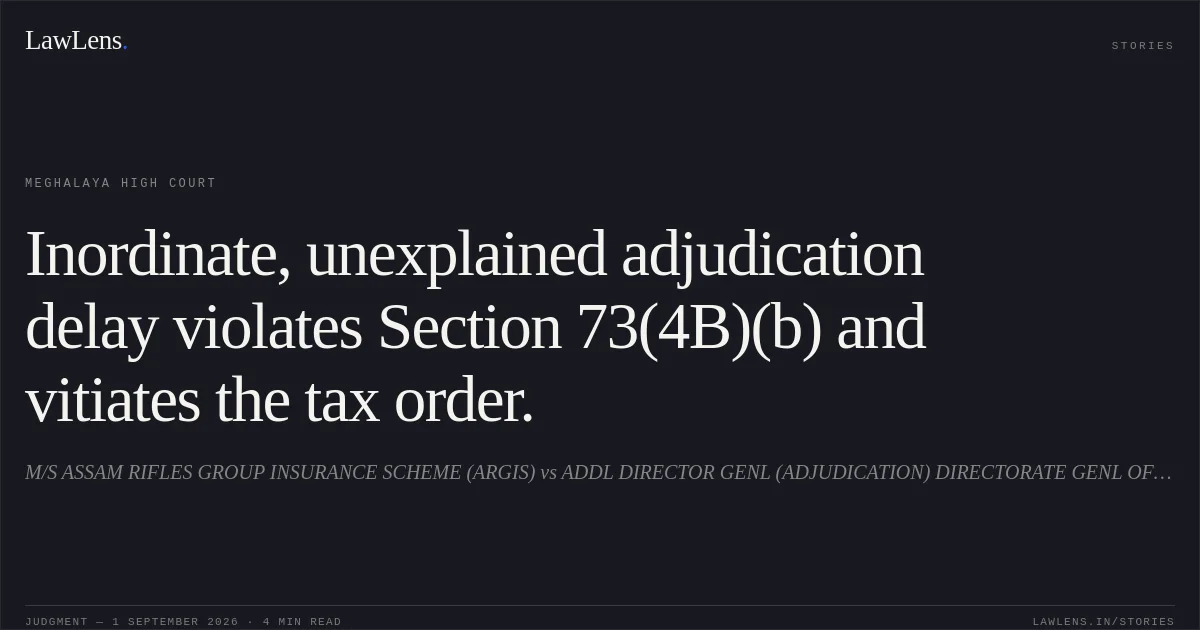
The Court held that the Order-in-Original dated 12.03.2025, having been passed after an undue, unexplained and inordinate delay of approximately 8.5 years, violated Section 73(4B)(b) of the Finance Act, 1994 and was arbitrary and bad in law.
¶ 27 · p. 26The availability of an alternative statutory remedy did not bar the writ petition because the case involved interpretation of Section 73(4B) and a challenge to arbitrary State action under Article 14.
¶ 29 · p. 26The impugned order was accordingly set aside and quashed on the ground of delay alone; the Court did not decide the remaining substantive and jurisdictional issues.
¶ 28–31 · pp. 26–27Original Court PDF
M/S ASSAM RIFLES GROUP INSURANCE SCHEME (ARGIS)vsADDL DIRECTOR GENL (ADJUDICATION) DIRECTORATE GENL OF GST INTELLIGENCE (ADJUDICATION CELL), AND ORS.
Click to open original judgment
Original judgment, available to read, download and summarize on LawLens.in