Facts
The applicants sought condonation under Section 5 of the Limitation Act of a 1,402-day delay in filing a Civil Revision Application under Section 29(2) of the Bombay Rents, Hotel and Lodging House Rates Control Act, 1947.
Source reference: paras. 2–6They attributed the delay to unsuccessful settlement discussions, the time needed to gather the record, and the death in March 2024 of Madhusudanbhai, who had been handling the proceedings.
Source reference: paras. 2–6The revision was filed on 8 May 2026; the applicants had lost their eviction suit before both the trial court and the appellate court.
Source reference: paras. 2–6The application did not mention Madhusudanbhai’s death or provide particulars explaining the delay.
Source reference: paras. 5–6Issues
Whether the applicants established “sufficient cause” under Section 5 of the Limitation Act to condone the 1,402-day delay in filing the revision application.
Source reference: paras. 4–6, 9Whether the delay could be condoned by imposing costs or other conditions despite the absence of a satisfactory explanation and the applicants’ inaction.
Source reference: paras. 3.2, 7, 9Law Applied
Section 5 of the Limitation Act permits condonation only where sufficient cause is shown; although the provision is to be applied liberally, the discretion must be exercised judiciously, and negligence, lack of bona fides, or want of due diligence may justify refusal, particularly in cases of inordinate delay.
Source reference: para. 8.1; para. 8.2The Court also relied on Basawaraj v. Special Land Acquisition Officer, which holds that delay cannot be condoned, even on conditions, where sufficient cause is absent and the party has been negligent or inactive.
Source reference: para. 8.3The limitation period serves the public policy of ending stale claims and requiring parties to assert their rights within a reasonable time.
Source reference: para. 8Section 29(2) of the 1947 Act was identified as the provision under which the proposed revision was to be filed.
Source reference: para. 2Reasoning
The Court found the applicants’ account of settlement efforts and record-gathering to be vague and unsupported by particulars, and held that it did not adequately explain the prolonged delay.
Source reference: paras. 4–5The death of Madhusudanbhai did not assist the applicants: it was omitted from the application, he had not initiated revision proceedings during his lifetime, and the application was filed more than two years after his death.
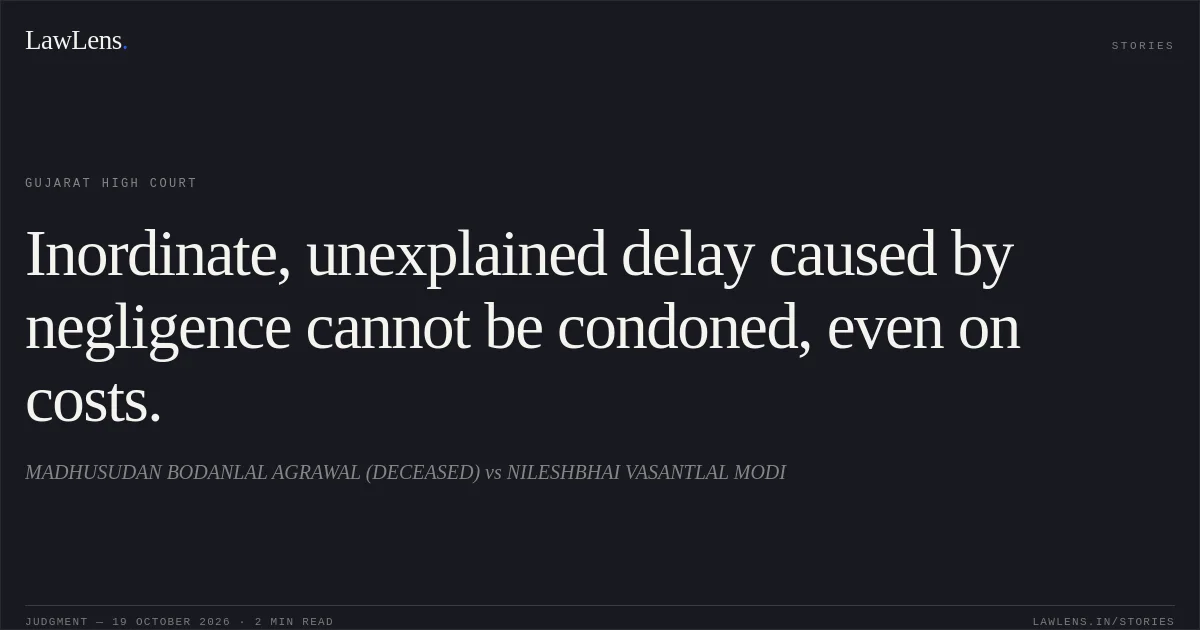
Source reference: para. 6Applying the principles governing inordinate delay and due diligence, the Court concluded that the delay resulted from the applicants’ negligence and that costs could not cure the absence of sufficient cause.
Source reference: paras. 7–9Holding
The Court held that the applicants had not satisfactorily explained the 1,402-day delay or established sufficient cause under Section 5 of the Limitation Act.
It dismissed the condonation application and directed the Registry to refuse registration of the Civil Revision Application and any related Civil Application.
Source reference: paras. 9–11Acts & Sections Cited
2 provisions across 1 statute referred to in this judgment. Each provision opens on LawLens.
Original Court PDF
MADHUSUDAN BODANLAL AGRAWAL (DECEASED)vsNILESHBHAI VASANTLAL MODI
Click to open original judgment
Original judgment, available to read, download and summarize on LawLens.in