Facts
On 18 December 2003, Bharatsinh alias Babubha Bachubha Jadeja and Mobatsinh Gumansinh Jadeja were travelling with fertilizer in a Chhakda rickshaw that overturned, causing fatal injuries.
Source reference: para. 3–7Their claimants alleged that each deceased was travelling as an owner of goods; the Tribunal accepted that account and awarded ₹5,08,000 and ₹11,70,736, respectively, with interest at 9% per annum.
Source reference: para. 3–7The insurer appealed, contending that the goods vehicle had no seating capacity and that the policy did not cover the deceased.
Source reference: para. 9–10It did not press its challenge concerning the driver’s licence.
Source reference: para. 13Issues
Whether the insurer was contractually liable under the policy for the deaths of persons travelling in a goods vehicle with no seating capacity.
Source reference: para. 9–10, 13–14If the policy did not cover the deceased, whether the insurer could nevertheless be directed to satisfy the awards first and recover the amounts from the vehicle owner.
Source reference: para. 11, 14–16Law Applied
Under the Motor Vehicles Act, 1988, claims were brought under Section 166 and the appeals were filed under Section 173.
Source reference: para. 1, 5The Court treated the goods-carrying policy as not covering persons travelling in a vehicle that had no seating capacity, including where they travelled with goods.
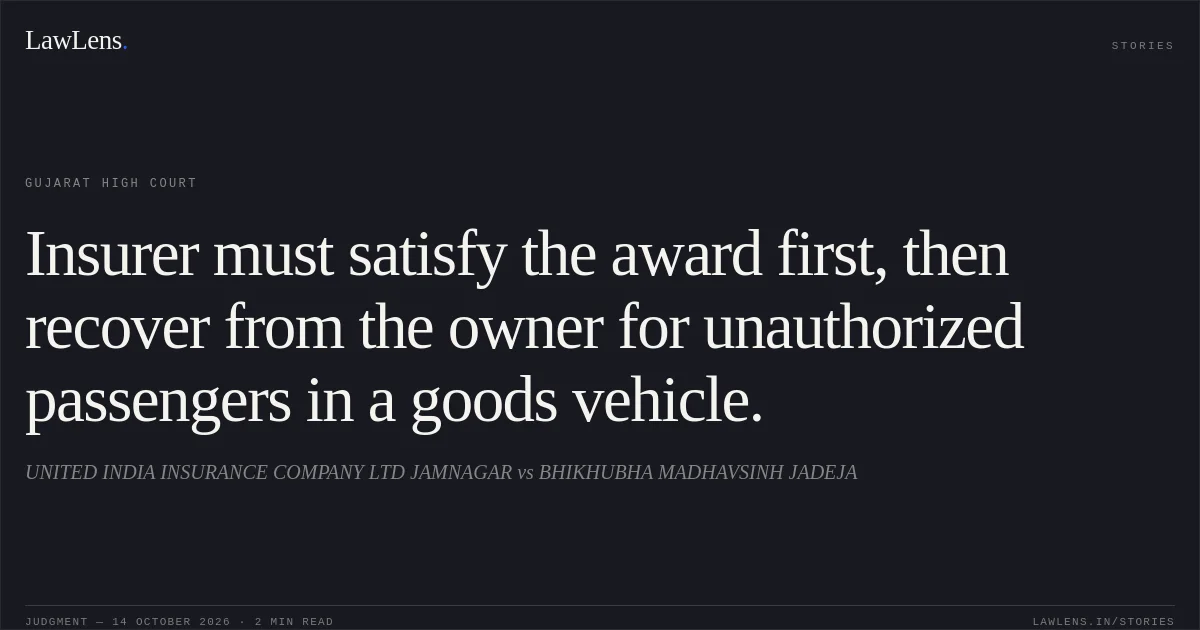
Source reference: para. 14Relying on Kaminiben & Ors. v. The Oriental Insurance Company Limited & Ors., 2026 LiveLaw (SC) 1174, and the principles in Manuara Khatun and National Insurance Co. Ltd. v. Saju P. Paul, the Court applied the “pay and recover” principle: an insurer may be directed to satisfy an award for the claimants’ benefit and then recover the amount from the insured, despite being exonerated from contractual liability.
Source reference: para. 11, 14Reasoning
The Tribunal had found that the deceased were travelling as owners of goods, supported by evidence concerning fertilizer purchases.
Source reference: para. 13However, the vehicle had no seating capacity, and its goods-carrying policy did not permit passengers; the Court therefore held that the insurer was not contractually liable to indemnify the owner.
Source reference: para. 14Applying the Supreme Court authorities cited in Kaminiben, the Court nonetheless directed the insurer to satisfy the awards first, preserving the claimants’ ability to obtain compensation while allowing the insurer to recover from the owner.
Source reference: para. 14–16Holding
Both appeals were partly allowed.
The Court held the insurer exonerated from contractual liability but ordered it, under the “pay and recover” principle, to deposit the entire decretal amounts with the Tribunal, if not already deposited, and permitted recovery from the rickshaw owner by execution of the judgment and award.
Source reference: para. 16The Tribunal was directed to disburse the compensation to the claimants; the remaining findings were left undisturbed, and the stay application was disposed of as no longer surviving.
Source reference: para. 16–17Acts & Sections Cited
3 provisions across 1 statute referred to in this judgment. Each provision opens on LawLens.
Motor Vehicles Act, 19883
Original Court PDF
UNITED INDIA INSURANCE COMPANY LTD JAMNAGARvsBHIKHUBHA MADHAVSINH JADEJA
Click to open original judgment
Original judgment, available to read, download and summarize on LawLens.in