Facts
The CBI filed a criminal revisional application challenging orders dated October 28 and 29, 2025, passed by the Chief Judicial Magistrate (CJM), Bankura, in Complaint Case No. 36C/2014
Source reference: para. 1In a previous writ petition (WPA 29425/2014), the High Court had issued a peremptory mandate on September 3, 2025, directing the trial court to conclude the proceedings by December 19, 2025, on a day-to-day basis
Source reference: para. 4During the trial, the CBI sought warrants of arrest against non-appearing witnesses under Section 87 CrPC and moved an eleventh-hour application under Section 311 CrPC to summon an additional witness, Bina Ghosh
Source reference: para. 1, 9The CJM rejected these pleas and closed the evidence to meet the High Court's deadline
Source reference: para. 1By the time of this revision, the trial had progressed to the final stage: Section 313 statements were recorded, defense evidence was concluded, and the matter was fixed for judgment on November 27, 2025
Source reference: para. 14–15Issues
1. Whether the trial court’s refusal to issue warrants of arrest under Section 87 and summon a witness under Section 311 CrPC constituted a failure of justice in light of a time-bound High Court mandate
Source reference: para. 1, 42. Whether a criminal revision is maintainable against interlocutory orders rejecting the summoning of witnesses when the trial is at the stage of pronouncement of judgment
Source reference: para. 12, 15Law Applied
The Court applied Section 87 of the Code of Criminal Procedure (CrPC), noting the term "may" grants judicial discretion rather than a mandatory right to issue warrants
Source reference: para. 8Section 311 CrPC, holding that while powers are wide, they cannot be used to fill lacunae caused by long-standing inertia
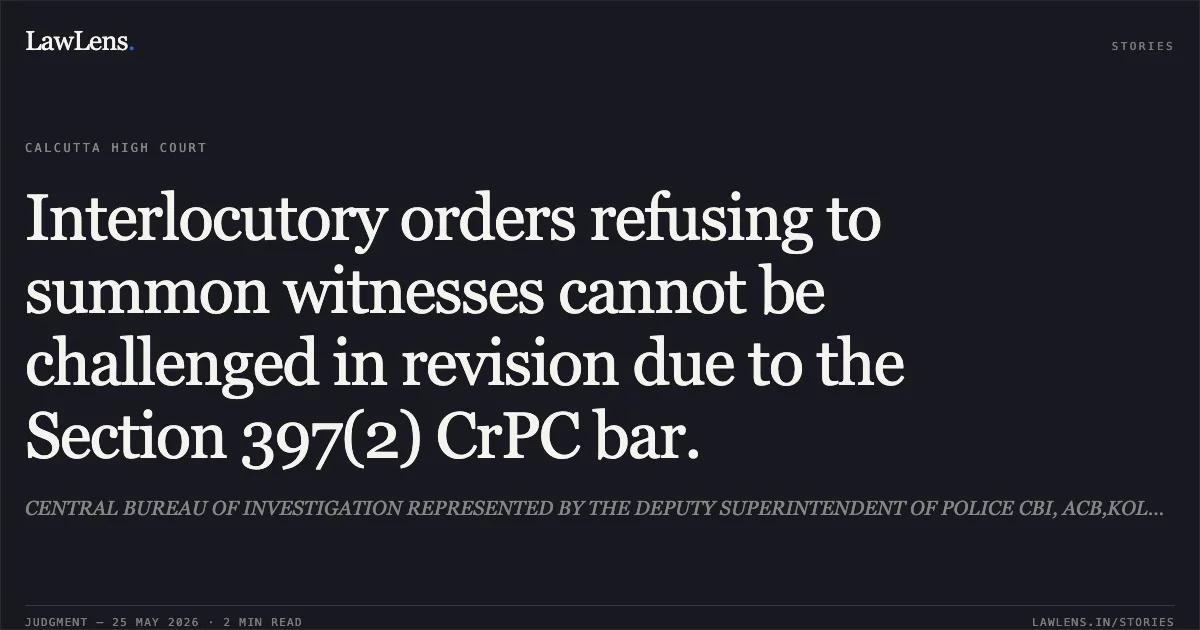
Source reference: para. 11The Court invoked the statutory bar under Section 397(2) CrPC, which prohibits the exercise of revisional jurisdiction against interlocutory orders passed during an inquiry or trial
Source reference: para. 12Reasoning
The Court reasoned that the sub-ordinate court was under a "solemn obligation" to comply with the High Court’s time-locked constitutional decree, which overrode procedural indulgences
Source reference: para. 5The CBI’s attempt to summon Bina Ghosh was deemed "tainted by laches" because the agency had over a decade to identify the witness but only claimed her relevance at the "eleventh hour"
Source reference: para. 9–10The Court found that issuing warrants would have necessitated indefinite adjournments, directly defying the superior court's embargo on routine delays
Source reference: para. 6, 8The Court determined that the impugned orders regarding witness summoning were purely intermediate and "interlocutory in nature," as they did not determine the final guilt or innocence of the accused
Source reference: para. 13Allowing the revision at the final stage of the trial would result in "procedural infinite regression"
Source reference: para. 17Holding
The Court dismissed the revisional application, holding it was both devoid of merit and legally unmaintainable under Section 397(2) CrPC
The Court ruled that the trial court acted correctly in balancing procedural fairness with the mandate for a swift conclusion
Source reference: para. 16All interim orders were vacated, and the Trial Court was directed to pronounce the judgment at its earliest convenience upon receipt of the order
Source reference: para. 17, 19Acts & Sections Cited
4 provisions across 1 statute referred to in this judgment. Each provision opens on LawLens.
Code of Criminal Procedure, 19734
Original Court PDF
CENTRAL BUREAU OF INVESTIGATION REPRESENTED BY THE DEPUTY SUPERINTENDENT OF POLICE CBI, ACB,KOLKATAvsGOUTAM MONDAL AND ANR.
Click to open original judgment
Original judgment, available to read, download and summarize on LawLens.in