Facts
The appellant, the mother of deceased Sepoy Anil Kumar, challenged the Railway Claims Tribunal's order dated 24.05.2018, which dismissed her claim for compensation
Source reference: p.2The deceased allegedly fell from a running train near Hazrat Nizamuddin Railway Station on 15.03.2011 while traveling from Ghewra to Tughlaqabad
Source reference: p.3The Tribunal rejected the claim on the grounds that the body was initially marked as "unknown," no seizure memo was prepared for the recovered tickets/ID, and the original tickets were not produced
Source reference: p.3, 4The appellant also sought condonation of an 832-day delay in filing the appeal, citing illiteracy, poverty, and personal trauma
Source reference: p.1, 2Issues
1. Whether the delay of 832 days in filing the appeal should be condoned given the appellant's socio-economic circumstances
Source reference: p.22. Whether the non-production of original journey tickets and irregularities in police investigation (failure to prepare a seizure memo) are sufficient grounds to deny a claim for compensation under the Railways Act
Source reference: p.4, 53. Whether the deceased was a bona fide passenger who died in an "untoward incident"
Source reference: p.6Law Applied
The Court applied the principle of "sufficient cause" for condonation of delay under the Limitation Act, guided by Mohsina v. Union of India, which emphasizes a lenient approach for economically weaker claimants
Source reference: p.2Substantively, the Court applied Section 124-A of the Railways Act, 1989, regarding compensation for "untoward incidents"
Source reference: p.6It relied on Union of India v. Rina Devi, establishing that a claimant's initial burden is discharged by filing a relevant affidavit, after which the burden shifts to the Railways to disprove the claim
Source reference: p.6It further cited Rajni & Ors. v. Union of India regarding the beneficial nature of the legislation
Source reference: p.4Reasoning
The Court first condoned the 832-day delay, noting the appellant’s illiteracy and the trauma of losing her son and husband
Source reference: p.2On the merits, the Court observed that the Tribunal erred by focusing on procedural lapses by the Investigating Officer, such as the failure to prepare a seizure memo or the initial "unknown" status of the body
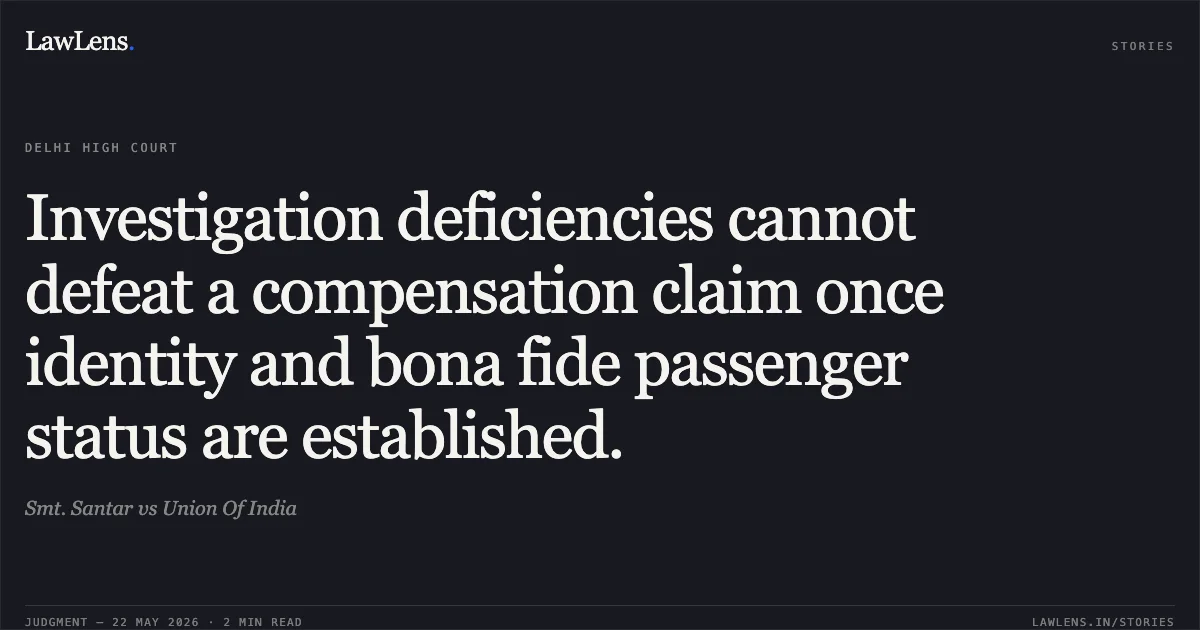
Source reference: p.5The Court held that once the identity of the deceased was established, social welfare legislation should not be defeated by police deficiencies
Source reference: p.5Since photocopies of the tickets were provided and the respondent failed to produce a DRM report or evidence of trespassing, the Court found that the appellant had discharged the initial burden under the Rina Devi standard
Source reference: p.5, 6Holding
The Court allowed the appeal and set aside the judgment dated 24.05.2018
It held that the deceased was a bona fide passenger and his death constituted an "untoward incident"
Source reference: p.6The matter was remanded to the Tribunal to assess and disburse compensation within two weeks of the order
Source reference: p.6The delay in filing the appeal was formally condoned
Source reference: p.2Acts & Sections Cited
2 provisions across 2 statutes referred to in this judgment. Each provision opens on LawLens.
Railway Claims Tribunal Act, 19871
Code of Criminal Procedure, 19731
Original Court PDF
Smt. SantarvsUnion Of India
Click to open original judgment
Original judgment, available to read, download and summarize on LawLens.in