Facts
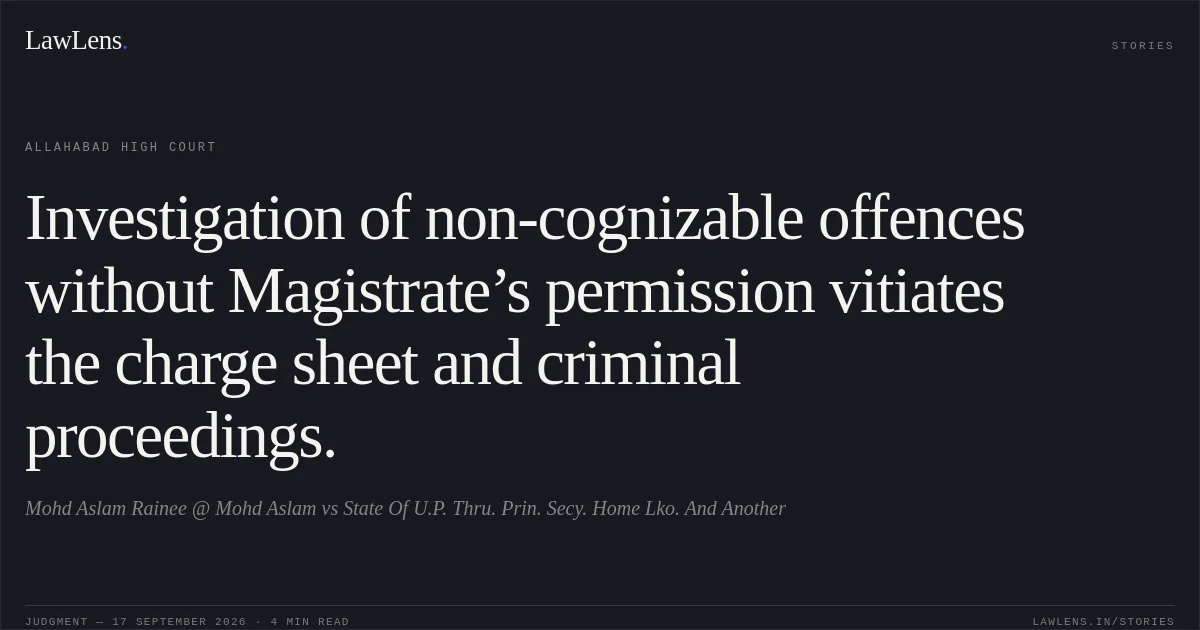
The applicant challenged the summoning order dated 7 August 2026, charge-sheet No. A-240/2025 dated 14 November 2025, and the criminal proceedings in Case No. 3337/2026 arising from Case Crime No. 35/2022, Police Station Ikauna, District Shrawasti.
Source reference: paras. 2–3, 12The FIR alleged that the applicant, along with approximately 500–600 supporters, conducted election canvassing/public meetings without permission during the 2022 Assembly elections, allegedly violating the Model Code of Conduct and COVID-19 guidelines.
Source reference: paras. 2–3, 12The FIR and charge-sheet invoked Sections 186, 269, 270 and 171H IPC, Section 3 of the Epidemic Diseases Act, 1897, and Section 51 of the Disaster Management Act, 2005.
Source reference: para. 2The applicant contended that Section 171H IPC was non-cognizable, that prosecution for offences under Sections 172–188 IPC was barred absent a written complaint under Section 195(1) Cr.P.C., and that the police had investigated and filed the charge-sheet without the Magistrate’s prior permission under Section 155(2) Cr.P.C.
Source reference: paras. 6–10The State opposed the application and supported the summoning order.
Source reference: para. 11Issues
Whether the FIR, police investigation, and charge-sheet were legally maintainable when the alleged offences were non-cognizable and the investigation was conducted without prior Magistrate authorization under Section 155(2) Cr.P.C.
Source reference: paras. 24–29Whether cognizance could be taken for offences falling within Sections 172–188 IPC without a written complaint by the concerned public servant, as required by Section 195(1) Cr.P.C.
Source reference: paras. 13–16, 21–23Whether the allegations disclosed an offence under Section 171H IPC against the applicant, particularly when that provision applies to a person other than the election candidate who incurs unauthorized election-related expenditure.
Source reference: paras. 17–18Whether the summoning order dated 7 August 2026 was vitiated by non-application of judicial mind and failure to record reasons demonstrating sufficient grounds for proceeding.
Source reference: paras. 30, 32Law Applied
The Court applied Section 195(1) Cr.P.C., which bars cognizance of offences under Sections 172–188 IPC except upon a written complaint by the concerned public servant or an administratively superior public servant.
Source reference: para. 13Section 2(d) Cr.P.C. distinguishes a complaint from a police report, while Section 155(2) Cr.P.C. prohibits police investigation of a non-cognizable offence without prior Magistrate authorization.
Source reference: paras. 15, 25–27Section 171H IPC penalizes unauthorized election-related expenditure incurred by a person other than the candidate.
Source reference: para. 17Section 190 Cr.P.C. identifies the permissible modes of taking cognizance.
Source reference: paras. 19–20Relying on Sachida Nand Singh v. State of Bihar, Daulat Ram v. State of Punjab, and M.S. Ahlawat v. State of Haryana, the Court held that Section 195 is mandatory and must be strictly complied with.
Source reference: paras. 21–23Under State of Haryana v. Bhajan Lal, proceedings may be quashed where the allegations disclose no offence, investigation of a non-cognizable offence was undertaken without Magistrate authorization, or a legal bar prevents continuation of the prosecution.
Source reference: para. 33The Court also relied on Lalankumar Singh v. State of Maharashtra for the rule that issuance of process is not an empty formality and requires a reasoned application of mind, and on Inder Mohan Goswami v. State of Uttaranchal regarding the inherent power to prevent abuse of process and secure the ends of justice.
Source reference: paras. 31–32Reasoning
The Court found that Section 171H IPC was non-cognizable and that the record did not disclose any cognizable offence enabling the police to investigate the matter without prior permission under Section 155(2) Cr.P.C.
Source reference: paras. 24–29It further held that prosecution for offences within Sections 172–188 IPC, including the offence discussed under Section 188 IPC and the alleged disobedience of public authorities, could not proceed on the basis of an FIR and police report alone; a written complaint by the competent public servant was mandatory under Section 195(1) Cr.P.C.
Source reference: paras. 13–16The Court also accepted the applicant’s argument that Section 171H IPC was inapplicable because the provision targets a person other than the election candidate, whereas the applicant was himself alleged to be the candidate or campaigner.
Source reference: paras. 17–18Consequently, the police investigation and charge-sheet were treated as jurisdictionally defective and incapable of being validated merely by the Magistrate’s subsequent acceptance of the charge-sheet or taking of cognizance.
Source reference: paras. 27–29, 36The summoning order was additionally found deficient because it did not demonstrate the Magistrate’s application of mind or record sufficient grounds for proceeding.
Source reference: paras. 30, 32, 37Holding
The High Court held that the police investigation was without jurisdiction, the charge-sheet was legally vitiated, cognizance was impermissible in the absence of the mandatory written complaint under Section 195(1) Cr.P.C., and the summoning order lacked adequate application of judicial mind.
Exercising its inherent jurisdiction under Section 482 Cr.P.C./Section 528 BNSS, the Court allowed the application and quashed the summoning order dated 7 August 2026, charge-sheet No. A-240/2025 dated 14 November 2025, and the entire criminal proceedings in Case No. 3337/2026 arising from Case Crime No. 35/2022, insofar as they concerned the applicant.
Source reference: paras. 38–39The Senior Registrar was directed to transmit the order to the trial court for compliance.
Source reference: para. 40Acts & Sections Cited
49 provisions across 5 statutes referred to in this judgment. Each provision opens on LawLens.
Bharatiya Nagarik Suraksha Sanhita, 20231
Code of Criminal Procedure, 1973
Indian Penal Code, 1860
Epidemic Diseases Act, 18971
Disaster Management Act, 20051
Original Court PDF
Mohd Aslam Rainee @ Mohd AslamvsState Of U.P. Thru. Prin. Secy. Home Lko. And Another
Click to open original judgment
Original judgment, available to read, download and summarize on LawLens.in