Facts
The petitioner (prosecutrix) filed an F.I.R. alleging that the accused (Opposite Party No. 2) committed rape by force on 27.9.2015 and subsequently forced an abortion on 29.7.2016
Source reference: p. 1She further alleged that continued forcible physical relations, maintained through threats and obscene videos, resulted in a second pregnancy and the birth of a daughter
Source reference: p. 1Following the investigation, a charge sheet was filed only against the accused, exonerating his relatives
Source reference: p. 2During the trial, the accused moved an application under Section 311 Cr.P.C. to have a letter—purportedly written by the prosecutrix but denied by her during cross-examination—analyzed by a handwriting expert to prove consent
Source reference: p. 2The trial court allowed this on 23.10.2024
Source reference: p. 1Conversely, the trial court dismissed the prosecutrix's application for a DNA test between the accused and her daughter on 25.8.2022, citing the advanced stage of the trial and the Investigating Officer’s failure to conduct such a test during investigation
Source reference: p. 2-3The petitioner also sought the summoning of additional accused under Section 319 Cr.P.C., which was dismissed on 22.3.2021
Source reference: p. 1Issues
1. Whether the trial court erred in allowing the examination of a disputed letter by a handwriting expert under Section 311 Cr.P.C. after the prosecutrix denied its authorship
Source reference: p. 22. Whether the dismissal of the application for a DNA paternity test on grounds of trial delay and investigative omission was legally sustainable
Source reference: p. 2-33. Whether the additional accused should be summoned under Section 319 Cr.P.C.
Source reference: p. 1Law Applied
The Court applied Section 311 of the Cr.P.C. (corresponding to Section 348 of the BNSS), which empowers the court to summon material witnesses or examine documents essential to a "just decision of the case"
Source reference: p. 3It further relied on the constitutional right to a "fair trial," which includes the accused’s right to rebut prosecution evidence to prove consent in rape cases
Source reference: p. 3The Court also exercised inherent powers under Section 528 BNSS (formerly Section 482 Cr.P.C.) to ensure that crucial pieces of evidence, such as DNA reports, are not excluded based on procedural delays or investigative lapses
Source reference: p. 3Reasoning
Regarding the handwriting expert, the Court reasoned that while the prosecutrix denied authorship of the letter, the accused’s defense hinges on proving consent
Source reference: p. 3Excluding expert analysis of a document that could potentially establish consent would deprive the accused of a fair trial and hinder "effective and proper adjudication"
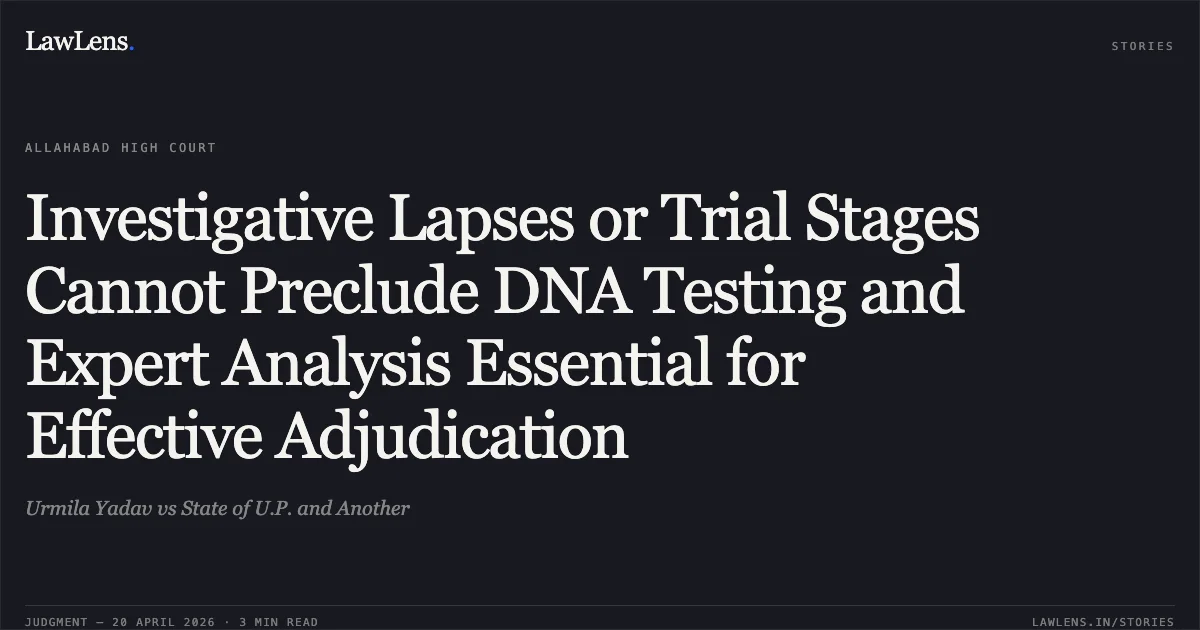
Source reference: p. 3Regarding the DNA test, the Court found the trial court's reasoning—that the trial was at an "advanced stage" or that the Investigating Officer had failed to perform the test—to be insufficient grounds for rejection
Source reference: p. 3The Court determined that a DNA report constitutes a "crucial piece of evidence" with a "direct bearing" on the prosecution’s allegations of paternity resulting from the alleged crime
Source reference: p. 3Consequently, the scientific determination of paternity is essential to the truth-seeking process of the trial
Source reference: p. 3Holding
The High Court dismissed the challenge to the order allowing the handwriting expert, holding that the trial court provided valid reasons to ensure a fair trial
The Court allowed the application for the DNA test, setting aside the order dated 25.8.2022, and directed the accused to provide samples as required by the trial court
Source reference: p. 3Application U/S 528 BNSS No. 12417 of 2025 is dismissed
Source reference: p. 4Application U/S 482 No. 42067 of 2022 is allowed
Source reference: p. 4Criminal Revision No. 1738 of 2021 is dismissed as withdrawn
Source reference: p. 4Acts & Sections Cited
7 provisions across 3 statutes referred to in this judgment. Each provision opens on LawLens.
Bharatiya Nagarik Suraksha Sanhita, 20231
Code of Criminal Procedure, 19733
Indian Penal Code, 18603
Original Court PDF
Urmila YadavvsState of U.P. and Another
Click to open original judgment
Original judgment, available to read, download and summarize on LawLens.in