Facts
The petitioners had filed an Original Application before the Principal Bench of the Central Administrative Tribunal challenging the final merit list and Computer Based Aptitude Test (CBAT) results in the Assistant Loco Pilot recruitment.
Source reference: pp. 2–3They sought, inter alia, shift-wise preparation of CBAT scores, normalization of marks, setting aside of the combined CBAT result, and remedial measures for candidates affected by technical glitches.
Source reference: pp. 2–3The final merit list and CBAT result had been issued by the Railway Recruitment Board, Chandigarh, and any consequential implementation of relief would have to be undertaken by that RRB.
Source reference: p. 3The Tribunal rejected the OA on the grounds of territorial jurisdiction and merits, following which the petitioners approached the Delhi High Court.
Source reference: p. 1Issues
Whether the Original Application concerning the CBAT results and final merit list issued by the Railway Recruitment Board, Chandigarh, was maintainable before the Principal Bench of the Central Administrative Tribunal at Delhi?
Source reference: p. 1; pp. 4–5, paras. 3–8Whether the location of the Railway Board at Delhi, and its issuance of recruitment instructions concerning normalization of marks, conferred territorial jurisdiction on the Principal Bench?
Source reference: pp. 3–4, paras. 7–10Law Applied
The Court applied the principle that territorial jurisdiction is determined by the facts constituting the cause of action and by the authority against whom effective relief is sought.
Source reference: no citationIt relied on Kusum Ingots & Alloys Ltd. v. Union of India, (2004) 6 SCC 254, for the rule that the mere issuance of a statute, rule, or instruction from a particular place does not form part of the cause of action; the cause of action arises when that instrument is implemented against the concerned person.
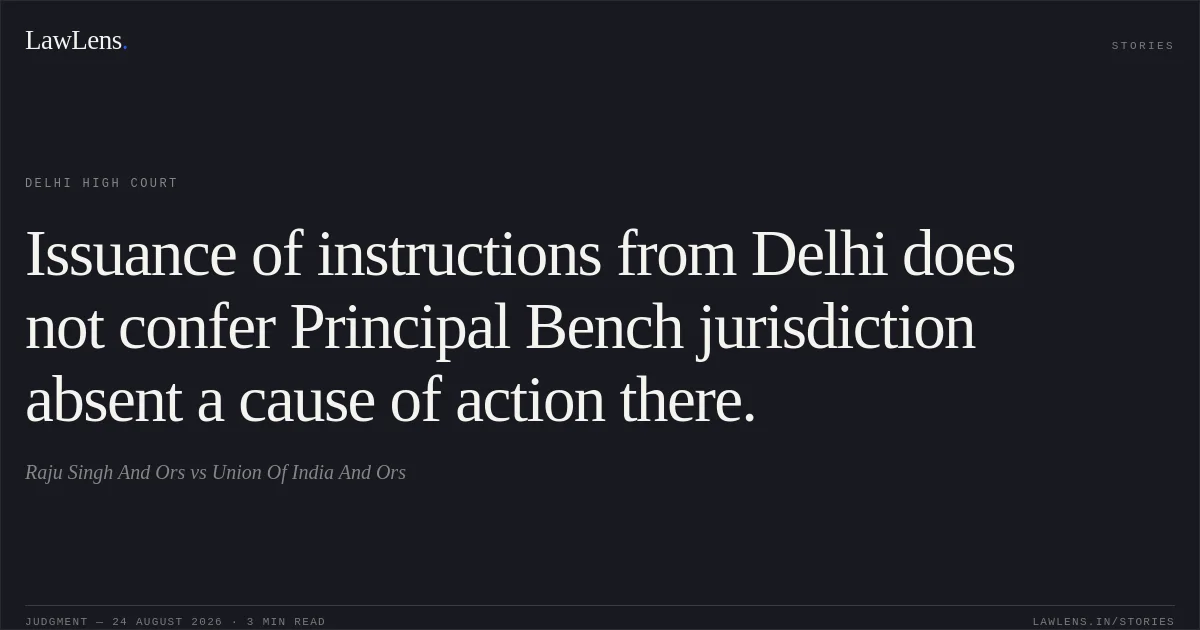
Source reference: p. 3, para. 10The Court further applied the principle that jurisdiction cannot be founded merely on the possibility that a superior authority located within the territorial jurisdiction may issue directions to an authority situated elsewhere.
Source reference: p. 4, para. 5Reasoning
The reliefs sought in the OA were directed to the preparation, normalization, and revision of the CBAT results and final merit list. These acts had been undertaken, and any directions would have had to be implemented, by the RRB, Chandigarh—not by any authority situated in Delhi.
Source reference: pp. 2–3; p. 4, para. 4Although the petitioners contended that the Railway Board at Delhi had issued the instruction relating to normalization, they acknowledged that the actual computation and normalization of marks were performed by the concerned RRB.
Source reference: p. 3, paras. 8–9Applying Kusum Ingots, the Court held that the mere issuance of the instruction from Delhi did not create a cause of action there, since the relevant question was where the instruction was implemented against the petitioners.
Source reference: p. 3, para. 10Accepting the petitioners’ broader argument would effectively permit every matter involving a subordinate authority to be filed before the Principal Bench merely because the concerned Ministry or superior authority was located in Delhi, irrespective of where the cause of action arose.
Source reference: p. 4, para. 5As all parties and the operative authorities were situated outside Delhi, the petitioners failed to establish territorial jurisdiction of the Principal Bench.
Source reference: p. 4, paras. 6–7Holding
The Delhi High Court held that the OA had been wrongly instituted before the Principal Bench of the Tribunal because no material part of the cause of action arose within its territorial jurisdiction.
The writ petition was accordingly dismissed.
Source reference: p. 5, paras. 9–10The petitioners were granted liberty to initiate appropriate fresh proceedings before the competent Bench of the Tribunal, which, if approached, was directed to decide the matter uninfluenced by the impugned Tribunal order dated 13 April 2026, as that order had been rendered by a forum coram non judice and possessed no binding legal effect.
Source reference: p. 5, paras. 9–10Original Court PDF
Raju Singh And OrsvsUnion Of India And Ors
Click to open original judgment
Original judgment, available to read, download and summarize on LawLens.in