01Facts
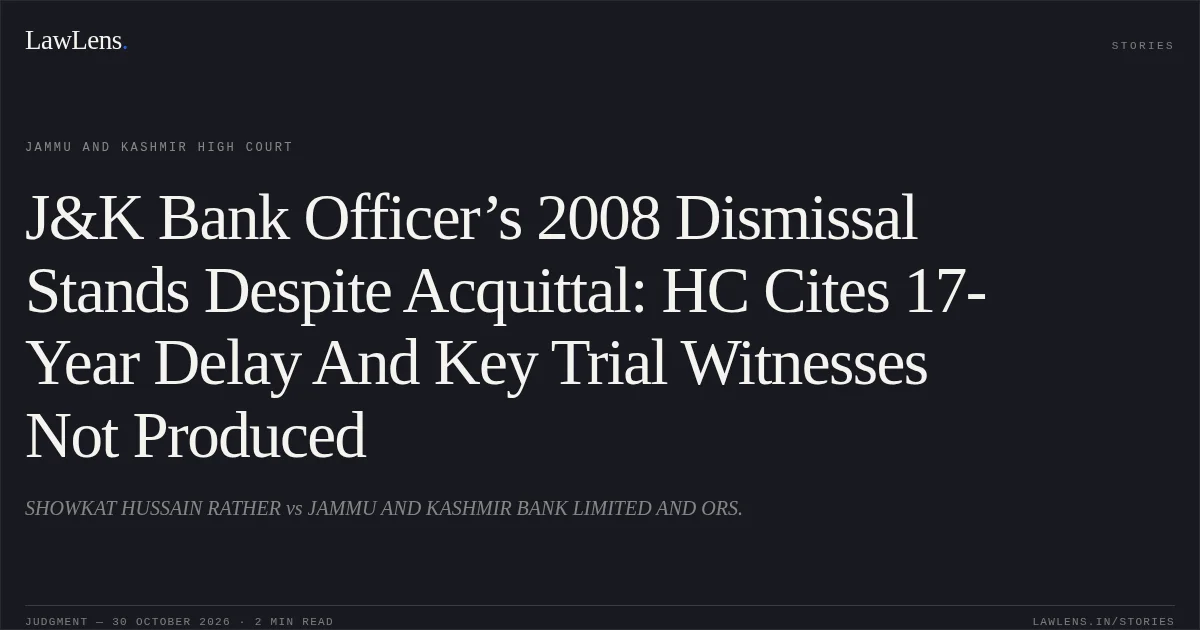
The petitioner, an Officer Scale-I, was dismissed from service on 15 March 2008 following a departmental inquiry into allegations involving fictitious loans against stolen fixed deposit receipts.
pp. 1–4 · ¶ 1–4He was also prosecuted in FIR No. 74/2005 under Sections 420, 467 and 409 RPC, and was acquitted on 26 November 2024.
pp. 1–4 · ¶ 1–4He then sought to quash the dismissal order and obtain salary and consequential service and post-retirement benefits.
pp. 1–4 · ¶ 1–4The Bank opposed the petition, relying on the completed inquiry, the petitioner’s participation in it, the delay in challenging the dismissal, and the distinct standards governing criminal and departmental proceedings.
pp. 1–4 · ¶ 1–4The Court identified the petitioner’s grounds as alleged procedural irregularity and bias in the inquiry, and the asserted conflict between the disciplinary findings and the criminal acquittal.
p. 5 · ¶ 802Issues
i.1. Whether the petitioner could challenge the departmental inquiry for procedural irregularity or bias after participating in it and waiting approximately 17 years to raise the challenge.
pp. 5–7 · ¶ 9ii.2. Whether the petitioner’s acquittal in the criminal case, on the same underlying allegations, invalidated the departmental findings or entitled him to consequential service benefits.
pp. 11–14 · ¶ 11–1403Law Applied
The Court relied on Union of India v. N. Murugesan, (2022) 2 SCC 25, for the principles that laches involve unreasonable delay and may be assessed by reference to the delay, the claimant’s conduct and prejudice to the opposing party.
pp. 5–11 · ¶ 9–10The Court relied on SBI v. M.J. James, (2022) 2 SCC 301, for the rule that an appeal or challenge must be brought within a reasonable time and that acquiescence and laches may bar relief in the circumstances of a case.
pp. 5–11 · ¶ 9–10On the effect of acquittal, the Court applied Southern Railway Officers Association v. Union of India, (2009) 9 SCC 24, and Karnataka Power Transmission Corpn. Ltd. v. C. Nagaraju, (2019) 10 SCC 367: acquittal does not, by itself, invalidate disciplinary punishment, because departmental proceedings have a distinct purpose and standard of proof, and the disciplinary authority is not necessarily bound by the criminal court’s findings.
pp. 11–12 · ¶ 11–12Provisions in the judgment · 3 · Linked ones open on LawLens
Indian Penal Code, 1860 Section 420Section 467Section 409
04Reasoning
The petitioner had participated in the departmental inquiry but waited approximately 17 years to challenge its procedure and allege bias. The Court therefore held that his challenge on those grounds was barred by gross delay and laches.
pp. 5–7 · ¶ 9As to the acquittal, the Court found that it resulted from deficiencies in the prosecution case, including the non-production or non-examination of key witnesses, rather than an exoneration that displaced the disciplinary findings.
pp. 11–14 · ¶ 11–14Applying the rule that criminal acquittal does not automatically set aside departmental action, the Court held that the acquittal did not establish that the disciplinary findings were unsustainable.
pp. 11–14 · ¶ 11–1405Holding
The Court answered both issues against the petitioner.
p. 14 · ¶ 15It held that the delayed procedural challenge could not be entertained and that the criminal acquittal did not invalidate the departmental findings or entitle the petitioner to the relief sought.
p. 14 · ¶ 15The writ petition was dismissed; any interim direction ceased to operate.
p. 14 · ¶ 15Original Court PDF
SHOWKAT HUSSAIN RATHERvsJAMMU AND KASHMIR BANK LIMITED AND ORS.
Click to open original judgment
Original judgment, available to read, download and summarize on LawLens.in