01Facts
Respondent No. 1, the plaintiff in the underlying suit, amended her plaint to seek declarations that certain powers of attorney and consequential sale deeds concerning the suit property were null and void, along with possession and injunctive relief.
pp. 3–4After the petitioners filed their written statement, the plaintiff sought leave under Order VIII Rule 9 CPC to reply to specified paragraphs concerning, among other matters, bona fide purchase, proceedings at Hoshiarpur, limitation, the effect of the amendment, Section 41 of the Transfer of Property Act, and the parties’ alleged status and relationship.
pp. 4–5, 11–14The Trial Court allowed the application.
pp. 1–3The petitioners challenged that order under Article 227, arguing that the replication introduced a new or inconsistent case and that the written statement raised no new facts requiring a reply.
pp. 1–302Issues
i.1. Whether the Trial Court could grant leave under Order VIII Rule 9 CPC for the plaintiff to file a replication in response to the specified pleas in the written statement.
pp. 9–10, 14–15ii.2. Whether the Trial Court’s order involved a jurisdictional error or miscarriage of justice warranting interference under Article 227 of the Constitution.
pp. 5–9, 14–1503Law Applied
Order VIII Rule 9 CPC permits subsequent pleadings with the Court’s leave; leave should not be granted mechanically.
pp. 9–10Under Sheikh Noorul Hassan v. Nahakkapam Indrajit Singh, 2024 INSC 391, a replication is not required merely to traverse the written statement and cannot introduce a new cause of action or a plea inconsistent with the original plaint; it may be allowed where needed to explain or clarify newly pleaded facts for a fair and effective trial.
pp. 9–10K. Laxman v. Thekkayil Padmini, (2009) 1 SCC 354, establishes that a replication, if permitted, forms part of the pleadings, but its absence does not amount to an admission of the written statement’s allegations.
p. 10Under Article 227, as explained in Shalini Shyam Shetty v. Rajendra Shankar Patil, (2010) 8 SCC 329, and Garment Craft v. Prakash Chand Goel, (2022) 4 SCC 181, the High Court exercises supervisory, not appellate, jurisdiction and intervenes sparingly for jurisdictional error, perversity, grave injustice, or comparable exceptional circumstances.
pp. 5–9Provisions in the judgment · 2 · Linked ones open on LawLens
Transfer of Property Act, 1882 Section 41
Code of Civil Procedure, 1908 Section 115
04Reasoning
The High Court examined the particular replies allowed by the Trial Court and found that, in most instances, the plaintiff was addressing matters raised in the written statement—such as the petitioners’ bona fide-purchaser plea, the Hoshiarpur proceedings, the effect of Section 41 of the Transfer of Property Act, and allegations concerning the parties’ status and relationships—rather than setting up an inconsistent case.
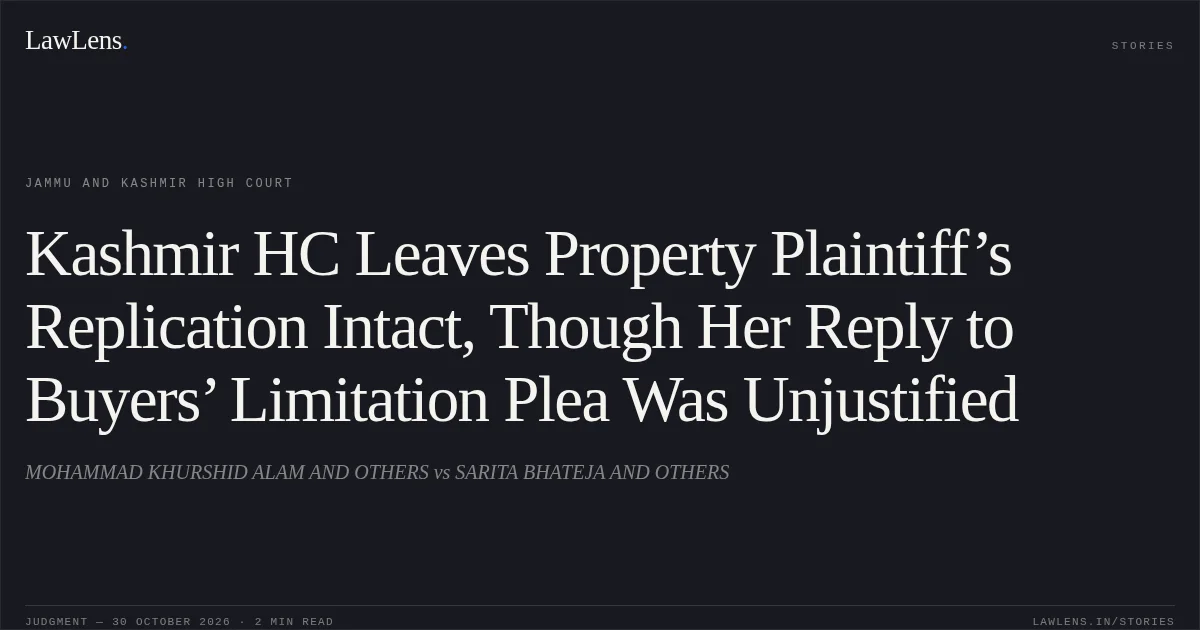
pp. 11–14However, leave to reply to the limitation plea was unjustified because a replication cannot be permitted merely to deny a defence.
p. 12The Court nevertheless concluded that this limited error neither caused a miscarriage of justice nor amounted to a jurisdictional error warranting Article 227 intervention.
pp. 14–1505Holding
The Court held that the Trial Court’s grant of leave was generally within the law, although leave to respond to the limitation plea ought not to have been granted.
pp. 14–15Finding no miscarriage of justice or jurisdictional error requiring supervisory intervention, the High Court dismissed the petition and did not set aside the impugned order.
p. 15Original Court PDF
MOHAMMAD KHURSHID ALAM AND OTHERSvsSARITA BHATEJA AND OTHERS
Click to open original judgment
Original judgment, available to read, download and summarize on LawLens.in