01Facts
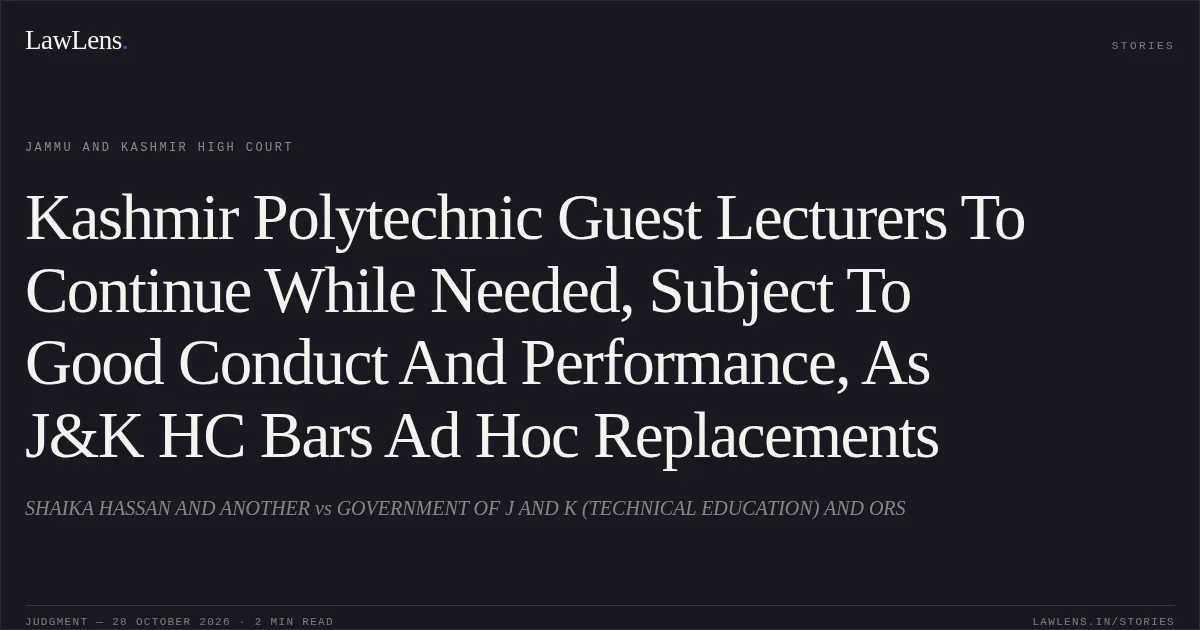
The petitioner was selected, following an advertisement, as a Guest Faculty member and Software Testing Assistant for the 2022–2023 academic session, on consolidated remuneration of ₹20,000 per month.
pp. 1–3He claimed that he continued to work and that the respondents proposed to replace him with another temporary appointee without conducting regular recruitment.
pp. 1–3The respondents maintained that his engagement was session-based, conferred no right to continuation, and had ended due to unsatisfactory performance.
pp. 3–4 · ¶ 8The Court noted counsel’s statement that the petitioner continued to work, supported by the attendance and monthly status records.
p. 7 · ¶ 2002Issues
i.Whether a temporary or ad hoc employee may be replaced by another employee engaged on a similar temporary basis, rather than through regular recruitment.
p. 1 · ¶ 1 · pp. 4–5 · ¶ 11–13ii.Whether the petitioner was entitled to continue as Guest Faculty while the institutional requirement persisted, subject to satisfactory conduct and performance.
pp. 2–3 · ¶ 3 · p. 7 · ¶ 20–2103Law Applied
Articles 14 and 16 of the Constitution require fairness and non-arbitrariness in public employment; the absence of a fundamental right to appointment does not permit arbitrary State action.
p. 4 · ¶ 11Under Rattan Lal v. State of Haryana, (1985) 4 SCC 43, and State of Haryana v. Piara Singh, (1992) 4 SCC 118, an ad hoc or temporary employee should not be displaced by another ad hoc or temporary employee.
pp. 5–6 · ¶ 14–16Hargurpratap Singh v. State of Punjab, (2007) 13 SCC 292, supports continuation of temporary employees until regular incumbents are appointed, without conferring a right to regular appointment.
pp. 5–6 · ¶ 14–16Manish Gupta v. President, Jan Bhagidari Samiti, 2022 SCC OnLine SC 485, reaffirmed that a temporary employee may be replaced by a regularly selected candidate, not by another temporary appointee.
pp. 6–7 · ¶ 17–1904Reasoning
The Court treated the petitioner’s engagement as temporary but found that the claimed ongoing work was supported by attendance records and counsel’s statement.
p. 7 · ¶ 20Applying the Supreme Court authorities, it held that replacing him with another temporary appointee, while the need for the work continued, would be inconsistent with the requirement of non-arbitrary public employment under Articles 14 and 16.
pp. 6–7 · ¶ 17–21The respondents remained free to fill the post through a formal, regular selection process, and continuation was made conditional on the continuing requirement and the petitioner’s satisfactory conduct and performance.
p. 8 · ¶ 21–2305Holding
The petition was allowed.
p. 8 · ¶ 21The respondents were directed to permit the petitioner to continue as Software Testing Assistant, with existing benefits under the rules, for as long as the requirement existed and subject to satisfactory conduct and performance; they were restrained from replacing him through a similar ad hoc or contractual arrangement.
p. 8 · ¶ 21The respondents could fill the post through regular selection, and the judgment conferred no automatic right to regularization.
p. 8 · ¶ 22–23Original Court PDF
MANZOOR AHMAD SHEIKHvsUNION TERRITORY OF J AND K AND ORS (TECHNICAL EDUCATION)
Click to open original judgment
Original judgment, available to read, download and summarize on LawLens.in