01Facts
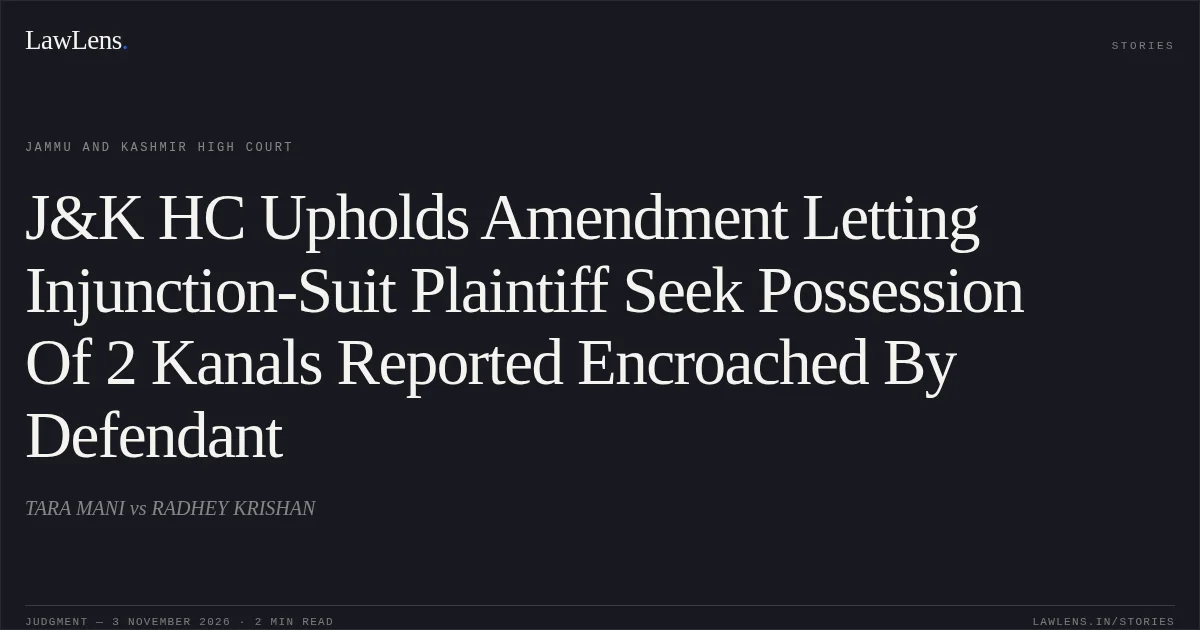
The respondent-plaintiff filed a suit for permanent prohibitory injunction, claiming co-ownership and possession of land in Khasra Nos. 1204 and 1205 and alleging that the petitioner-defendant threatened to encroach upon it.
p. 2The defendant denied any encroachment and asserted ownership and possession of adjoining land.
pp. 2–3At the defendant’s request, a Local Commissioner inspected the site and reported encroachment on portions of the suit land.
p. 3Before trial commenced, the plaintiff sought to amend the plaint to claim recovery of possession of those portions.
p. 3The trial Court allowed the amendment, and the defendant challenged that order under Article 227, contending that it changed the nature and character of the suit.
pp. 3–402Issues
i.Whether the amendment seeking recovery of possession of allegedly encroached portions of the suit property fundamentally altered the nature or character of the original injunction suit.
pp. 4–6 · ¶ 7, 12–13ii.Whether the trial Court’s order allowing the amendment warranted interference under Article 227 of the Constitution.
p. 6 · ¶ 1403Law Applied
Order VI Rule 17 of the Code of Civil Procedure empowers a court to permit amendments necessary to determine the real questions in controversy; after commencement of trial, the applicant must also show that, despite due diligence, the matter could not have been raised earlier.
pp. 4–5 · ¶ 9Courts generally adopt a liberal approach to amendments, but may refuse one that causes irreparable prejudice, withdraws an admission, introduces a time-barred cause of action, or fundamentally changes the suit’s basic structure or character.
p. 5 · ¶ 10In Sampath Kumar v. Ayyakannu, (2002) 7 SCC 559, the Supreme Court held that changing the relief from injunction to possession in a dispute concerning the same property does not, by itself, fundamentally alter the suit; requiring a fresh suit may cause unnecessary delay and waste judicial time.
p. 6 · ¶ 1204Reasoning
The amendment arose from the Local Commissioner’s report, which identified portions of the same suit property as allegedly encroached upon, and sought possession only of those portions.
pp. 5–6 · ¶ 11Because the amendment concerned the same property and dispute as the original injunction action, the Court held that adding a possession claim did not fundamentally alter the suit’s character.
p. 6 · ¶ 13The amendment was allowed before trial commenced, and the trial Court’s decision disclosed no perversity or illegality warranting supervisory interference.
pp. 6–7 · ¶ 13–1405Holding
The Court answered that the proposed amendment did not change the basic structure or character of the suit and that the trial Court’s order did not warrant interference under Article 227.
p. 7 · ¶ 14Finding no merit in the petition, the High Court dismissed it.
p. 7 · ¶ 15Original Court PDF
TARA MANIvsRADHEY KRISHAN
Click to open original judgment
Original judgment, available to read, download and summarize on LawLens.in