Facts
The Plaintiffs (Respondents herein) filed a suit for recovery of possession, permanent injunction, and mesne profits regarding property T-38/1, Kalu Sarai, Hauz Khas.
Source reference: p. 2The Plaintiffs claimed sole ownership via a registered Sale Deed dated 28.01.1971, asserting they permitted the Defendants (Appellants herein/real brothers) to reside there as licensees out of love and affection.
Source reference: p. 3-4The Defendants contested this, claiming the property was purchased using the terminal benefits of their deceased father, Sh. Sarju Ram, and that they were joint owners.
Source reference: p. 5-6Alternatively, they pleaded acquisition of title via adverse possession, having lived there for over 42 years.
Source reference: p. 6The Trial Court decreed the suit in favor of the Plaintiffs on 17.12.2024.
Source reference: p. 2Issues
1. Whether the Plaintiffs purchased the suit property using their independent funds and held absolute title.
Source reference: p. 9 / para. 312. Whether the Defendants established a claim of ownership through adverse possession.
Source reference: p. 9 / para. 313. Whether the suit was barred by the period of limitation under Article 65 of the Limitation Act.
Source reference: p. 9 / para. 45Law Applied
The court applied Section 96 of the Code of Civil Procedure, 1908, regarding first appeals.
Source reference: p. 2It relied on Article 65 of the Limitation Act, 1963, which stipulates a 12-year limitation for possession based on title, beginning when the defendant's possession becomes adverse.
Source reference: p. 21The court invoked the doctrine of nec vi, nec clam, nec precario (possession must be peaceful, open, and continuous) as clarified in S.M. Karim v. Mst. Bibi Sakina and Karnataka Board of Wakf v. Govt. of India, emphasizing that the claimant must prove the specific date when possession turned hostile.
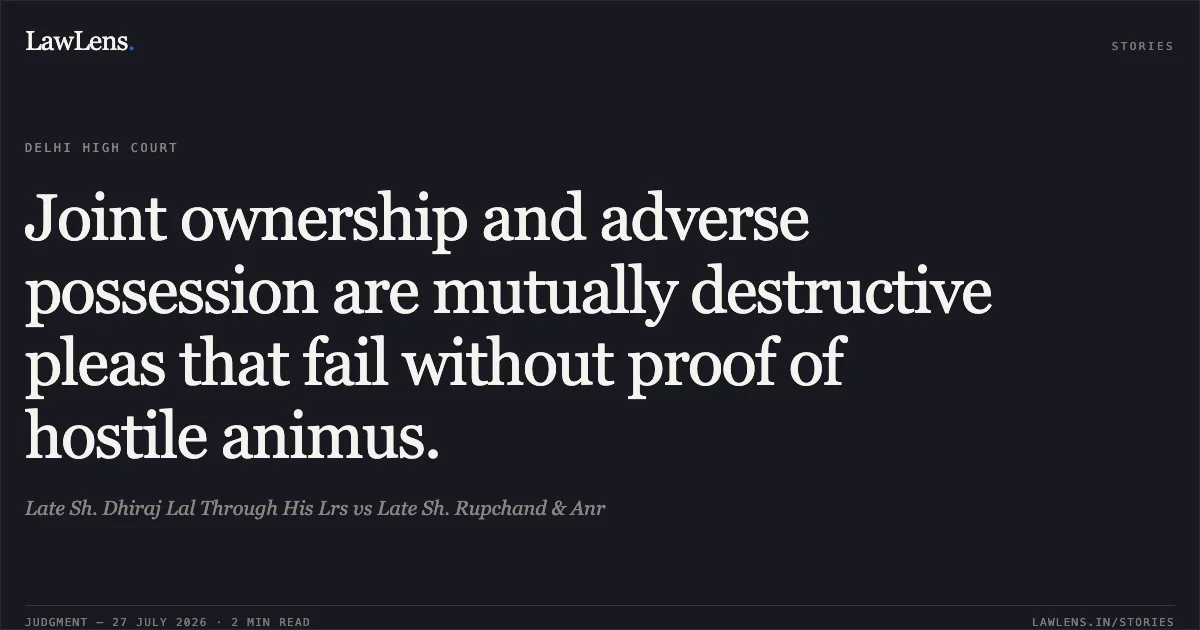
Source reference: p. 20, 22-24It further applied the principle from Narasamma v. A. Krishnappa that pleas of joint title and adverse possession are mutually destructive.
Source reference: p. 26Reasoning
The Court found that the Plaintiffs proved sole ownership through the registered Sale Deed and bank records showing a housing loan taken in 1971.
Source reference: p. 16Conversely, the Defendants failed to evidence that the father’s terminal benefits (a mere Rs. 1,620.77 received in 1963) were used for the Rs. 14,000 purchase in 1971.
Source reference: p. 17-18Regarding adverse possession, the Court noted the Defendants’ possession was "permissive user" (licensees).
Source reference: p. 20The Defendants failed to provide a specific date when their animus changed from permissive to hostile; mere long stays or payment of utility bills do not constitute adverse possession.
Source reference: p. 27-28Furthermore, their claim of being "joint owners" legally precluded a claim of "adverse possession" as one cannot hold adversely against oneself.
Source reference: p. 28The limitation period only began in 2012 when the license was revoked via legal notice.
Source reference: p. 28Holding
The High Court dismissed the appeal and upheld the Trial Court's decree.
The Court held that the Plaintiffs were the absolute owners and the suit was filed within the limitation period following the termination of the license in 2012.
Source reference: p. 28-29The Defendants failed to prove either joint ownership or the essential ingredients of adverse possession.
Source reference: p. 28The Plaintiffs were held entitled to possession and mesne profits as quantified by the lower court.
Source reference: p. 12Acts & Sections Cited
4 provisions across 3 statutes referred to in this judgment. Each provision opens on LawLens.
Code of Civil Procedure, 19082
Limitation Act, 19631
Administrators-General Act, 19631
Original Court PDF
Late Sh. Dhiraj Lal Through His LrsvsLate Sh. Rupchand & Anr
Click to open original judgment
Original judgment, available to read, download and summarize on LawLens.in