Facts
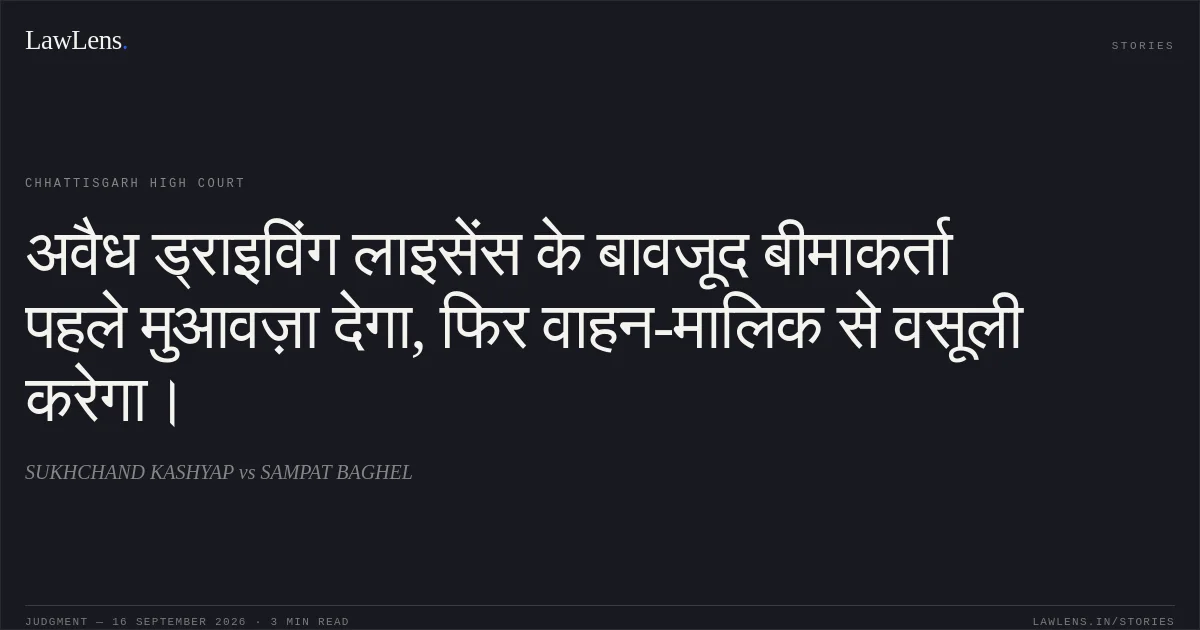
On the night of 10–11 October 2018, Halधर Baghel was walking with his friends when he was struck by a motorcycle bearing registration No. CG-04-KP-2757, allegedly driven rashly and negligently by the appellant, Sukhchand Kashyap. Halधर sustained serious injuries and died while being taken to the hospital. A criminal case was registered and a charge-sheet was filed in relation to the accident.
Source reference: paras. 2–3; pp. 2–3The deceased’s parents, Sampat Baghel and Smt. Dayamati Baghel, filed a claim petition under Section 166 of the Motor Vehicles Act, 1988. The Motor Accident Claims Tribunal awarded compensation of ₹12,55,000 with interest at 9% per annum against the appellant, who was found to be the driver and registered owner of the offending vehicle. The insurer, Iffco Tokio General Insurance Co. Ltd., was exonerated after the Tribunal found that the appellant did not possess a valid driving licence at the time of the accident.
Source reference: para. 1; p. 2The appellant challenged the Tribunal’s finding, contending that a photocopy of his driving licence had been produced and that the insurer had failed to prove that the licence was invalid or that any policy condition had been breached.
Source reference: para. 4; p. 3The claimants supported the award, while the insurer opposed the appeal and relied on the finding that the driver lacked a valid licence.
Source reference: paras. 5–6; pp. 3–4Issues
Whether the Tribunal was justified in holding that the appellant did not possess a valid driving licence at the time of the accident and in fastening liability upon him as the driver and owner of the offending vehicle?
Source reference: paras. 4, 8–9; pp. 3–5Whether the insurer was rightly exonerated from primary liability on account of breach of the insurance policy condition relating to possession of a valid driving licence?
Source reference: paras. 3–6, 9; pp. 3–5Whether the insurer should nevertheless be directed to first pay the compensation to the claimants and recover it from the driver-owner under the “pay and recover” principle?
Source reference: para. 10; p. 5Law Applied
The Court applied Sections 166 and 173 of the Motor Vehicles Act, 1988, governing claims for compensation arising from motor accidents and appeals against awards of the Claims Tribunal.
Source reference: para. 1; p. 2Under the terms of a motor insurance policy, the insurer may avoid or be exonerated from ultimate liability where the vehicle was driven in breach of the policy condition requiring the driver to possess a valid and effective driving licence.
Source reference: no citationThe Court further relied on Amrit Paul Singh v. Tata AIG General Insurance Co. Ltd., (2018) 7 SCC 558, applying the “pay and recover” principle, under which the insurer may be directed to satisfy the award in the first instance and thereafter recover the amount from the driver and owner responsible for the policy breach.
Source reference: para. 10; p. 5Reasoning
The Court found that the appellant had produced only a photocopy of an alleged driving licence and had neither produced the original licence nor offered a satisfactory explanation for its non-production. He also failed to plead clearly before the Tribunal that he possessed a valid licence or to disclose its number, and he did not lead evidence on the issue despite appearing as a witness.
Source reference: para. 8; p. 4In contrast, the insurer summoned officials from the District Transport Office, who established that the alleged licence had not been issued by that office.
Source reference: para. 9; p. 5The Court therefore upheld the finding that the appellant had no valid driving licence at the time of the accident, constituting a breach of the policy condition.
Source reference: para. 9; p. 5Since the appellant was both the driver and registered owner, liability was properly fastened upon him.
Source reference: para. 9; p. 5However, because the vehicle was insured and the accident claimants had already obtained an award, the Court applied the pay-and-recover principle recognized in Amrit Paul Singh.
Source reference: paras. 9–10; p. 5Holding
The appeal was dismissed. The Court upheld the Tribunal’s award of ₹12,55,000 with 9% annual interest and affirmed that the appellant, Sukhchand Kashyap, was ultimately liable as the driver and owner of the offending vehicle.
The insurer was directed to first pay the awarded compensation to the claimants and was granted liberty to recover the amount from the appellant in accordance with law through appropriate proceedings before the Claims Tribunal.
Source reference: para. 10; p. 6The Tribunal’s record was directed to be returned for necessary compliance.
Source reference: para. 12; p. 6Original Court PDF
SUKHCHAND KASHYAPvsSAMPAT BAGHEL
Click to open original judgment
Original judgment, available to read, download and summarize on LawLens.in