01Facts
The petitioner, the informant in FIR No. 349 of 2012 (lodged 16.10.2012 under Section 302 IPC at P.S. Kotwali, Dehradun against unknown persons), alleged the murder of his wife.
¶ 2The High Court transferred the investigation to the CBI on 03.01.2013 in Criminal Writ Petition No. 1215 of 2012.
¶ 2The CBI filed a charge-sheet on 08.11.2013.
¶ 3The Special Judicial Magistrate rejected the petitioner's plea for further investigation on 13.02.2014, but the District and Sessions Judge set that order aside in Revision No. 158 of 2014 on 15.11.2014.
¶ 4–5Further investigation commenced on 22.01.2015, and the CBI's supplementary report of 31.07.2015 found no evidence against Shamim Alam Khan and others.
¶ 6The trial court dismissed the petitioner's Section 319 CrPC application to summon Shamim Alam Khan on 01.03.2016.
¶ 7The High Court, in Criminal Revision No. 79 of 2016, issued notice and deferred cross-examination of PW1.
¶ 8Supplementary investigation into bank accounts and mobile locations was completed on 23.01.2016.
¶ 9By the impugned order dated 26.08.2016 in Sessions Trial No. 36 of 2014, the trial court directed examination of witnesses other than PW1 and ordered further investigation against Constable Naveen Chandra. It also recorded that it had become functus officio regarding Shamim Alam Khan.
¶ 9The petitioner filed this writ under Article 226 seeking certiorari against that order, prohibition against further evidence recording, a fresh or SIT-supervised investigation, protection, and compensation.
¶ 1At the threshold, the CBI objected that a writ of certiorari does not lie against a judicial order.
¶ 1202Issues
i.1. Whether a writ petition under Article 226 of the Constitution is maintainable against a judicial order passed by a criminal trial court in Sessions Trial No. 36 of 2014.
¶ 26ii.2. Whether the ancillary reliefs (fresh investigation, SIT, monitoring, protection, and compensation) have an independent cause of action that can sustain the writ, or are merely a means of challenging the judicial order.
¶ 22, 3303Law Applied
Article 226 of the Constitution confers a plenary but discretionary writ power. The rule that alternative statutory remedies ordinarily bar writ jurisdiction is one of policy and discretion, not law, and is subject to exceptions (fundamental rights, natural justice, lack of jurisdiction, vires), as laid down in Godrej Sara Lee Ltd., State of U.P. v. Mohd. Nooh, and Whirlpool Corporation v. Registrar of Trade Marks.
¶ 13–16Naresh Shridhar Mirajkar v. State of Maharashtra (nine-Judge Bench) holds that a judicial order of a competent court cannot violate a fundamental right.
¶ 18–20, 31Radhey Shyam v. Chhabi Nath holds that judicial orders of civil courts are not amenable to certiorari under Article 226, and that Article 227 is the distinct remedy.
¶ 20Neeta Singh v. State of U.P. extends that principle to criminal courts: if a civil court's judicial order cannot be challenged under Article 226, a criminal court's order cannot either, a fortiori.
¶ 19, 31Rikhab Chand Jain v. Union of India holds that refusal to entertain a writ is the rule where the statutorily designated forum is the High Court itself.
¶ 21Statutory remedies lie under the CrPC and BNSS, and supervisory jurisdiction lies under Article 227.
¶ 30, 34–35Provisions in the judgment · 2 · Linked ones open on LawLens
Indian Penal Code, 1860 Section 302
Code of Criminal Procedure, 1973 Section 319
04Reasoning
The three binding authorities (Neeta Singh, Radhey Shyam, Mirajkar) squarely govern the maintainability question.
¶ 31The petitioner's reliance on Mohd. Nooh and Whirlpool was found unpersuasive. The CBI argued that Mohd. Nooh arose from departmental proceedings and was not authority for amenability of judicial orders.
¶ 23, 28The Court relied instead on the later nine-Judge decision in Mirajkar, as clarified in Radhey Shyam, which governs on this point.
¶ 32On the second issue, the Court compared the prayers with the petitioner's applications 200-B and 208-B in the trial court. It found that the third prayer was "almost identical" to those applications and concluded that the writ, as a whole, was a challenge to the judicial order, and that the other prayers were framed in different language to bring the challenge within Article 226. The ancillary reliefs were therefore treated as lacking independent cause of action.
¶ 33The judgment does not separately examine whether any Whirlpool exception (fundamental rights, natural justice, lack of jurisdiction) applied to the impugned order. The Court's reasoning rests on the categorical bar for judicial orders rather than on an exception analysis.
The Court limited its findings to maintainability and left all merits open.
¶ 3505Holding
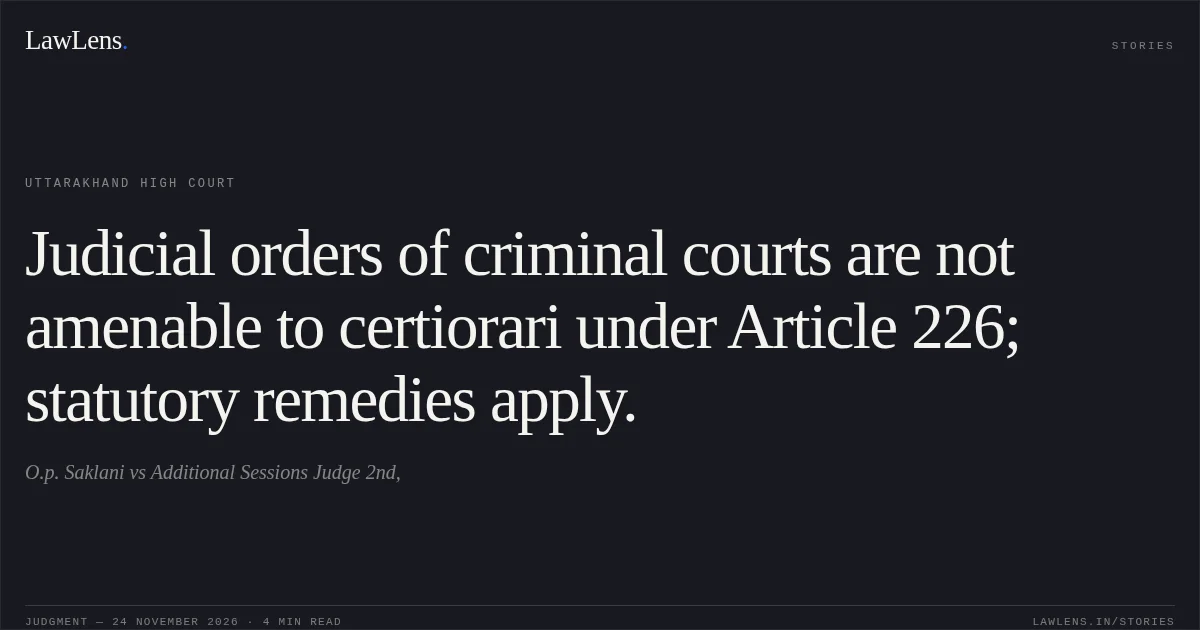
A writ of certiorari under Article 226 is not maintainable against a judicial order passed by a criminal court, and judicial orders of criminal courts cannot be assailed in writ jurisdiction.
¶ 34, 36The writ petition was dismissed as not maintainable, with liberty granted to the petitioner to pursue the appropriate remedies under the CrPC/BNSS, if so advised, and with all contentions on merits expressly kept open.
¶ 35–36Original Court PDF
O.p. SaklanivsAdditional Sessions Judge 2nd,
Click to open original judgment
Original judgment, available to read, download and summarize on LawLens.in