Facts
The Appellant, a juvenile, was apprehended during a police raid at the house of co-accused Hasnain Thakur
Source reference: p. 1The prosecution alleged that the Appellant was an associate of a drug syndicate engaged in preparing and selling pouches of 'charas' and 'smack' at the Indo-Nepal border
Source reference: p. 2-3While 208g of smack and 1092g of charas were recovered from the premises, no contraband was found on the Appellant's person
Source reference: p. 2, 19The Children’s Court rejected the Appellant’s bail on 03.11.2025, citing a risk of "bad association" and "moral danger"
Source reference: p. 1-2The Appellant challenged this order, asserting a clean criminal record and a Social Investigation Report (SIR) that showed he assisted his parents in their vegetable shop
Source reference: p. 3Issues
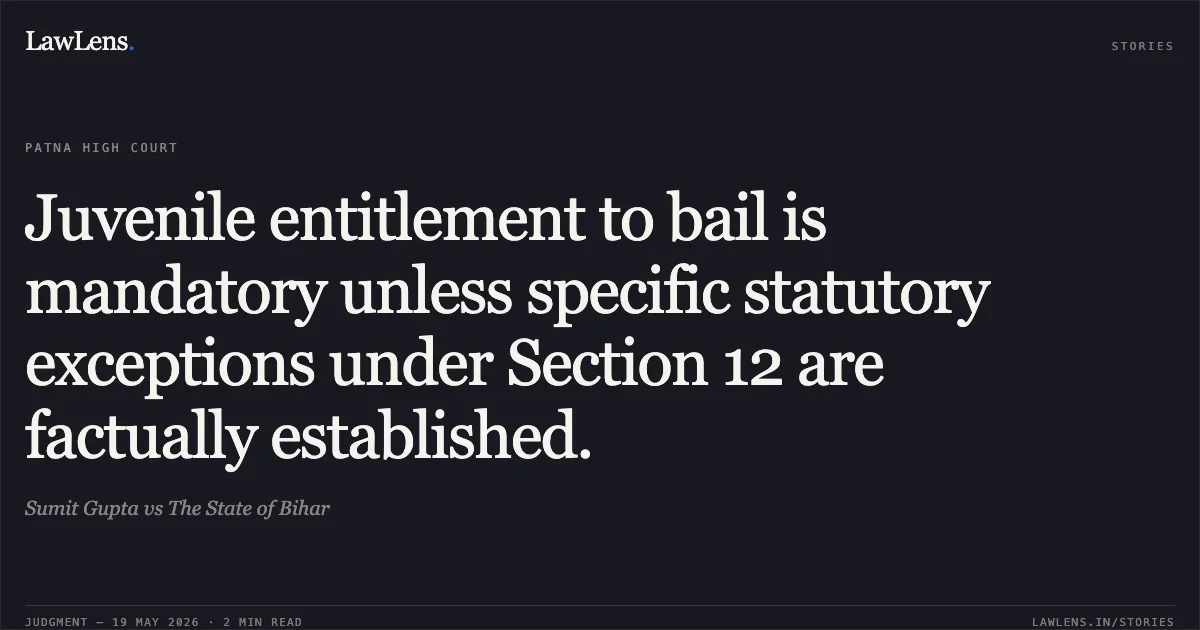
1. Whether a juvenile in conflict with law (CICL) can be denied bail solely based on the seriousness of the offence or without specific material evidence satisfying the exceptions under the proviso to Section 12(1) of the J.J. Act.
Source reference: p. 4-102. Whether the "ends of justice" in the context of the Juvenile Justice Act implies punitive detention or the child's reformation and rehabilitation.
Source reference: p. 12-15Law Applied
Section 12 of the Juvenile Justice (Care and Protection of Children) Act, 2015, which mandates that a juvenile "shall" be released on bail notwithstanding the CrPC, unless release brings them into association with known criminals, exposes them to danger, or defeats the ends of justice
Source reference: p. 4-5Juvenile in Conflict with Law v. State of Rajasthan (2024), which held that bail is the rule and refusal must be supported by clear findings on the proviso
Source reference: p. 5-6Lalu Kumar @ Lal Babu v. State of Bihar (2019), establishing that the gravity of the offence is irrelevant for juvenile bail
Source reference: p. 8The "Principle of Best Interest" and "Principle of Institutionalization as a last resort" under Section 3 of the J.J. Act
Source reference: p. 13-16Reasoning
The Court observed that the lower court rejected bail mechanically based on the nature of the recovery from co-accused persons rather than the Appellant’s individual circumstances
Source reference: p. 11, 20It reasoned that "ends of justice" under the J.J. Act must be interpreted in favor of the child’s welfare and rehabilitation rather than as a punitive measure
Source reference: p. 12-15Applying the specific facts, the Court noted that the SIR confirmed the Appellant had no criminal antecedents and was helping his parents earn a livelihood, contradicting the lower court’s assumption of "bad association"
Source reference: p. 19-20The Court held that since the family is the primary institution for reformation, the Appellant's right to be reunited with his family outweighed institutionalization
Source reference: p. 16, 20Holding
The Court answered that the seriousness of the offence cannot be a ground to deny bail under Section 12 of the J.J. Act
The appeal was allowed, and the impugned order dated 03.11.2025 was set aside; the appellant was ordered to be released on a bail bond of Rs. 10,000/- with an undertaking from his father to ensure his welfare and prevent contact with criminals
Source reference: p. 20-21Acts & Sections Cited
10 provisions across 2 statutes referred to in this judgment. Each provision opens on LawLens.
Narcotic Drugs and Psychotropic Substances Act, 19855
Juvenile Justice (Care and Protection of Children) Act, 2015.5
Original Court PDF
Sumit GuptavsThe State of Bihar
Click to open original judgment
Original judgment, available to read, download and summarize on LawLens.in