Facts
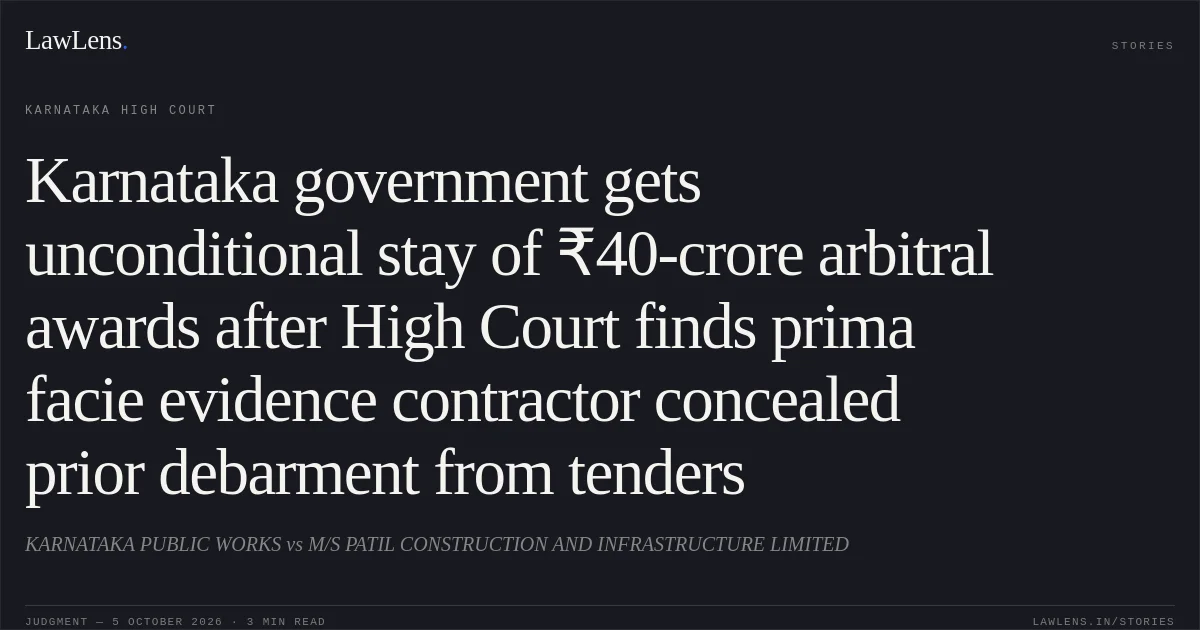
The Karnataka Public Works, Ports and Inland Water Transport Department awarded the respondent twelve contracts, dated 21 April 2012, for works in Belagavi.
Source reference: para. 2–5The Department later challenged the arbitral awards, aggregating approximately ₹40 crore, under Section 34 of the Arbitration and Conciliation Act, 1996.
Source reference: para. 2–5It sought unconditional stay under the second proviso to Section 36(3), alleging that the respondent had failed to disclose a Ministry of Road Transport and Highways communication dated 13 May 2011 debarring it from specified tenders for three years.
Source reference: para. 6–7, 13–14In an earlier round, the High Court directed the Section 34 court to determine whether the respondent knew of that communication when applying for and obtaining the contracts.
Source reference: para. 15On remand, the Section 34 court found no prima facie proof of such knowledge and stayed the awards only on condition that the Department deposit 25% of the award amounts.
Source reference: para. 16The Department challenged those orders.
Source reference: no citationThe High Court noted that the respondent’s pleadings before the Bombay High Court showed receipt of the communication by 19 and 24 May 2011, before the tender notification of 30 July 2011; the contracts were awarded after the respondent had filed its Bombay proceedings.
Source reference: para. 18–20Issues
Whether the respondent knew of the 13 May 2011 debarment communication when it applied for and obtained the contracts, such that its failure to disclose it could support a prima facie case of fraud.
Source reference: para. 12, 19–22Whether the Department had made out a prima facie case that the contract was induced or affected by fraud, warranting unconditional stay of the awards under the second proviso to Section 36(3).
Source reference: para. 27, 31–32Law Applied
Section 36(3) of the Arbitration and Conciliation Act, 1996 permits a court to stay an arbitral award subject to conditions, having due regard, for money awards, to the principles governing stays of money decrees under the Code of Civil Procedure, 1908.
Source reference: para. 27Under the second proviso to Section 36(3), where the court is satisfied that a prima facie case exists that the arbitration agreement or contract forming the basis of the award, or the making of the award, was induced or affected by fraud or corruption, the court must grant an unconditional stay pending the Section 34 challenge.
Source reference: para. 27Section 17 of the Indian Contract Act, 1872 includes active concealment of a fact known to a party and recognises that silence may amount to fraud where the circumstances impose a duty to speak.
Source reference: para. 29The tender condition also required that a tenderer not be under a declaration of ineligibility for corrupt or fraudulent practices.
Source reference: para. 21Reasoning
The respondent’s own Bombay High Court pleadings referred to representations made in May 2011 concerning the debarment communication, establishing that it had received the communication before the Department’s tender notification.
Source reference: para. 18–19By the time the contracts were awarded in April 2012, the respondent had also commenced proceedings concerning that communication; the High Court considered it incumbent on the respondent to disclose the matter, particularly given the tender’s ineligibility condition.
Source reference: para. 20–22The Bombay High Court’s subsequent treatment of the communication as a show-cause notice did not, in the High Court’s view, negate the fact that the respondent had been declared ineligible when it obtained the contracts.
Source reference: para. 23–26The Department had raised the alleged fraud in its arbitral objections, but the award did not appear to frame or decide an issue on it.
Source reference: para. 30–31Taken together, these circumstances established a prima facie element of fraud sufficient for the limited purpose of applying the second proviso to Section 36(3), without deciding whether fraud was ultimately proved.
Source reference: para. 32–35Holding
The High Court allowed the petitions and set aside the orders requiring the Department to deposit 25% of the award amounts as a condition of stay.
The Department’s applications under the second proviso to Section 36(3) were allowed, and the Section 34 court was directed to proceed on the merits without insisting on a deposit as a condition for considering those applications.
Source reference: para. 36(iii)–(iv)The Court clarified that its observations were confined to the stay applications and must not influence the Section 34 court’s independent determination of fraud on the merits; all parties’ contentions remained open.
Source reference: para. 33–35, 36(v)–(vi)Acts & Sections Cited
3 provisions across 2 statutes referred to in this judgment. Each provision opens on LawLens.
Arbitration and Conciliation Act, 19962
Indian Contract Act, 18721
Original Court PDF
KARNATAKA PUBLIC WORKSvsM/S PATIL CONSTRUCTION AND INFRASTRUCTURE LIMITED
Click to open original judgment
Original judgment, available to read, download and summarize on LawLens.in