01Facts
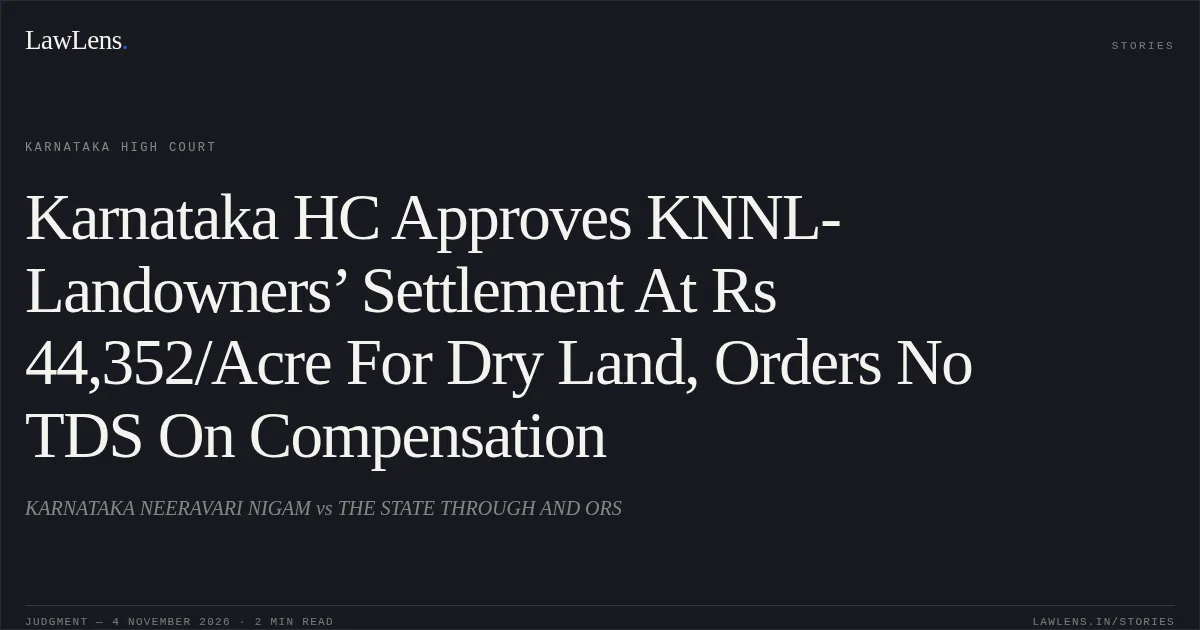
Karnataka Neeravari Nigam (KNNL), the beneficiary of the land acquisition, petitioned under Articles 226 and 227 challenging the First Appellate Court’s judgment and award dated 9 January 2015.
pp. 1–2 · ¶ 2KNNL contended that it had not been impleaded before that court.
pp. 1–2 · ¶ 2During the writ proceedings, the dispute was referred to mediation, and the parties filed a settlement agreement setting out the compensation and related terms.
pp. 3–7 · ¶ 3The State had, in principle, consented to the settlement, and the authorized Land Acquisition Officer had signed it; the Deputy Commissioner had not.
p. 7 · ¶ 6–702Issues
i.Whether the Court should accept the parties’ mediation agreement and dispose of the writ petition in accordance with its terms.
pp. 3–7 · ¶ 3–7ii.Whether payments under the agreement should be made without deduction of tax at source.
p. 8 · ¶ 803Law Applied
The Court relied on Section 89 of the Code of Civil Procedure, 1908, read with Order XXIII Rule 3 CPC, under which a qualifying settlement may be recorded as a lawful compromise and embodied in a decree.
p. 8 · ¶ 9It also applied its earlier order in W.P. No. 102884/2025, dated 20 August 2025, which held that compensation awarded for compulsory acquisition of land was not subject to tax deduction at source under the applicable provisions of the Income Tax Act.
p. 8 · ¶ 8Provisions in the judgment · 1 · Linked ones open on LawLens
Code of Civil Procedure, 1908 Section 89
04Reasoning
The Court accepted the settlement after noting that the dispute was principally between KNNL, as beneficiary, and the land loser, and that the State had consented to it in principle.
p. 7 · ¶ 6–7Because the authorized Land Acquisition Officer had signed the agreement, the Court dispensed with the Deputy Commissioner’s signature.
p. 7 · ¶ 6–7Addressing the claimants’ concern about TDS, the Court applied its earlier ruling and directed that payments under the agreement be made without TDS.
p. 8 · ¶ 8It did not determine the merits of KNNL’s challenge to the appellate award; the settlement governed the disposition.
05Holding
The Court accepted the mediation agreement and disposed of the writ petition in its terms.
p. 9 · ¶ 10It directed that payments be made without deduction of tax at source.
p. 8 · ¶ 8It declared the agreement a lawful settlement under Section 89 CPC read with Order XXIII Rule 3 CPC, and directed the concerned courts to draw up a decree in its terms within 60 days of receiving a certified copy of the order.
pp. 8–9 · ¶ 9The settlement was to operate in substitution for any award, judgment, or decree of the Reference Court or Appellate Court.
p. 8 · ¶ 9Original Court PDF
KARNATAKA NEERAVARI NIGAMvsTHE STATE THROUGH AND ORS
Click to open original judgment
Original judgment, available to read, download and summarize on LawLens.in