01Facts
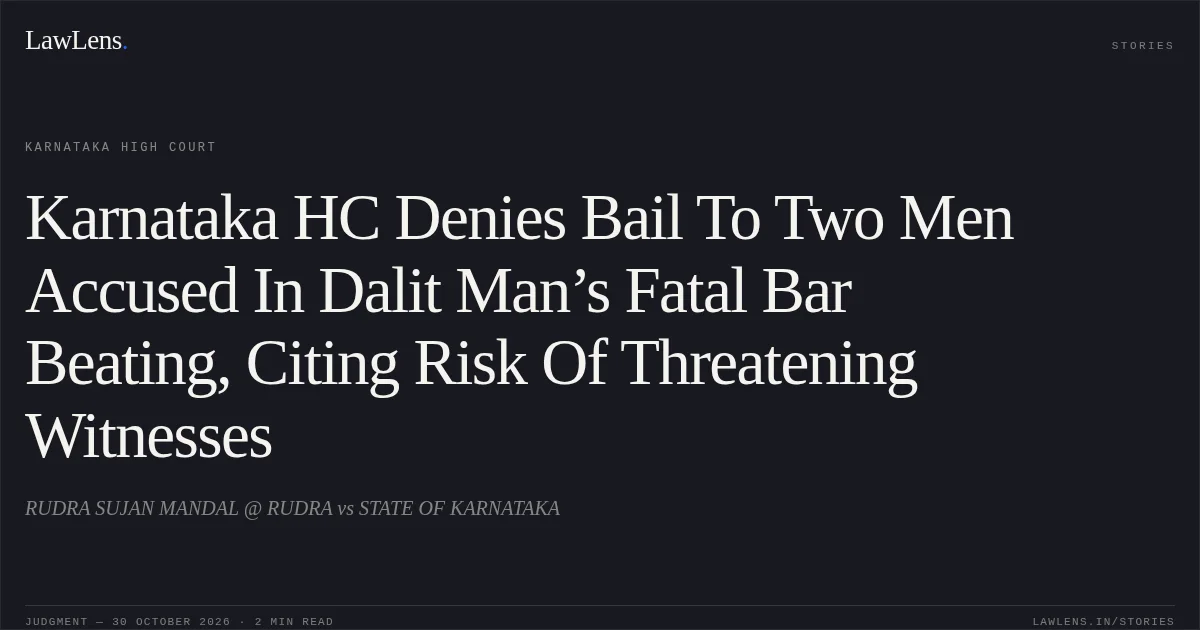
The appellants, accused Nos. 1 and 2 in Special Case No. 48/2026, appealed under Section 14A(2) of the SC/ST (Prevention of Atrocities) Act against the order dated 22 July 2026 refusing them bail.
¶ 1–3, 8They were arrested on 21 January 2026 and charged, following investigation, with offences under Sections 103(1), 127(1), 238 and 3(5) of the Bharatiya Nyaya Sanhita, 2023, and Section 3(2)(va) of the SC/ST Act
¶ 1–3, 8The appellants argued, among other things, that the alleged eyewitnesses had not described the assault in their statements and that accused No. 4 had been granted bail.
¶ 4–6, 9, 11The complainant opposed the appeals
¶ 4–6, 9, 1102Issues
i.Whether the appellants should be released on bail pending trial, having regard to the materials collected during the investigation and the circumstances relied on by the parties.
¶ 4–10ii.Whether the trial court’s stated ground that the investigation was complete was sufficient to warrant bail in the circumstances of the case.
¶ 1203Law Applied
Section 14A(2) of the SC/ST Act provides the appellate route invoked to challenge the bail order; Section 483 of the Bharatiya Nagarik Suraksha Sanhita, 2023, was the provision under which the appellants had sought bail before the trial court.
¶ 1, 3In considering bail, the High Court assessed the prima facie material, the seriousness of the alleged offences—including that they were punishable with death or imprisonment for life—and the possibility of interference with prosecution witnesses.
¶ 10, 12The complainant cited State of Karnataka v. Sri Darshan, Deepak Yadav v. State of U.P. and Mahipal v. Rajesh Kumar @ Polia, but the judgment does not set out or apply specific propositions from those decisions.
¶ 6Provisions in the judgment · 7 · Linked ones open on LawLens
Scheduled Castes and the Scheduled Tribes (Prevention of Atrocities) Act, 1989 Section 3
Bharatiya Nyaya Sanhita, 2023 Section 127Section 103Section 238Section 3
Bharatiya Nagarik Suraksha Sanhita, 2023 Section 483Section 183
04Reasoning
The Court considered the charge-sheet, witness statements, accused persons’ voluntary statements, CCTV footage and related mahazars, and found prima facie material against the appellants.
¶ 8–10It noted that the alleged eyewitnesses had not described the assault in their recorded statements, but had placed the deceased at the relevant location; the Court nevertheless concluded that the material as a whole disclosed a prima facie case.
¶ 9–10The grant of bail to accused No. 4 did not resolve the appellants’ applications, as the victim’s appeal against that grant remained pending.
¶ 11The Court held that completion of the investigation, without consideration of the merits, was not by itself a valid basis for bail given the gravity of the alleged offences and the risk of threats to or tampering with prosecution witnesses.
¶ 1205Holding
The High Court dismissed both appeals
¶ 12left in place the trial court’s refusal to grant bail to the appellants
¶ 12Original Court PDF
RUDRA SUJAN MANDAL @ RUDRAvsSTATE OF KARNATAKA
Click to open original judgment
Original judgment, available to read, download and summarize on LawLens.in