01Facts
The prosecution alleged that the appellant, Sannappa, abused and assaulted his wife, threatened her with a knife, and set her on fire on 22 September 2015.
pp. 2–6She suffered burns over 90–95% of her body and died on 28 September 2015.
pp. 2–6The prosecution relied principally on two statements recorded from her in hospital: Ex.P14, described as a dying declaration, and Ex.P15, on which the FIR was registered.
pp. 2–6The Sessions Court convicted the appellant under Sections 498-A, 302, 504, 323, 341 and 506 IPC.
pp. 2–6He appealed under Section 374(2) CrPC.
pp. 2–6The High Court noted concerns including the absence of the doctor’s signature on the statements, the lack of a fitness endorsement for Ex.P15, the non-production of hospital records, and the failure to examine two persons said to have been present when Ex.P14 was recorded.
pp. 17–2002Issues
i.Whether the prosecution proved beyond reasonable doubt that the appellant committed murder under Section 302 IPC, particularly in light of the doubts concerning Exs.P14 and P15?
pp. 9, 17–23ii.Whether the convictions for cruelty and the other offences under Sections 498-A, 341, 504, 323 and 506 IPC could be sustained on the evidence apart from the disputed statements?
pp. 23–2403Law Applied
The Court considered Section 302 IPC in assessing whether the prosecution had proved murder beyond reasonable doubt, and Sections 498-A, 341, 504, 323 and 506 IPC in reviewing the remaining convictions.
pp. 19–22It applied the principle that a dying declaration may be recorded by a police officer and is not inadmissible solely because it was not recorded by a Magistrate; however, its reliability must be assessed in light of the circumstances, and it is unsafe to rely on it where material doubts remain.
pp. 19–22Medical certification of fitness is not an indispensable legal requirement, but its absence may assume significance alongside other evidence raising doubt about the declarant’s condition.
pp. 19–22The Court also stated that last-seen evidence, by itself, is insufficient to sustain conviction unless the circumstances form a complete chain pointing to guilt and excluding reasonable hypotheses consistent with innocence.
pp. 19–22Under Section 65B of the Indian Evidence Act, 1872, the electronic recording could not be relied upon without the requisite certificate or another legally recognised basis for admissibility.
pp. 22–23Provisions in the judgment · 7 · Linked ones open on LawLens
Code of Criminal Procedure, 1973 Section 374Section 313
Indian Penal Code, 1860 Section 302Section 504Section 323Section 341Section 506
04Reasoning
The Court found Ex.P14 unreliable because the doctor’s signature was absent, the persons said to have witnessed its recording were not examined, and the circumstances surrounding the deceased’s ability to speak were disputed.
pp. 17–21Ex.P15 was also doubtful: despite the severity of the burns, it lacked a medical fitness endorsement, and the doctor’s signature was absent even though the doctor was said to have been present.
pp. 17–21The failure to obtain a Magistrate’s statement, the absence of hospital records, and conflicting evidence about whether the deceased could converse further undermined the statements’ reliability.
pp. 17–21The video recording could not cure these defects because the prosecution had not produced the Section 65B certificate required for its admissibility.
pp. 22–23The Court therefore found the evidence insufficient to prove murder beyond reasonable doubt, while concluding that the testimony of PWs.2, 4, 5 and 7 established cruelty.
p. 2305Holding
The appeal was allowed in part.
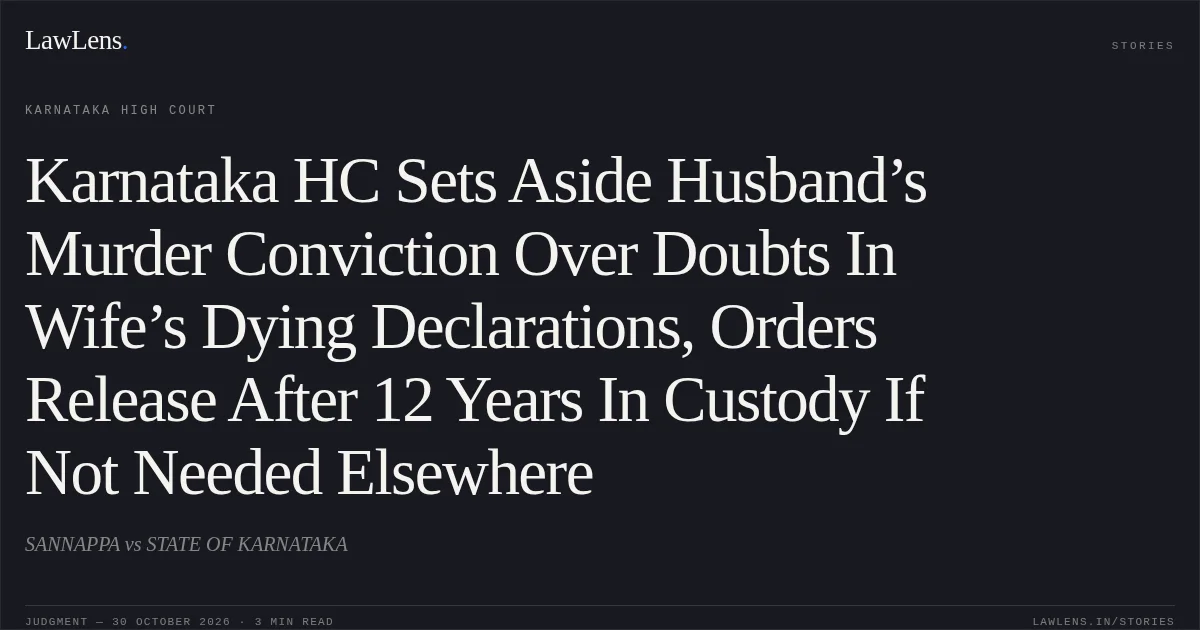
pp. 23–25The conviction and sentence under Section 302 IPC were set aside, but the convictions under Sections 498-A, 341, 504, 323 and 506 IPC were confirmed.
pp. 23–25As the appellant had already undergone 12 years’ imprisonment—exceeding the sentences imposed for those offences—the Court held that the sentences were served and directed his release if he was not required in another case.
pp. 23–25Original Court PDF
SANNAPPAvsSTATE OF KARNATAKA
Click to open original judgment
Original judgment, available to read, download and summarize on LawLens.in