01Facts
The appellant, Krishna Bhagya Jala Nigam Limited (KBJNL), is the beneficiary for whose benefit the private respondents' lands were acquired.
It was not made a party to the reference proceedings before the Reference Court, which passed an award.
¶ 3KBJNL filed W.P. No. 109591/2025, and on 16.06.2026 the learned Single Judge remanded the matter to the Reference Court subject to conditions.
¶ 3 · pp. 3–4The writ appeal challenges only Conditions 4 to 9 of the operative portion.
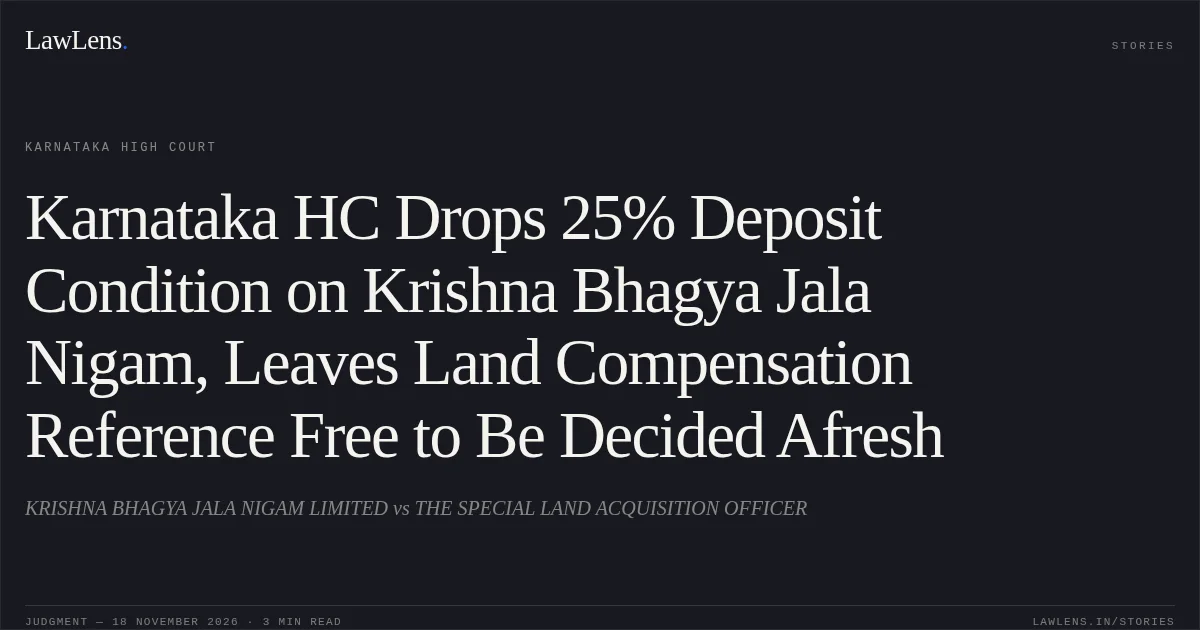
p. 1 · ¶ 3Those conditions permitted the beneficiary to file objections, cross-examine the claimants and lead evidence, directed the Reference Court to inquire whether enhanced compensation had been paid for similarly placed lands, fixed time limits of six months and one year for disposal, and required a 25% deposit of the award amount.
quoted order · ¶ 3(iv)–(ix) · pp. 5–7A connected appeal (W.A. No. 100590/2026 with W.A. No. 100503/2026) raised the same issue. It was disposed of by a Division Bench, which affirmed the remand but set aside Conditions (iv) to (ix).
¶ 4 · pp. 5–10The present appellant sought the same relief.
¶ 502Issues
i.1. Whether the unserved private respondents must be given notice before the writ appeal is finally heard and disposed of, given the safeguard provided to them.
¶ 2 · ¶ 4ii.2. Whether the conditions (Conditions 4 to 9) imposed by the Single Judge on remanding the reference, which restrict the Reference Court's discretion, are sustainable when the sole ground accepted was the beneficiary's non-impleadment.
¶ 3 · ¶ 4 (quoting WA No. 100475/2026 · ¶ 7–8) · pp. 8–903Law Applied
The Karnataka High Court Act, 1961, s.4, is the statutory basis for the writ appeal.
p. 1The Reference Court must be given a free hand to decide the reference in accordance with law.
quoted order · ¶ 5 · p. 8Where the writ petition rests solely on the legal contention that an award passed in the beneficiary's absence is unsustainable, the writ court may set aside the award and remit the matter, but it may not impose conditions that restrict the Reference Court's discretion over how the reference is decided.
quoted order · ¶ 5 · pp. 8–9An appeal may be disposed of in terms of an earlier decision in a connected matter where the issues are identical.
¶ 6 · p. 11No specific statutory provision of the Land Acquisition Act is quoted in the judgment.
Provisions in the judgment · 1 · Linked ones open on LawLens
KARNATAKA HIGH COURT ACT, 1961 Section 4
04Reasoning
The beneficiary's only ground was non-impleadment, which rendered the award legally unsustainable.
quoted order · ¶ 5, 8 · pp. 8–9The Single Judge's Conditions 4 to 9 went beyond that ground by regulating the evidence, objections, cross-examination, timelines and deposit that the Reference Court was to follow, thereby curtailing its discretion.
quoted order · ¶ 5, 8 · pp. 8–9The Division Bench therefore affirmed the setting aside of the award and the remand, but removed those conditions.
quoted order · ¶ 8The matter is identical to W.A. No. 100590/2026, so the Court saw no reason to decide it differently.
¶ 6 · p. 11Because the claimants were not yet served in the appeal and the Reference Court would issue notice to them, the Court held that the appeal could be finally disposed of without issuing notice to them.
¶ 2 · ¶ 7 · p. 1105Holding
Notice to the unserved respondents was not required before final disposal.
¶ 7 · p. 11Conditions 4 to 9 imposed by the Single Judge could not stand.
¶ 7 · p. 11The appeal is disposed of in terms of W.A. No. 100590/2026 and the connected matter. The parties are to appear before the Reference Court on 26.11.2026, and the Reference Court is directed to issue notice to the unserved parties and proceed in accordance with law. Pending applications are disposed of.
¶ 7 · p. 11 · ¶ 8 · p. 11Original Court PDF
KRISHNA BHAGYA JALA NIGAM LIMITEDvsTHE SPECIAL LAND ACQUISITION OFFICER
Click to open original judgment
Original judgment, available to read, download and summarize on LawLens.in