01Facts
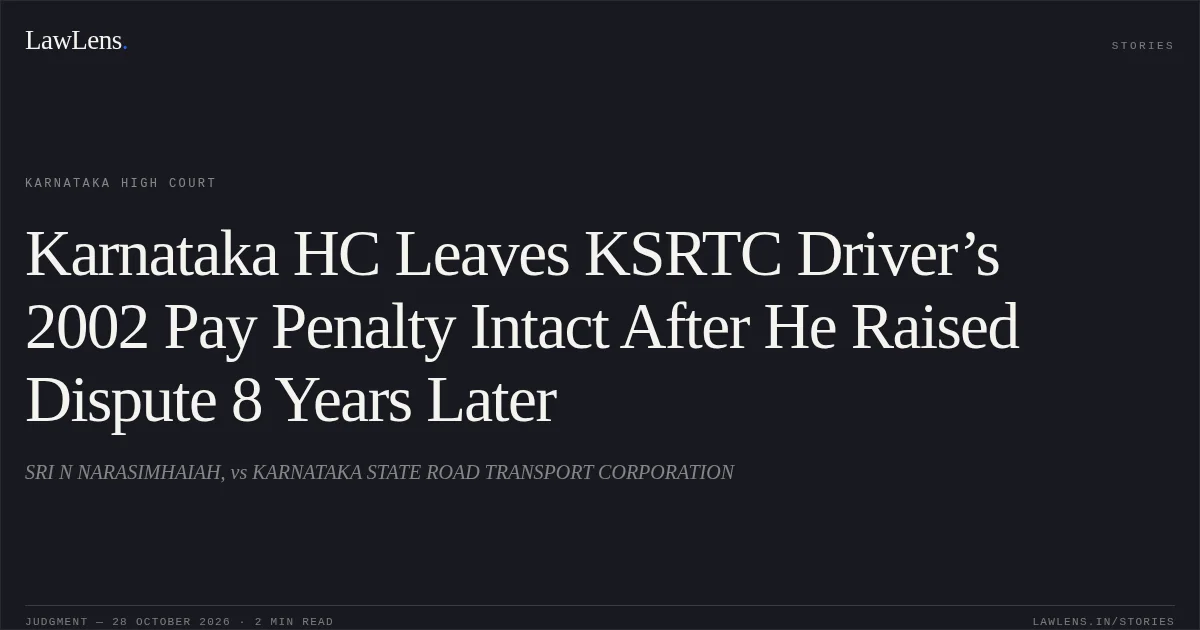
The appellant, a retired KSRTC driver, was subjected to a disciplinary penalty on 29 January 2002: reduction of his basic pay by one incremental stage with cumulative effect. In 2010, he raised an industrial dispute. The Industrial Tribunal set aside the penalty by an award dated 16 February 2018. KSRTC successfully challenged the award before a learned Single Judge, who held that the dispute was stale; the workman appealed that decision.
¶ 3–5, 11–13 · pp. 3–5, 8–9The appellant asserted that an appeal against the penalty was pending, but produced no evidence of an appeal having been filed.
¶ 6–7, 11 · pp. 5–6, 802Issues
i.1. Whether the dispute raised in 2010 concerning the penalty imposed in 2002 was stale, such that no existing industrial dispute remained for adjudication.
¶ 4–5, 10–13 · pp. 4–5, 7–9ii.2. Whether, despite the delay, the Tribunal could grant relief by moulding it or limiting back wages.
¶ 9 · p. 703Law Applied
Under Section 10(1) of the Industrial Disputes Act, 1947, no limitation period is prescribed for making a reference, but the appropriate Government must consider whether a reference is expedient and whether an existing dispute remains. Ajaib Singh v. Sirhind Cooperative Marketing-cum-Processing Service Society Limited, (1999) 6 SCC 82, holds that courts cannot impose an unsupported limitation period for raising an industrial dispute.
¶ 8 · pp. 6–7However, Prabhakar v. Joint Director, Sericulture Department, (2015) 15 SCC 1, explains that where a workman has not agitated the matter and an unexplained delay indicates waiver or acquiescence, the dispute may have become stale and cease to be an “existing dispute”; in that event, the Government may decline a reference, or the Labour Court or Industrial Tribunal may find that no industrial dispute exists under Section 2(k) of the Act.
¶ 10 · pp. 7–8Provisions in the judgment · 1 · Linked ones open on LawLens
KARNATAKA HIGH COURT ACT, 1961 Section 4
04Reasoning
The Court distinguished the absence of a statutory limitation period from the question whether a live dispute existed. The penalty had been imposed in 2002, and the workman raised the dispute only eight years later.
¶ 9–13 · pp. 7–9Although he claimed that an appeal was pending, he produced no evidence of any appeal, while KSRTC had specifically denied that one was filed. In those circumstances, the delay was unexplained and the dispute had become stale; the Single Judge’s conclusion was reasonable.
¶ 9–13 · pp. 7–9The contention that relief could be moulded or back wages limited did not alter that conclusion.
¶ 9–13 · pp. 7–905Holding
The Court held that the reference made in 2010 concerning the disciplinary penalty imposed in 2002 was hit by delay and laches.
¶ 13–14 · p. 9Finding no ground to interfere with the Single Judge’s judgment, it dismissed the writ appeal.
¶ 13–14 · p. 9Original Court PDF
SRI N NARASIMHAIAH,vsKARNATAKA STATE ROAD TRANSPORT CORPORATION
Click to open original judgment
Original judgment, available to read, download and summarize on LawLens.in