01Facts
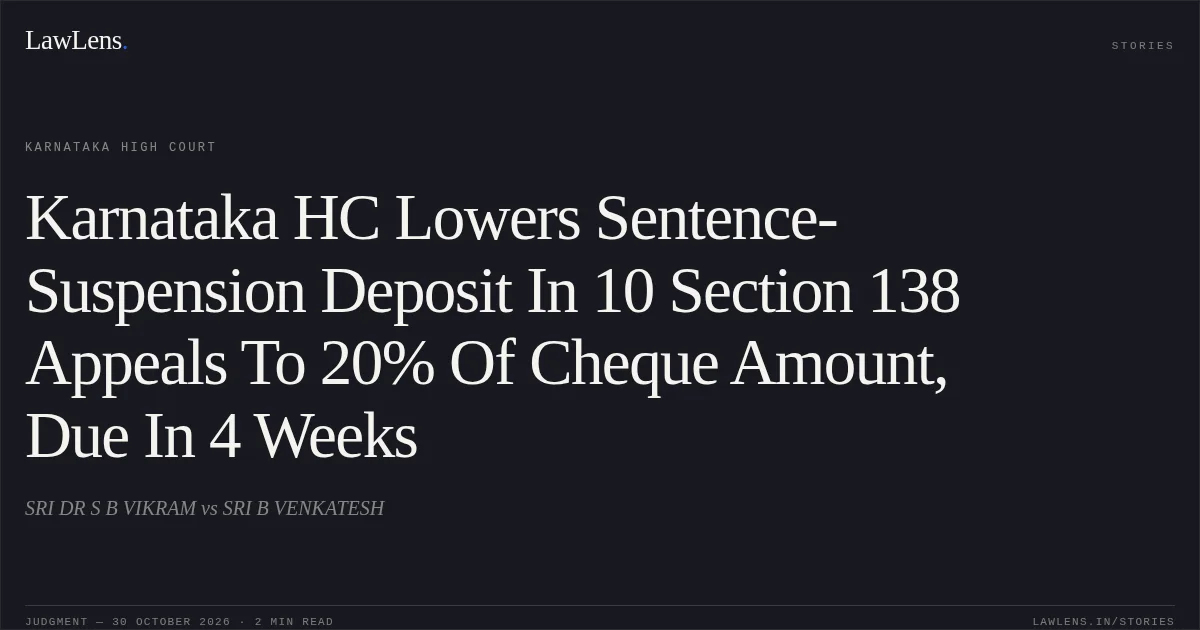
The petitioners, accused No. 2 in proceedings under Section 138 of the Negotiable Instruments Act, challenged appellate orders requiring them to deposit 25% of the fine as a condition of suspension of sentence.
p. 11 · ¶ 2–3The fine was twice the cheque amount, and the appellate court had allowed six weeks for deposit.
p. 11 · ¶ 2–3The petitioners submitted that the required deposit would be ₹25 lakh each and argued that the underlying payments had been made to a company, not to the individual petitioners.
pp. 11–12 · ¶ 4, 6, 9The respondents relied on their status as senior citizens, the time taken to secure the convictions, and the petitioners’ alleged capacity to pay.
p. 11 · ¶ 5The High Court considered the challenged orders in connected petitions.
p. 11 · ¶ 1–202Issues
i.Whether the appellate court’s condition requiring deposit of 25% of the fine should be modified, given that the fine was twice the cheque amount and the petitioners asserted financial hardship.
pp. 11–12 · ¶ 3–4, 8–9ii.Whether modification of the deposit condition should be tied to the petitioners’ undertaking to argue their appeals promptly, without seeking adjournments.
pp. 12–13 · ¶ 9–1003Law Applied
The petitions invoked the High Court’s inherent jurisdiction under Section 482 of the Code of Criminal Procedure, corresponding to Section 528 of the Bharatiya Nagarik Suraksha Sanhita, as stated in the petition descriptions.
pp. 2–10The underlying convictions and appellate proceedings concerned Section 138 of the Negotiable Instruments Act, 1881.
p. 11 · ¶ 2The judgment does not cite a precedent or set out a general statutory formula for the deposit; it modifies the condition in light of the circumstances and the petitioners’ undertaking to pursue the appeals promptly.
pp. 12–14 · ¶ 9–10 and orderProvisions in the judgment · 3 · Linked ones open on LawLens
Code of Criminal Procedure, 1973 Section 482
Bharatiya Nagarik Suraksha Sanhita, 2023 Section 528
Negotiable Instruments Act, 1881 Section 138
04Reasoning
The Court noted that the fine was double the cheque amount and that the trial proceedings had taken eight years.
p. 12 · ¶ 8It also considered the petitioners’ submission that each would otherwise have to deposit ₹25 lakh and that the payments in question had been made to a company.
pp. 12–13 · ¶ 9Rather than determine that contention at this stage, the Court made the reduced deposit conditional on the petitioners addressing it before the appellate court within two months and not seeking adjournments.
pp. 12–13 · ¶ 5, 9–10 · p. 14, orderThe respondents’ senior-citizen status also informed the direction for expedition.
pp. 12–13 · ¶ 5, 9–10 · p. 14, order05Holding
The petitions were disposed of and the impugned orders modified.
pp. 13–14, orderEach petitioner was directed to deposit 20% of the cheque amount—not 20% of the fine—before the trial court within four weeks; the amount is to remain in a nationalised bank for one year with auto-renewal.
pp. 13–14, orderThe petitioners were required to address arguments before the appellate court within two months and not seek adjournments; if they sought an adjournment, they would lose the benefit of the interim order, and the trial court would proceed as if sentence suspension had not been granted.
pp. 13–14, orderOriginal Court PDF
SRI DR S B VIKRAMvsSRI B VENKATESH
Click to open original judgment
Original judgment, available to read, download and summarize on LawLens.in