01Facts
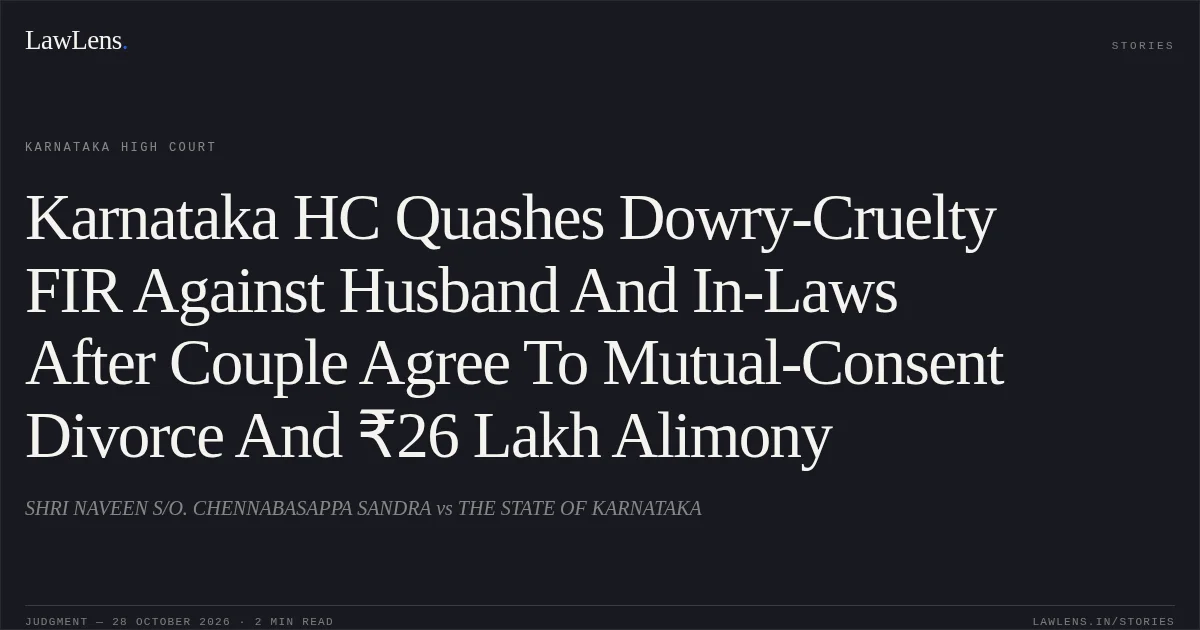
Respondent No. 2, Priyanka, lodged a complaint against her husband and two family members, leading to registration of Crime No. 278/2026 for offences under Sections 85, 115(2), 352 and 3(5) of the Bharatiya Nyaya Sanhita, 2023, and Sections 3 and 4 of the Dowry Prohibition Act.
pp. 3–4Investigation was pending when the accused petitioned under Section 528 of the BNSS (corresponding to Section 482 of the Cr.P.C.) to quash the proceedings.
pp. 3–4The parties subsequently filed a joint application and affidavit stating that they had settled the dispute voluntarily; the spouses had also agreed to seek divorce by mutual consent, with the husband agreeing to pay ₹26,00,000 as permanent alimony.
pp. 4–602Issues
i.Whether the High Court should exercise its inherent jurisdiction to quash non-compoundable criminal proceedings arising from a matrimonial dispute after the parties have settled.
pp. 3–5, 7–8ii.Whether, in the circumstances, continuation of the investigation and prosecution would amount to an abuse of process or serve the ends of justice.
pp. 7, 14–1503Law Applied
Section 528 of the BNSS, 2023 (corresponding to Section 482 of the Cr.P.C.) preserves the High Court’s inherent power to quash proceedings, including in non-compoundable cases, where necessary to secure the ends of justice or prevent abuse of process; this power is distinct from statutory compounding under Section 359 of the BNSS.
pp. 4, 7–8Relying on Narinder Singh & Ors. v. State of Punjab & Anr., (2014) 6 SCC 466, the Court applied the principles that settlement may support quashing in disputes with a predominantly private or matrimonial character, subject to the nature and seriousness of the offences, the stage of the proceedings, and whether the prospect of conviction is remote.
pp. 7–13Provisions in the judgment · 14 · Linked ones open on LawLens
Bharatiya Nagarik Suraksha Sanhita, 2023 Section 359Section 528
Code of Criminal Procedure, 1973 Section 320Section 482
Bharatiya Nyaya Sanhita, 2023 Section 3Section 85Section 115Section 352
Dowry Prohibition Act, 1961 Section 3Section 4
Indian Penal Code, 1860 Section 34Section 307Section 323Section 324
04Reasoning
The Court treated the case as a family and matrimonial dispute that had been resolved voluntarily, as confirmed by the parties’ joint application and affidavit.
pp. 4–6, 7The offences were non-compoundable, but the Court considered that the matter was still under investigation and that, following settlement, the likelihood of witnesses supporting the prosecution was minimal.
pp. 7, 14–15It concluded that the prospect of conviction was remote and that continuing the proceedings would be unnecessary and an abuse of process.
pp. 7, 14–1505Holding
The Court accepted the settlement and allowed the criminal petition.
pp. 15–16It quashed the proceedings in Crime No. 278/2026, insofar as they concerned accused Nos. 1 to 3, and allowed I.A. No. 2/2026 accordingly.
pp. 15–16Original Court PDF
SHRI NAVEEN S/O. CHENNABASAPPA SANDRAvsTHE STATE OF KARNATAKA
Click to open original judgment
Original judgment, available to read, download and summarize on LawLens.in