01Facts
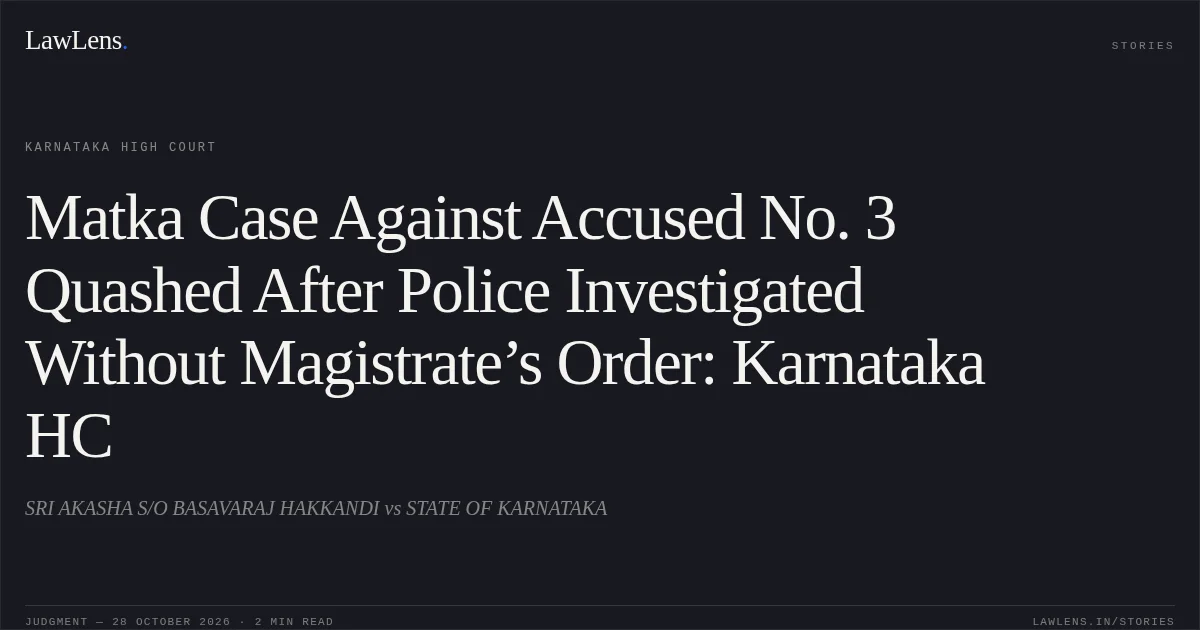
On 2 August 2024, police received information that persons were writing matka chits and numbers on Alwandi–Handral Road.
pp. 2–3 · ¶ 3Police raided the location, arrested Accused Nos. 1 and 2, and seized a pen, mobile phone, chit and cash.
pp. 2–3 · ¶ 3A case was registered under Section 78(3) of the Karnataka Police Act, 1963, and a charge-sheet was later filed against the petitioner, Accused No. 3.
pp. 2–3 · ¶ 3The petitioner sought quashing of the proceedings, contending that the offence was non-cognizable and that the police had neither followed Section 155(1) of the Code of Criminal Procedure, 1973 (“CrPC”) nor obtained the Magistrate’s permission to investigate under Section 155(2).
pp. 3–4 · ¶ 502Issues
i.1. Whether the police could investigate the alleged non-cognizable offence under Section 78(3) of the Karnataka Police Act without first obtaining an order under Section 155(2) CrPC
pp. 5–6 · ¶ 7–9ii.2. Whether the proceedings against the petitioner were liable to be quashed where the raid, seizure and investigation occurred without the required Magistrate’s permission
pp. 9–10 · ¶ 12–1303Law Applied
Section 155(1) CrPC requires the officer in charge, on receiving information about a non-cognizable offence, to record its substance in the prescribed book and refer the informant to the Magistrate; Section 155(2) prohibits police investigation of a non-cognizable case without an order from a Magistrate empowered to try or commit the case.
p. 5 · ¶ 8The Court relied on Vageppa Guruling Jangaligi v. State of Karnataka, ILR 2020 KAR 630, which explained the mandatory procedure for seeking and granting such permission, including the need for a reasoned judicial order and specification of the investigating officer.
pp. 6–8 · ¶ 10Provisions in the judgment · 4 · Linked ones open on LawLens
Code of Criminal Procedure, 1973 Section 482Section 155
Bharatiya Nagarik Suraksha Sanhita, 2023 Section 528
KARNATAKA POLICE ACT, 1963. Section 78
04Reasoning
The Court accepted that the offence under Section 78(3) of the Karnataka Police Act was non-cognizable.
p. 5 · ¶ 7The Magistrate’s permission had not been obtained before the raid, and the seizure panchanama formed part of the charge-sheet.
pp. 8–9 · ¶ 12–13The Court concluded that the police had commenced investigation before obtaining the order required by Section 155(2) CrPC.
p. 10 · ¶ 13In those circumstances, allowing the proceedings to continue would amount to an abuse of process of law.
p. 10 · ¶ 1305Holding
The Court allowed the petition and quashed the proceedings in C.C. No. 4071/2024, pending before the Additional Civil Judge and JMFC, Koppal, insofar as they concerned the petitioner, Accused No. 3.
p. 10 · orderAny pending interlocutory applications were dismissed.
p. 10 · orderOriginal Court PDF
SRI AKASHA S/O BASAVARAJ HAKKANDIvsSTATE OF KARNATAKA
Click to open original judgment
Original judgment, available to read, download and summarize on LawLens.in