01Facts
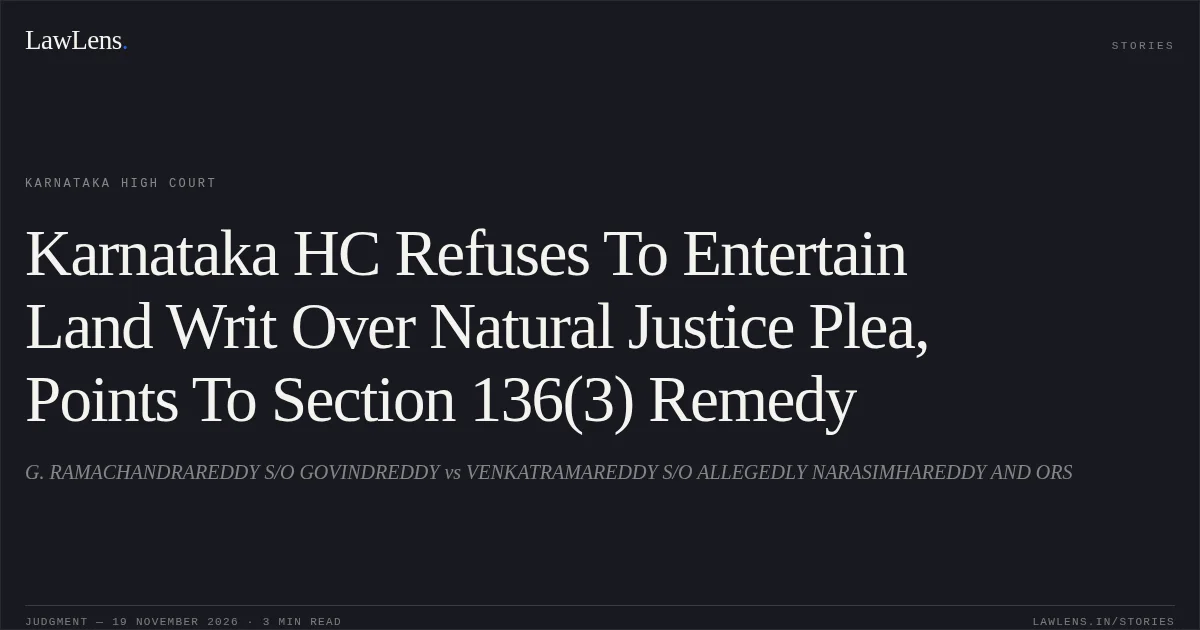
The petitioner, G. Ramachandrareddy, filed a writ petition under Articles 226 and 227 of the Constitution challenging the order dated 03.01.2020 passed by the Assistant Commissioner (R-3) under Section 136(2) of the Karnataka Land Revenue Act, 1964.
p. 3, para 1He sought quashing of that order and restoration of agricultural land records previously standing in his name.
pp. 1–2, prayer (a)–(b)His counsel contended that the petitioner was not made a party to the proceedings and that the order was passed behind his back, in violation of natural justice, rendering the writ petition maintainable.
pp. 3, paras 3–4Respondent No. 1 appeared in person.
The Court noted parallel proceedings in O.S. No. 19/2017 before the Principal Judge, Family Court, Raichur.
pp. 6–7, para 8The Court did not examine the merits of the revenue order.
02Issues
i.1. Whether a writ petition under Articles 226/227 is maintainable against an order under Section 136(2) of the Karnataka Land Revenue Act, 1964, where the petitioner has an efficacious statutory remedy under Section 136(3) and alleges violation of natural justice.
pp. 3, paras 2–4 · p. 6, para 6ii.2. Whether the petitioner is entitled to the benefit of Section 14 of the Limitation Act, 1963, and whether the Assistant Commissioner must decide afresh independent of prior observations, if the petitioner pursues the statutory remedy.
pp. 6–7, paras 7–803Law Applied
Section 136(3) of the Karnataka Land Revenue Act, 1964, provides the statutory appellate remedy against the Section 136(2) order.
p. 3, para 2The writ jurisdiction under Article 226 is discretionary and ordinarily should not be exercised where an alternative remedy exists, so as to avoid bypassing the statutory machinery, as derived from Thansingh Nathmal v. A. Mazid, Superintendent of Taxes, AIR 1964 SC 1419 (Constitution Bench) and quoted in para 10 of Rikhab Chand Jain v. Union of India, Civil Appeal No. 6791/2012.
pp. 4–6, para 5Section 14 of the Limitation Act, 1963, excludes time spent in bona fide prosecution of proceedings in a court without jurisdiction, and was applied to protect the petitioner's limitation position on refiling.
p. 6, para 7Provisions in the judgment · 1 · Linked ones open on LawLens
Limitation Act, 1963 Section 14
04Reasoning
The petitioner's central grievance was non-impleadment and lack of notice before the Assistant Commissioner, which he framed as a natural justice violation rendering the writ maintainable.
pp. 3, paras 3–4The violation of natural justice alleged by the petitioner was treated as a ground to be raised before the statutory authority, not as an exception that by itself justified writ jurisdiction.
p. 3, para 4 · p. 6, para 6A plea of natural justice violation does not, by itself, displace the statutory appellate remedy, because the Section 136(3) forum can examine the same contention on facts and record.
p. 6, para 6Applying Thansingh Nathmal and Rikhab Chand Jain, the Court found that the petitioner had an efficacious and unburdensome alternative remedy and that the writ court should not allow the statutory scheme to be bypassed.
pp. 4–6, para 5 · p. 6, para 6To avoid prejudice from the dismissal, the Court preserved the petitioner's right to pursue the proper forum and extended the Section 14 benefit.
p. 6, para 7The Court further directed that the appellate authority decide independently and not be influenced by observations of the Family Court in O.S. No. 19/2017.
pp. 6–7, para 8Because the writ was dismissed on maintainability, the Court did not reach the merits of the land-record dispute.
05Holding
The writ petition was not maintainable because the petitioner had an efficacious alternative remedy under Section 136(3) of the Karnataka Land Revenue Act, 1964, and no ground existed to entertain the writ despite the alleged natural justice violation.
p. 6, para 6The writ petition was dismissed.
p. 6, para 6The petitioner was granted liberty to approach the appropriate forum, with entitlement to the benefit of Section 14 of the Limitation Act, 1963.
p. 6, para 7The appropriate authority was directed to decide any such application independently, without being influenced by the observations of the Principal Judge, Family Court, Raichur, in O.S. No. 19/2017.
pp. 6–7, para 8All pending memos were held not to survive for consideration.
p. 7Original Court PDF
G. RAMACHANDRAREDDY S/O GOVINDREDDYvsVENKATRAMAREDDY S/O ALLEGEDLY NARASIMHAREDDY AND ORS
Click to open original judgment
Original judgment, available to read, download and summarize on LawLens.in