01Facts
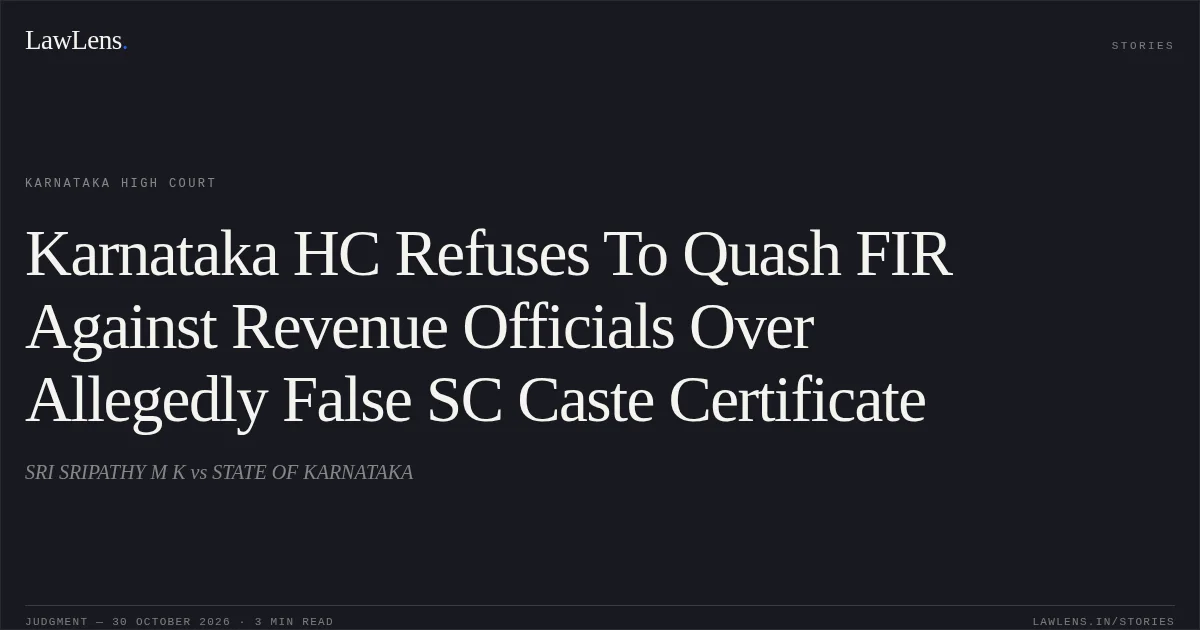
Accused No. 1, Lakshmamma, allegedly obtained a caste certificate claiming Scheduled Caste status as Adi-Karnataka. Following an enquiry, the District Caste Verification Committee concluded that she belonged to the Ganiga community and cancelled the certificate.
¶ 2–4The complaint also named the petitioners—a Revenue Inspector and a Tahsildar—involved in processing or issuing the certificate. Gulpet Police registered Crime No. 34/2023 under Sections 467, 468, 471, 198 and 420 of the IPC, Section 3(1)(q) of the SC/ST (Prevention of Atrocities) Act, 1989, and Sections 5A and 5B of the Karnataka SC/ST and OBC (Reservation of Appointments, etc.) Act, 1990. The petitioners sought to quash the FIR under Section 482 CrPC, invoking, among other grounds, absence of sanction and protection for good-faith official action.
¶ 5.1–5.702Issues
i.1. Whether sanction under Section 6 of the 1990 Act is required before an FIR is registered, or at a later stage of the criminal proceedings.
¶ 8(i)ii.2. Whether, at the FIR-registration stage, each alleged offence must be specifically attributed to each accused.
¶ 8(ii)iii.3. Whether the petitioners’ intention in issuing the certificate and their claim to protection for good-faith action could be conclusively determined under Section 482 CrPC at that stage.
¶ 8(iii)03Law Applied
Section 6 of the 1990 Act bars institution of a prosecution for an offence under that Act except by, or with the sanction of, the State Government; the statutory requirement must be complied with at the stage prescribed by law, but its absence at FIR registration does not, by itself, invalidate the investigation.
¶ 10.2–10.9Section 5A penalises obtaining a caste certificate through false information, a false statement or other fraudulent means, while Section 5B addresses a Tahsildar’s intentional issuance of a false certificate.
¶ 11.8, 11.18Section 11 protects acts done or intended in good faith under the 1990 Act, with its application dependent on the act and surrounding circumstances.
¶ 12.2–12.4Section 3(1)(q) of the 1989 Act concerns giving false or frivolous information to a public servant, causing that servant to use lawful power to the injury or annoyance of a Scheduled Caste or Scheduled Tribe member.
¶ 11.10–11.12The Court also applied the principle that Section 482 jurisdiction is not ordinarily used to conduct a mini-trial or resolve disputed factual questions, while remaining available where the allegations disclose no offence or a recognised ground for quashing exists.
¶ 12.5–12.7It considered Sri G. Chandrappa v. State of Karnataka and Others, W.P. No. 23834/2022, but held that, without investigation in the present case, it could not conclude that Section 3(1)(q) was inapplicable to the petitioners.
¶ 11.13Provisions in the judgment · 8 · Linked ones open on LawLens
Code of Criminal Procedure, 1973 Section 482
Bharatiya Nagarik Suraksha Sanhita, 2023 Section 528
Indian Penal Code, 1860 Section 467Section 468Section 471Section 198Section 420
Scheduled Castes and the Scheduled Tribes (Prevention of Atrocities) Act, 1989 Section 3
04Reasoning
The Court distinguished FIR registration and investigation from institution of prosecution. Because Section 6 did not make prior sanction a condition for registering the FIR, the absence of sanction at that stage did not justify quashing; compliance remained necessary at the stage mandated by law.
¶ 10.4–10.9The FIR’s invocation of multiple provisions did not mean every offence had to be conclusively attributed to every accused at registration. The roles of the applicant and officials, including what information was supplied, what verification was undertaken and what material was available to the Tahsildar, required investigation against the elements of the relevant offences.
¶ 11.3–11.7, 11.14–11.22Cancellation of the certificate warranted inquiry but did not, by itself, establish any accused’s criminal liability or the Tahsildar’s intention.
¶ 11.15Likewise, the petitioners’ assertion of good faith did not conclusively establish Section 11 protection; both intention and good faith depended on factual assessment.
¶ 12.1–12.905Holding
The Court held that absence of sanction when the FIR was registered did not, by itself, warrant quashing; the specific offences attributable to each accused, and the questions of intention and good faith, were left for consideration in accordance with law after investigation.
¶ 10.9, 11.23, 12.10The petition was dismissed. The Investigating Officer was directed to proceed in accordance with law, considering the distinct ingredients of the offences and each accused’s role; the competent Court was to ensure compliance with Section 6 at the legally mandated stage. All merits contentions remained open.
¶ 13.4Original Court PDF
SRI SRIPATHY M KvsSTATE OF KARNATAKA
Click to open original judgment
Original judgment, available to read, download and summarize on LawLens.in