01Facts
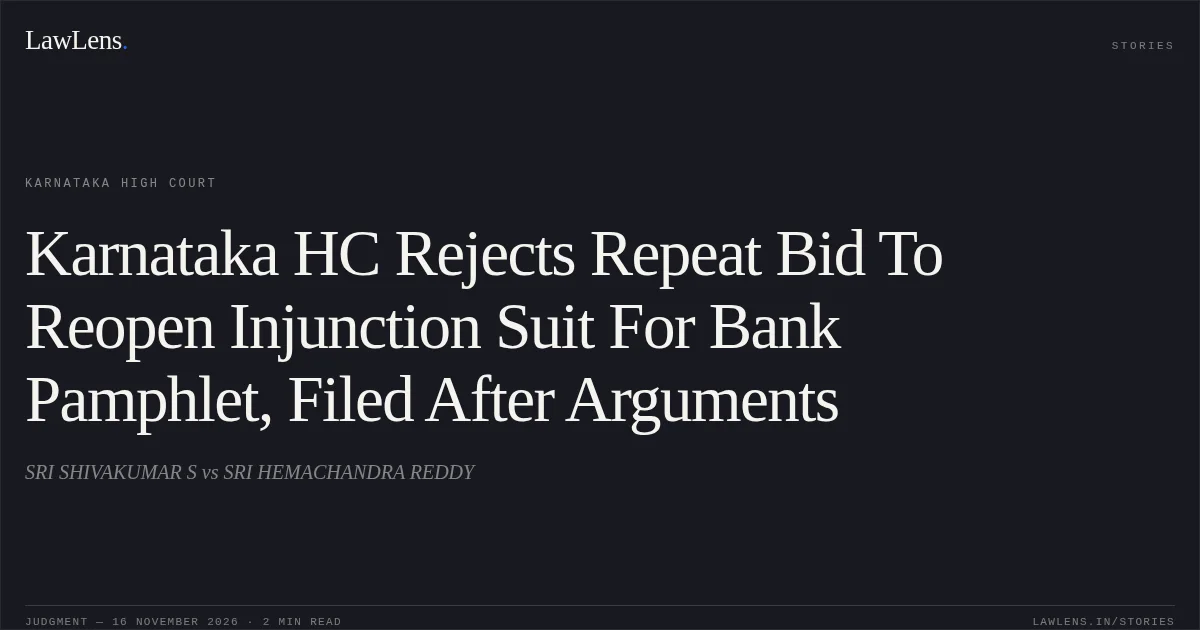
The petitions arose from a permanent-injunction suit, O.S. No. 8643/2014.
¶ 1–5, 7After both sides concluded their evidence and arguments, and the suit was posted for judgment, the petitioner sought to recall DW.2, reopen the evidence, and produce a bank pamphlet said to have come to his knowledge after the evidence closed.
¶ 1–5, 7The Trial Court rejected those applications on 4 November 2025.
¶ 1–5, 7It had earlier rejected substantially similar applications on 24 September 2025.
¶ 1–5, 7The petitioner challenged the later order under Article 227 of the Constitution.
¶ 1–5, 702Issues
i.1. Whether the Trial Court erred in rejecting the petitioner’s applications to recall DW.2, reopen evidence, and produce an additional document after the suit had been posted for judgment
¶ 1–6ii.2. Whether the Trial Court’s rejection of the repeated applications disclosed an error or infirmity warranting interference under Article 227
¶ 7–903Law Applied
The applications invoked Order XVIII Rule 17 and Section 151 of the Code of Civil Procedure, 1908 (CPC), for recall of a witness and reopening of evidence, and Order VIII Rule 1A CPC for permission to produce additional documents.
¶ 1The Court assessed whether the requested procedural steps were justified in the circumstances, including the timing of the applications and the explanation for not producing the document earlier.
In exercising its supervisory jurisdiction under Article 227, the Court considered whether the impugned order contained an error or infirmity warranting intervention.
¶ 9No precedent was cited.
Provisions in the judgment · 1 · Linked ones open on LawLens
Code of Civil Procedure, 1908 Section 151
04Reasoning
The Court noted that the applications were filed only after the evidence and arguments had concluded and the suit was posted for judgment.
¶ 4The petitioner asserted that the bank pamphlet had come to his knowledge later, but gave no satisfactory explanation for why it could not have been produced at the appropriate stage; the document also appeared prima facie to have limited evidentiary value.
¶ 5Although the Court did not conclusively decide the document’s relevance or evidentiary value, it considered the timing of the applications and the earlier rejection of substantially identical requests.
¶ 6–8It found that the repeated applications appeared intended to delay the proceedings.
¶ 6–805Holding
The Court held that no error or infirmity warranting interference under Article 227 had been shown
¶ 9–10and dismissed all three writ petitions, leaving the Trial Court’s order rejecting the applications undisturbed.
¶ 9–10Original Court PDF
SRI SHIVAKUMAR SvsSRI HEMACHANDRA REDDY
Click to open original judgment
Original judgment, available to read, download and summarize on LawLens.in