01Facts
The plaintiff claimed ownership of the ‘B’ Schedule property and sought consequential reliefs, including injunction.
p. 4Birla Estates denied encroachment, stating that its development project commenced in 2018, covered more than eight acres, and had received a partial occupancy certificate on 12 June 2023.
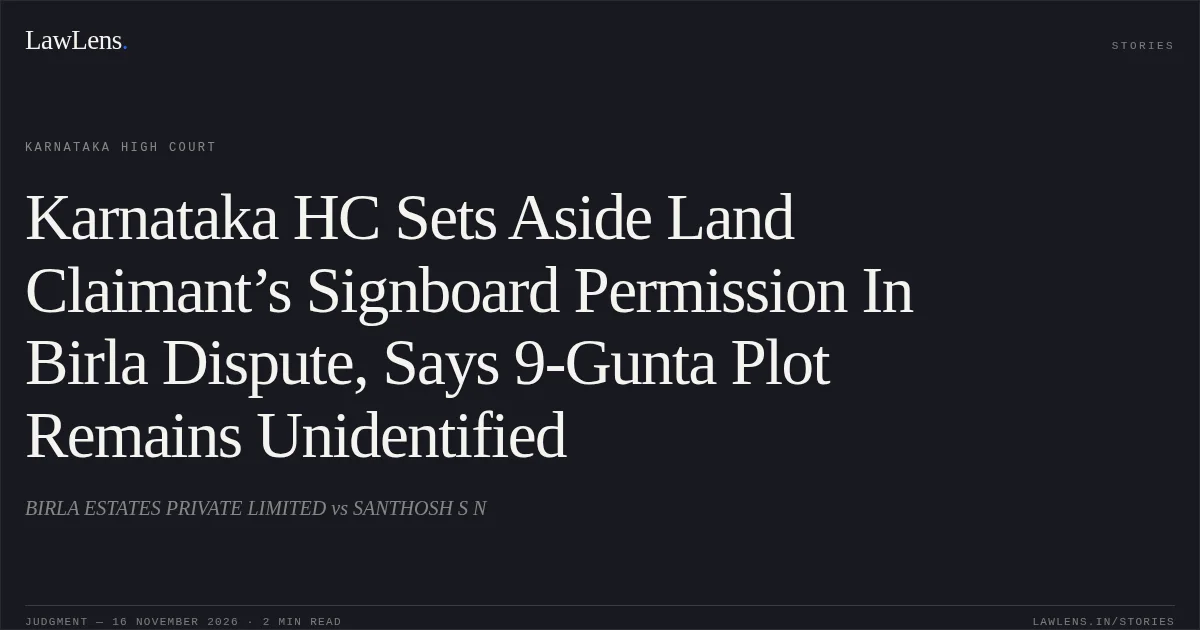
¶ 2.1 · ¶ 5 · p. 4 · p. 6The plaintiff applied under Section 151 CPC for permission to erect a signboard stating that litigation concerning the property was pending, alleging continuing violations of interim injunction orders.
¶ 3 · p. 5The Senior Civil Judge, Hoskote, allowed the application on 27 April 2026. Birla Estates challenged that order under Article 227 of the Constitution.
¶ 1 · ¶ 3 · pp. 4–502Issues
i.1. Whether the Trial Court was justified in permitting a signboard concerning the disputed ‘B’ Schedule property when the alleged violations of the injunction orders had not been pursued through the CPC’s specific remedy.
¶ 6 · ¶ 8 · pp. 6–7ii.2. Whether permission to erect the signboard was sustainable when the alleged encroachment and the identification of the ‘B’ Schedule property remained disputed.
¶ 7 · p. 603Law Applied
Section 151 CPC preserves the court’s inherent powers, but the court held that an alleged violation of an injunction should be examined through the specific remedy provided by the CPC.
¶ 6 · p. 6The judgment did not identify the provision governing that remedy or cite any precedent. It also applied the principles that, where an efficacious remedy is available, equitable relief may be inappropriate, and that irreparable injury is relevant when considering such relief.
¶ 8 · p. 7Provisions in the judgment · 1 · Linked ones open on LawLens
Code of Civil Procedure, 1908 Section 151
04Reasoning
The application for a signboard rested on an allegation that injunction orders had been violated, yet no proceedings to establish such violation had been commenced.
¶ 6 · p. 6Further, the alleged encroachment was disputed and the ‘B’ Schedule property had not been identified; the claimed nine guntas also had to be considered against the development project’s larger extent.
¶ 5 · ¶ 7 · pp. 6–7The Court concluded that granting permission in those circumstances was not properly considered. It also found that a signboard could cause Birla Estates irreparable prejudice, while the alleged breach could be addressed through the available CPC remedy and the Trial Court’s powers in the pending suit.
¶ 8 · p. 705Holding
The High Court allowed the writ petition, set aside the Trial Court’s order dated 27 April 2026, and rejected I.A. No. 6, filed under Section 151 CPC.
¶ 10 · p. 8The High Court allowed the writ petition, set aside the Trial Court’s order dated 27 April 2026, and rejected I.A. No. 6, filed under Section 151 CPC.
¶ 10 · p. 8Original Court PDF
BIRLA ESTATES PRIVATE LIMITEDvsSANTHOSH S N
Click to open original judgment
Original judgment, available to read, download and summarize on LawLens.in