01Facts
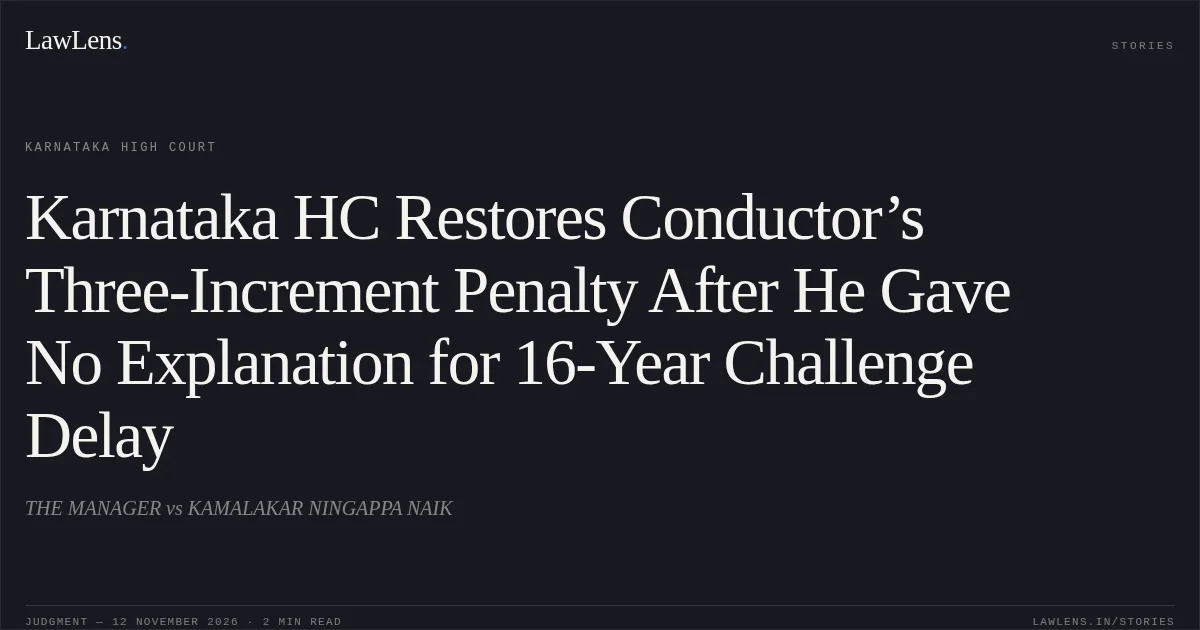
The workman challenged a punishment order dated 30 September 1993, which withheld three ensuing increments with cumulative effect.
pp. 2–3, 6He alleged that the charge arose from a ticket-checking incident on 9 April 1991 and maintained that he had issued tickets to all passengers.
pp. 2–3, 6In a reference made in 2009, the Industrial Tribunal held that the management had failed to prove the misconduct and set aside the punishment.
pp. 2–3, 6It also concluded that delay alone did not bar relief.
pp. 2–3, 6The Corporation challenged the award by writ petition.
pp. 2–3, 6The High Court noted that the workman had raised the dispute approximately 16 years after the punishment, without explaining the delay.
p. 2, 1602Issues
i.1. Whether the Industrial Tribunal could entertain the workman’s challenge to the 1993 punishment when the dispute was raised approximately 16 years later without an explanation for the delay.
p. 2, 16ii.2. Whether the Tribunal’s award setting aside the punishment could stand in light of that delay.
pp. 16–1703Law Applied
Section 10(1)(d) of the Industrial Disputes Act, 1947 empowers the appropriate Government to refer industrial disputes, but the absence of a statutory limitation period does not permit stale disputes to be revived without regard to delay and its explanation.
pp. 9–12In U.P. State Road Transport Corporation v. Babu Ram, (2006) 5 SCC 433, the Supreme Court held that whether a dispute is stale depends on the circumstances of the case and that the workman must show that the dispute was raised within a reasonable time, or explain the delay.
pp. 9–12The judgment also relied on Nedungadi Bank Ltd. v. K.P. Madhavankutty, (2000) 2 SCC 455, and S.M. Nilajkar v. Telecom District Manager, (2003) 4 SCC 27, concerning stale disputes and the consequences of delay.
pp. 9–12It further applied this Court’s earlier decision on unexplained delay, which had been affirmed by a Division Bench.
pp. 7–16Provisions in the judgment · 3
Industrial Disputes Act, 1947 Section 10Section 17ASection 11A
04Reasoning
The workman’s dispute concerned a punishment imposed in 1993, but he raised it only in 2009 and offered no explanation for the intervening delay.
pp. 16–17Applying the principles in Babu Ram and the earlier Karnataka High Court decisions, the Court held that the dispute was not maintainable because it was stale and the delay was unexplained.
pp. 16–17As the delay barred the dispute itself, the Court considered it unnecessary to address the Tribunal’s findings on the alleged misconduct or the other grounds urged by the parties.
pp. 16–1705Holding
The Court answered the maintainability issue against the workman and allowed the Corporation’s writ petition.
p. 17It set aside the Industrial Tribunal’s award dated 7 November 2012 in I.D. No. 518/2009.
p. 17Original Court PDF
THE MANAGERvsKAMALAKAR NINGAPPA NAIK
Click to open original judgment
Original judgment, available to read, download and summarize on LawLens.in