01Facts
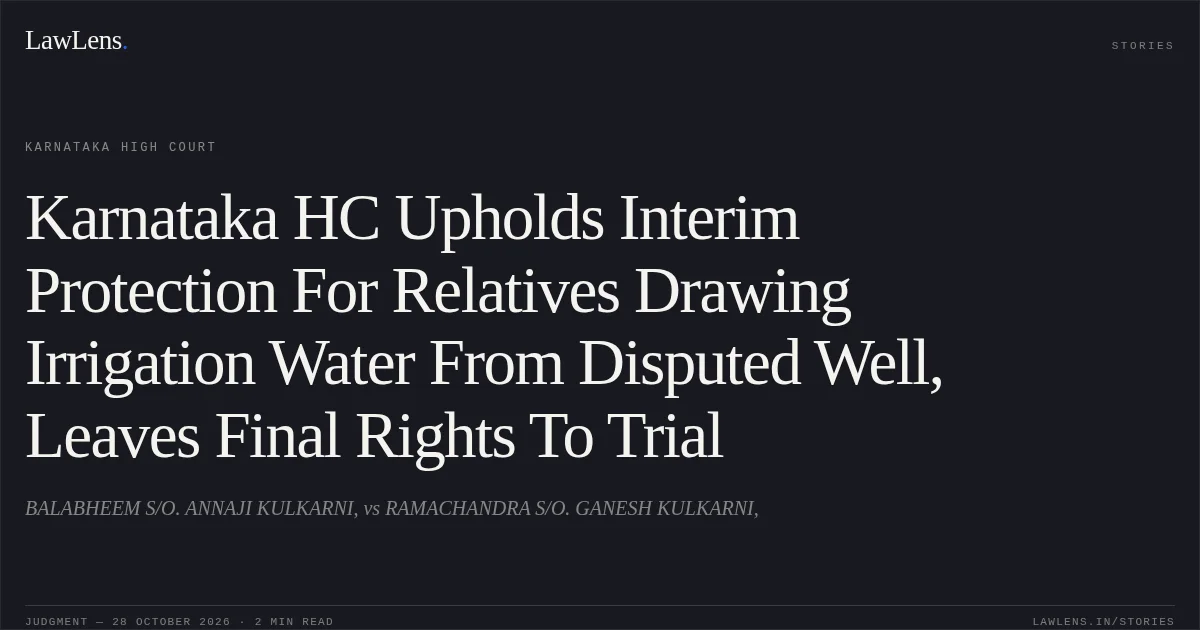
The respondents, plaintiffs in O.S. No. 1216/2024, claimed that they and the petitioner, the defendant, had used a well in Sy. No. 262/2 for irrigation for over 35 years, with separate electricity connections and pumps.
¶ 1–5They sought a permanent injunction and interim protection against interference with their use of the well water.
¶ 1–5The Trial Court rejected their application under Order XXXIX Rules 1 and 2 CPC, but the Senior Civil Judge allowed their appeal in M.A. No. 20/2024 and restrained the petitioner from obstructing their use of the water or damaging the pipeline or motor pending disposal of the suit.
¶ 1–5The petitioner challenged that order, disputing the existence of a common well and asserting that the well belonged exclusively to him.
¶ 6–7The respondents relied on RTC entries and other material indicating a well and irrigation use in the relevant survey lands.
¶ 8–9, 1302Issues
i.1. Whether the First Appellate Court’s interim order protecting the respondents’ use of the well water warranted interference under Articles 226 and 227 of the Constitution
¶ 1, 6–9, 16ii.2. Whether the material on record supported a prima facie finding that the well was used by both parties and justified interim protection pending trial
¶ 11–1503Law Applied
The petition invoked Articles 226 and 227 of the Constitution, under which the High Court considered whether the challenged interlocutory order called for its interference.
¶ 1The underlying interim-injunction application was made under Order XXXIX Rules 1 and 2 CPC.
¶ 5The Court treated the lower courts’ conclusions about the well and its use as prima facie findings relevant to interim relief, while clarifying that those findings were not to determine the merits at trial.
¶ 16–19Provisions in the judgment · 1 · Linked ones open on LawLens
Code of Civil Procedure, 1908 Section 151
04Reasoning
The Trial Court had noted that the revenue records indicated a well and that the parties were relatives who had commonly enjoyed it, but had declined relief because the plaintiffs had not sufficiently established their entitlement to, or the location of, the well.
¶ 11–12The First Appellate Court considered the RTC entries, the Village Accountant’s certificate, photographs, and electricity bills, and found prima facie support for the respondents’ claim of a well and irrigation use.
¶ 13The High Court concluded that the lower courts’ findings supported the interim protection and found no ground to interfere, while emphasizing that the findings were only prima facie.
¶ 15–1905Holding
The High Court declined to interfere with the First Appellate Court’s order and disposed of the writ petition.
¶ 16–20The interim restraint on the petitioner against obstructing the respondents’ use of the well water or damaging the pipeline or motor remained in place pending disposal of the suit.
¶ 16–20The parties remained free to prove their respective cases, and the Trial Court was directed to proceed uninfluenced by the interim orders.
¶ 16–20Original Court PDF
BALABHEEM S/O. ANNAJI KULKARNI,vsRAMACHANDRA S/O. GANESH KULKARNI,
Click to open original judgment
Original judgment, available to read, download and summarize on LawLens.in