01Facts
The respondents in the connected proceedings were daily-wage employees of the Panchayat Raj Engineering Sub-Division, serving in roles including assistants, drivers and gangmen.
pp. 15–17 · ¶ 2Following a circular dated 9 May 2018, their pay scales and related benefits were revised with effect from 1 April 2018.
pp. 15–17 · ¶ 2The petitioners later treated some payments as excess and sought their recovery.
pp. 15–17 · ¶ 2The Karnataka State Administrative Tribunal directed that no recovery be made and that amounts already recovered be refunded.
pp. 15–17 · ¶ 2The State and departmental authorities challenged that common order in these writ petitions.
pp. 15–17 · ¶ 202Issues
i.1. Whether the authorities could recover alleged excess pay and allowances paid to the respondents following the pay revision, in the absence of fraud or misrepresentation by the employees
p. 17 · ¶ 4ii.2. Whether the Tribunal’s order prohibiting recovery and directing repayment of amounts already recovered warranted interference in writ jurisdiction
p. 19 · ¶ 403Law Applied
Section 4 of the Karnataka Daily Wage Employees Welfare Act, 2012 addresses pay, leave and terminal benefits for covered daily-wage employees.
p. 16 · ¶ 2Relying on Jogeswar Sahoo and Others v. The District Judge, Cuttack and Others, 2025 INSC 449, and Thomas Daniel v. State of Kerala and Others, (2022) AIR (SC) 2153, the Court applied the principle that excess payments ordinarily should not be recovered where they resulted from the employer’s erroneous calculation or interpretation, rather than employee fraud or misrepresentation.
pp. 17–19 · ¶ 4Relief against recovery is equitable and discretionary, intended to prevent hardship; it is not founded on an absolute right of the employee.
pp. 17–19 · ¶ 4Provisions in the judgment · 1 · Linked ones open on LawLens
KARNATAKA DAILY WAGE EMPLOYEES WELFARE ACT, 2012 Section 4
04Reasoning
The Court noted that the respondents’ pay was revised pursuant to a government circular and that the authorities subsequently sought repayment of amounts they considered excessive.
pp. 17–19 · ¶ 4The petitioners did not allege that the employees had obtained the payments through fraud or misrepresentation.
pp. 17–19 · ¶ 4Applying the Supreme Court’s recovery principles, the Court held that the circumstances did not justify recovery and that the Tribunal had correctly restrained it.
pp. 17–19 · ¶ 4The Court also noted that the employees had not been given an opportunity of hearing before recovery was ordered.
pp. 17–19 · ¶ 405Holding
The Court answered the issues against the petitioners, found no ground to interfere with the Tribunal’s common order, and dismissed both writ petitions.
p. 19 · ¶ 4–5The Tribunal’s directions against recovery and for refund of any amounts already recovered remained in force; pending applications were disposed of.
p. 19 · ¶ 4–5Original Court PDF
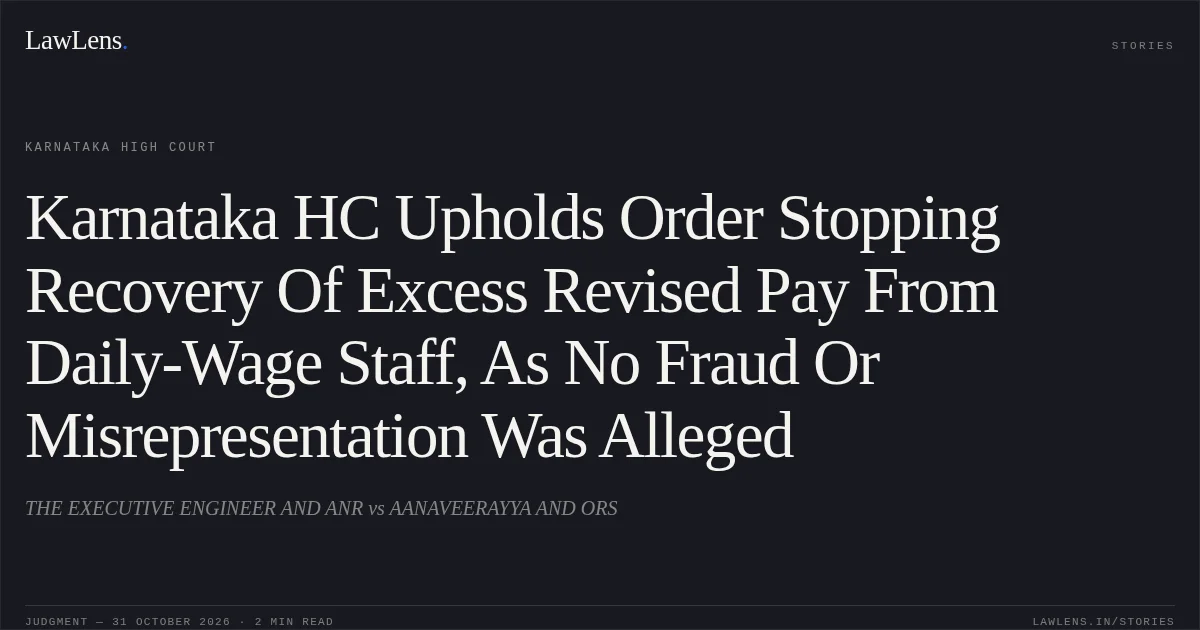
THE EXECUTIVE ENGINEER AND ANRvsAANAVEERAYYA AND ORS
Click to open original judgment
Original judgment, available to read, download and summarize on LawLens.in