01Facts
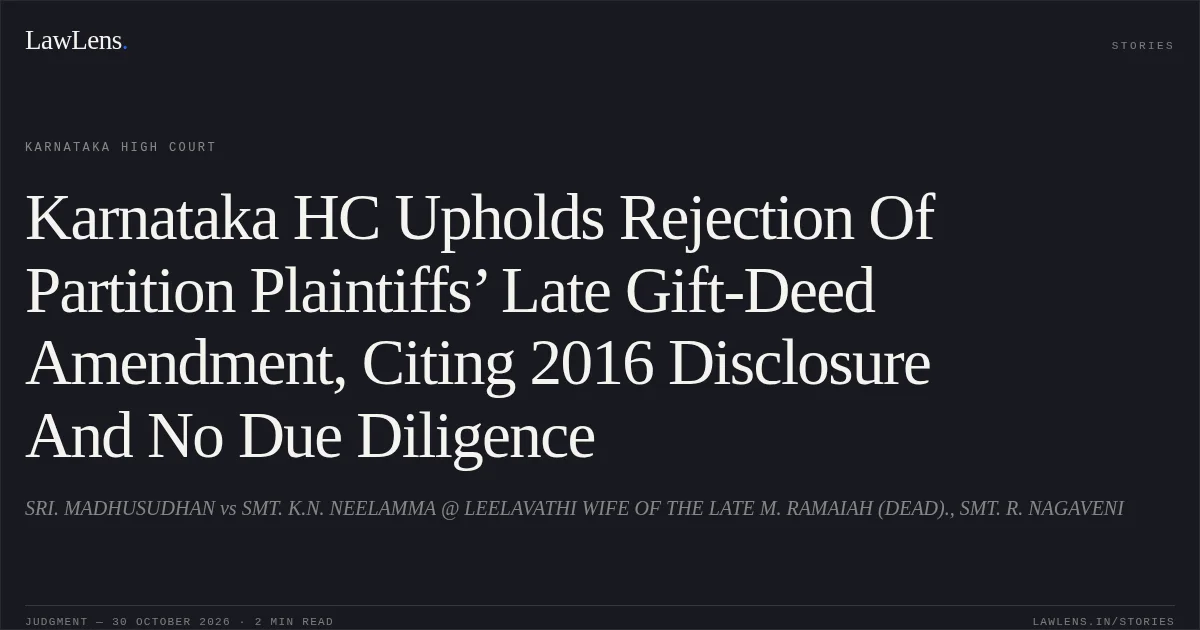
The petitioners brought a partition suit in 2014. Defendant No. 1’s written statement, filed in 2016, referred to three gift deeds dated 9 June 2005, 5 May 2014 and 19 May 2014.
pp. 4–7After defendant No. 1 died in 2020, and when the suit had reached final arguments, the petitioners sought to amend their pleadings under Order VI Rule 17 CPC, including to alter the claimed share from 1/7th to 1/6th and to seek relief concerning the gift deeds.
pp. 4–7The trial court rejected the application. The petitioners challenged that order under Article 227 of the Constitution.
pp. 4–702Issues
i.1. Whether the petitioners established that, despite due diligence, they could not have sought the proposed amendment before commencement of trial, as required by the proviso to Order VI Rule 17 CPC?
pp. 6–8ii.2. Whether the trial court’s refusal to permit the amendment warranted interference under Article 227 of the Constitution?
p. 903Law Applied
Order VI Rule 17 CPC permits amendment of pleadings to determine the real questions in controversy, but its proviso restricts amendments sought after commencement of trial: the court must be satisfied that, despite due diligence, the applicant could not have raised the matter earlier.
pp. 6–9The burden of establishing due diligence rests on the party seeking a post-commencement amendment; amendment is not a matter of right (Basavaraj v. Indira and Others, (2024) 3 SCC 705).
pp. 6–9The Court also accepted the general principles advanced by the petitioners—that amendments may be considered liberally to avoid multiplicity of proceedings and that limitation may be left for adjudication—while emphasizing that those principles remain subject to the proviso to Order VI Rule 17 CPC (Life Insurance Corporation of India v. Sanjeev Builders Private Limited and Another, Civil Appeal No. 5909 of 2022, decided 1 September 2022).
pp. 4–704Reasoning
The proposed amendment concerned gift deeds already mentioned in defendant No. 1’s written statement in 2016. The petitioners therefore had an opportunity to seek the amendment before trial commenced, but their supporting affidavit gave no explanation for failing to do so.
pp. 7–9The application was instead made after defendant No. 1’s death and when the suit had reached final arguments. The petitioners thus failed to discharge their burden of showing due diligence, and the general preference for amendments to avoid multiplicity could not override the statutory proviso.
pp. 7–905Holding
The Court held that the petitioners had not satisfied the due-diligence requirement in the proviso to Order VI Rule 17 CPC.
p. 9Finding no error or infirmity in the trial court’s order warranting supervisory interference, it dismissed the writ petition.
p. 9Original Court PDF
SRI. MADHUSUDHANvsSMT. K.N. NEELAMMA @ LEELAVATHI WIFE OF THE LATE M. RAMAIAH (DEAD)., SMT. R. NAGAVENI
Click to open original judgment
Original judgment, available to read, download and summarize on LawLens.in