01Facts
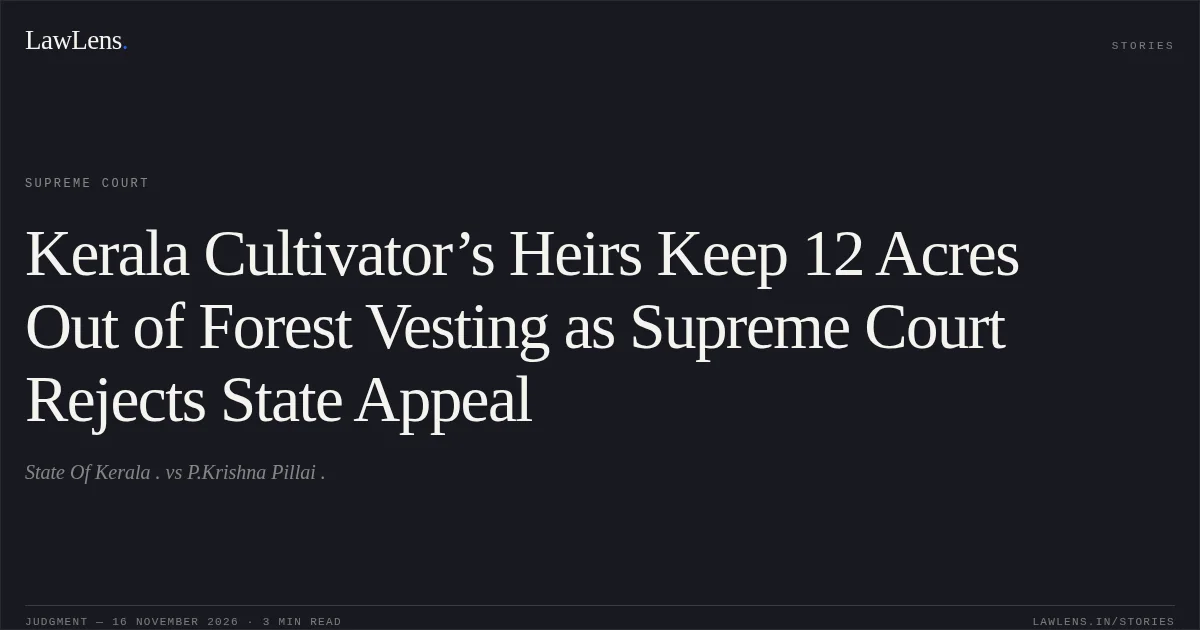
The respondents, legal representatives of Neelakandan Pillai, claimed that he had cultivated the disputed 12 acres in Nilambur from 1960 until his death in 1976, and that they remained in possession thereafter.
¶ 2–3After Forest Department officials obstructed their agricultural operations, they applied under Section 8 of the Kerala Private Forests (Vesting and Assignment) Act, 1971 (“the Act”), seeking a declaration that the land was not a private forest and had not vested in the State.
¶ 3On remand, the Forest Tribunal found no evidence that the land was governed by the Madras Preservation of Private Forests Act, 1949 (“MPPF Act”), and concluded that it was not a forest on the appointed day; the High Court affirmed that decision.
¶ 6–8Before the Supreme Court, the State sought to rely on a 1900 notification, produced for the first time at that stage, to establish that the land formed part of a contiguous forest.
¶ 11, 1302Issues
i.1. Whether the subject land was a “private forest” under Section 2(f) of the Act on the appointed day, 10 May 1971, and consequently vested in the State under Section 3(1).
¶ 19–20ii.2. Whether the State should be permitted to adduce the 1900 notification as additional evidence at the appellate stage.
¶ 24–2503Law Applied
Under Section 2(f)(1) of the Act, “private forest” in the Malabar District includes land to which the MPPF Act applied immediately before the appointed day, as well as certain non-Government forests to which that Act did not apply, including waste lands enclosed within wooded areas.
¶ 15–16Section 3(1) provides for automatic vesting of qualifying private forests from the appointed day; demarcation or notification under the Rules is not a precondition to vesting.
¶ 17, 19In a Section 8 proceeding, the person asserting that land is not a private forest bears the burden of proof, assessed on the balance of probabilities.
¶ 21“Forest” denotes a large tract of uncultivated land covered with trees and underwood, excluding land on which human skill and labour have been expended for agricultural operations.
¶ 23Additional evidence at the appellate stage may be allowed only where the applicant establishes that, despite due diligence, it could not have been produced earlier; it cannot be used to fill evidentiary gaps or set up a new case.
¶ 24Provisions in the judgment · 1 · Linked ones open on LawLens
States Reorganisation Act, 1956 Section 5
04Reasoning
The Court treated the decisive question as whether the land qualified as a private forest on 10 May 1971, since only land meeting the Act’s definition could vest automatically.
¶ 19–20Although the respondents bore the burden of showing that the land was not a private forest, the Tribunal relied on the Commissioner’s report, including evidence of young bamboo clusters and wells, and found that the land was neither a wooded area nor an enclave on the appointed day; the High Court’s affirmation of that factual finding was not shown to be perverse.
¶ 21, 23The State’s evidence did not establish that the MPPF Act applied to the land, its nature at the relevant dates, or its contiguity with a forest.
¶ 21–22, 25The 1900 notification was not produced before the Tribunal or High Court despite being attested in 1993 and despite the remand raising contiguity for reconsideration; it also did not identify the subject land or establish contiguity. The Court therefore found no due diligence and declined to admit it as additional evidence.
¶ 24–2505Holding
The Supreme Court held that the concurrent finding that the subject land was not a private forest on the appointed day disclosed no basis for appellate interference.
¶ 23–26It rejected the State’s application to adduce the 1900 notification and dismissed the appeal, with no order as to costs.
¶ 23–26Original Court PDF
State Of Kerala .vsP.Krishna Pillai .
Click to open original judgment
Original judgment, available to read, download and summarize on LawLens.in