01Facts
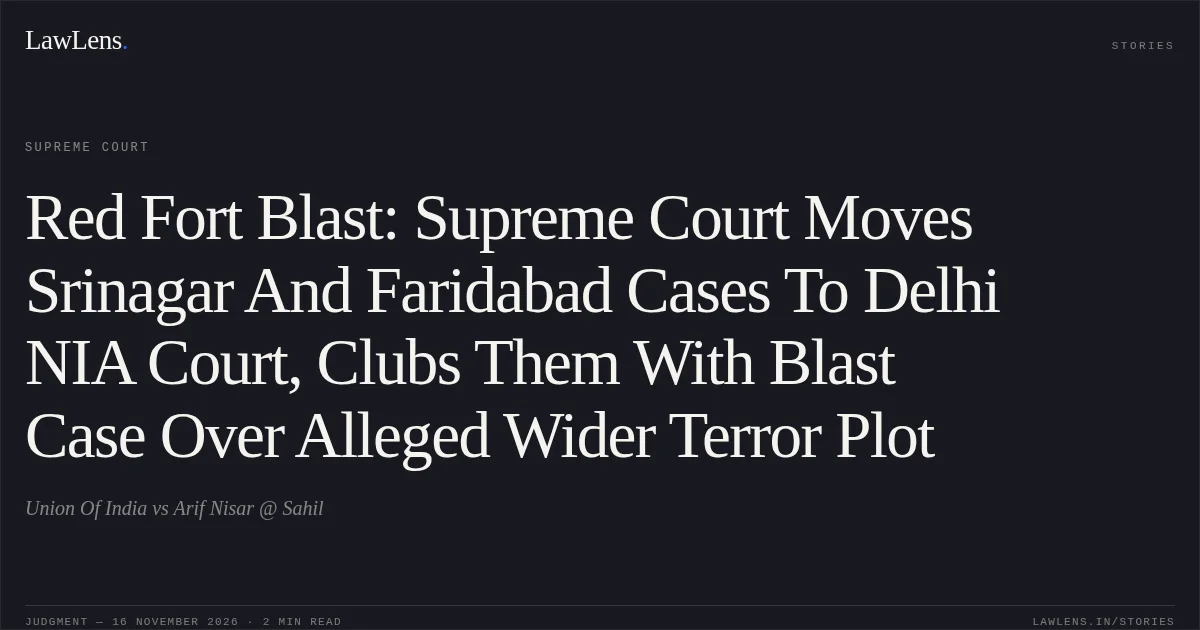
The Union of India sought transfer of a Jammu and Kashmir case and a Haryana case to the Special Court under the National Investigation Agency Act, 2008, at Patiala House Court, New Delhi, and their clubbing with the NIA’s Lal Qila Blast Case.
pp. 1–4The cases concerned alleged links among terrorist incidents, a broader conspiracy, and overlapping accused persons, witnesses, and evidence.
pp. 1–4The Central Government had directed the NIA to take over the investigations into the Haryana and Jammu and Kashmir cases as connected offences to the Lal Qila Blast Case.
p. 5The respondents opposed transfer and clubbing, arguing, among other things, that the cases were not part of the same transaction and that clubbing was premature.
p. 402Issues
i.1. Whether the Jammu and Kashmir and Haryana cases should be transferred to the Special Court under the NIA Act at Patiala House Court, New Delhi.
pp. 1, 4–6ii.2. Whether the three cases could be clubbed on the basis of an alleged larger conspiracy and their factual and evidentiary connections, although they arose from incidents in different States and on different dates.
pp. 4–603Law Applied
Section 13(2) of the NIA Act, read with Section 446 of the Bharatiya Nagarik Suraksha Sanhita, 2023 and Order XXXIX of the Supreme Court Rules, 2013, was invoked as the basis for seeking transfer of the cases.
p. 1The Court noted that the Central Government had acted under Section 6(5) of the NIA Act to direct the NIA to investigate the Haryana and Jammu and Kashmir cases as connected offences to the Lal Qila Blast Case.
p. 5It distinguished State (NCT) of Delhi v. Khimji Bhai Jadeja, which concerned offences in the same series of transactions, observing that the present application rested instead on an alleged larger conspiracy and connectivity between the cases.
p. 6The Court also referred to National Investigation Agency, New Delhi v. Rahul @ Faisal Karim Masud & Ors., in which related cases had been transferred and clubbed before the Special Court under the NIA Act.
p. 5It held that transfer and clubbing may be warranted where connected cases involve common accused, witnesses, or overlapping evidence, to avoid multiplicity, duplication, conflicting findings, and security risks.
p. 6Provisions in the judgment · 16 · Linked ones open on LawLens
National Investigation Agency Act, 2008 Section 13Section 6
Bharatiya Nagarik Suraksha Sanhita, 2023 Section 446
Bharatiya Nyaya Sanhita, 2023 Section 103Section 109Section 61Section 351Section 113Section 152Section 196Section 55
Unlawful Activities (Prevention) Act, 1967 Section 16Section 18Section 13
04Reasoning
The Court considered the NIA’s case that the three matters were linked to a larger conspiracy and that some accused, witnesses, and evidence were common or overlapping.
p. 6It found that separate trials in different States could result in duplicated evidence and potentially inconsistent findings, while moving accused persons between States could create security concerns.
p. 6The Court rejected the respondents’ reliance on Khimji Bhai Jadeja as determinative because the Union’s case was based on a broader conspiracy, not solely on the offences forming part of the same transaction.
p. 6Having regard to the asserted connections and the circumstances of the cases, it considered a single Special Court appropriate.
p. 605Holding
The Court allowed the transfer petitions.
p. 6The Court directed that the Jammu and Kashmir and Haryana cases be transferred to the Special Court under the NIA Act at Patiala House Court, New Delhi, and clubbed with the Lal Qila Blast Case.
p. 6Original Court PDF
Union Of IndiavsArif Nisar @ Sahil
Click to open original judgment
Original judgment, available to read, download and summarize on LawLens.in