01Facts
The petitioner enrolled in a six-year M.D. (General Medicine) course in Kyrgyzstan in 2017.
pp. 3–5Because of the COVID-19 pandemic, she was in India from 22 July 2020 to 13 November 2021, and the institute certified that she later compensated for missed online classes by attending physical classes for 9 months and 10 days.
pp. 3–5, 14–15After passing the screening test and obtaining provisional registration, she was directed by the Odisha Council of Medical Registration to complete two years of internship: one year of Clerkship and one year of CRMI.
pp. 4–5, 15She challenged that direction, contending that the CRMI Regulations, 2021 did not apply because she had begun her foreign medical education before those Regulations came into force.
pp. 6–11The Council also relied on a calculated shortfall in her compensated attendance to justify the additional year.
pp. 6–1102Issues
i.1. Whether the CRMI Regulations, 2021 applied to the petitioner, who began her foreign medical education before those Regulations came into force, and could therefore be required to complete an additional year of CRMI.
pp. 6–8, 15–16ii.2. Whether the petitioner could be required to complete two years of internship on account of an alleged shortfall in compensating for missed classes, despite the institute’s certification of physical attendance.
pp. 8–11, 16–1703Law Applied
Regulation 5(1)(b) of the CRMI Regulations, 2021 excludes from the Regulations candidates who were pursuing education in foreign institutions before the Regulations came into force.
pp. 6–7Schedule II, paragraph 2(a) provides that foreign medical graduates regulated by the National Medical Commission (Foreign Medical Graduate Licentiate) Regulations, 2021 must undergo internship at par with Indian medical graduates if they seek permanent registration.
pp. 6–7The Court also considered the Odisha Council’s proposal, approved by the National Medical Commission’s UGMEB, to condone specified shortfalls of up to 30 days in compensated physical attendance; the respondents relied on this framework to distinguish the petitioner’s alleged shortfall from those of other doctors.
pp. 9–12No judicial precedent was relied upon in the Court’s reasoning.
04Reasoning
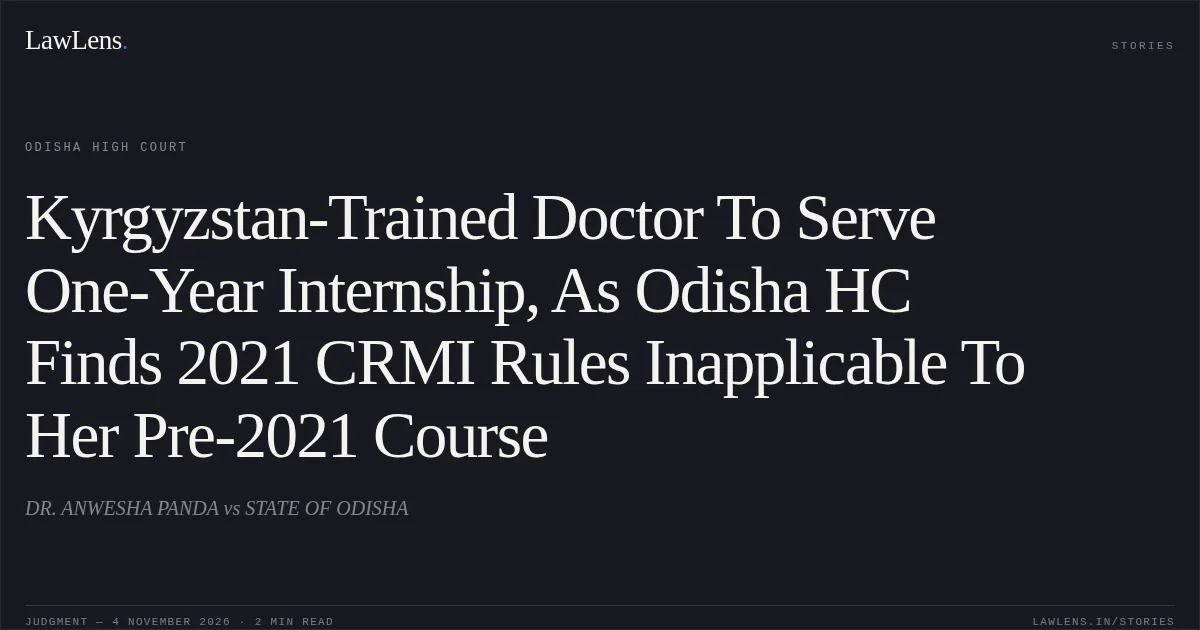
The Court found that the petitioner began her course in 2017, before the CRMI Regulations, 2021 came into force. Regulation 5(1)(b) therefore made those Regulations inapplicable to her, and the additional one-year CRMI requirement could not be imposed under them.
pp. 15–16The Court also accepted the institute’s certificate that she had compensated for the period of missed online classes through physical attendance.
pp. 16–17In that context, it rejected the respondents’ calculation of a shortfall and held that the certified compensation could not be disputed after the petitioner had been permitted to sit the screening test and had received provisional registration.
pp. 16–17It further observed that a shortfall exceeding 30 days had been condoned for another doctor and considered the petitioner entitled to similar treatment.
p. 1705Holding
The Court held that the direction requiring the petitioner to complete an additional year of CRMI was not legally sustainable.
p. 18It interfered with the order dated 17 January 2026 to that extent and directed the respondents to allow the petitioner to complete one year of internship instead of two.
p. 18The writ petition was disposed of accordingly.
p. 18Original Court PDF
DR. ANWESHA PANDAvsSTATE OF ODISHA
Click to open original judgment
Original judgment, available to read, download and summarize on LawLens.in